
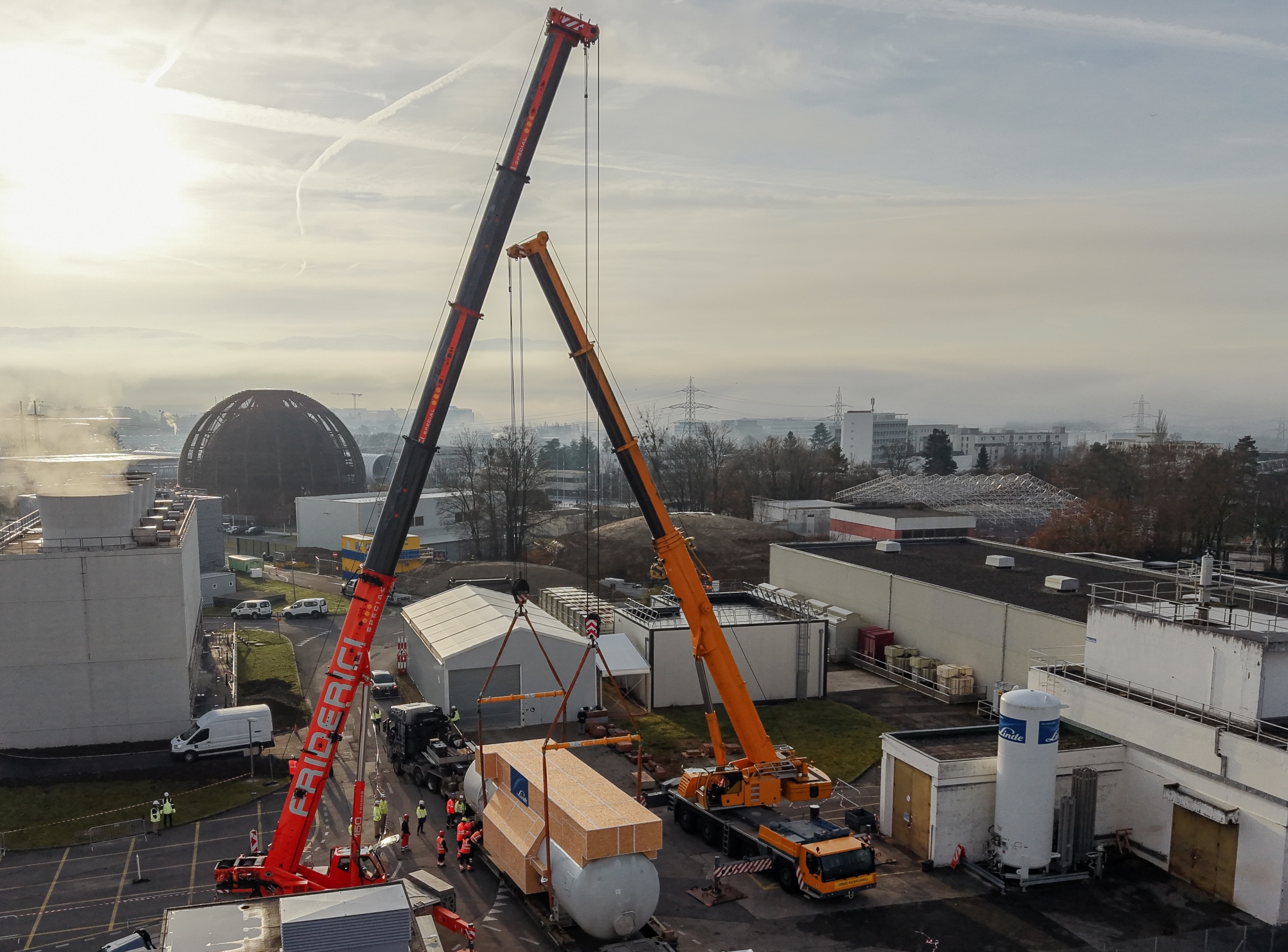
Delivery of a cold box on the ATLAS experiment site. This huge cylinder houses the turbines and heat exchangers that will be used to cool the helium to cryogenic temperatures for the High-Luminosity LHC. (Image: CERN)
Behind every particle collision generated at the Large Hadron Collider is a multitude of technical feats. One of these is refrigeration on an industrial scale. To guide the particles, the thousands of superconducting magnets in the accelerator must be cooled to a temperature of close to absolute zero. This makes the LHC the largest cryogenic installation in the world: 23 of its 27 kilometres are maintained at 1.9 kelvin (-271 °C) using refrigerators in which superfluid helium circulates.
This unique cooling system needs to be further strengthened in preparation for the High-Luminosity LHC (HL-LHC), a major upgrade to the LHC that is scheduled to begin operation in 2030. On both sides of the two large experiments, ATLAS and CMS, more powerful focusing magnets and new types of cavities will considerably increase the number of collisions at each beam crossing or, in other words, the luminosity. This ultra-sophisticated equipment requires increased cooling power. Two new refrigerators are therefore being installed, in addition to the eight that are already needed for the existing accelerator.
The LHC's refrigerators work on the same principle as the one in your kitchen, except that they are gigantic installations that occupy several buildings. Located on the surface, they include large compressors and an enormous cold box that contains the heat exchangers and the expansion turbines. These installations lower the helium temperature to 4.5 kelvins (-268.6 °C). Six compression units were installed in October. Last week, the work continued with the installation of two large cold boxes on the ATLAS and CMS sites. Cylindrical in shape, they measure 16 metres in length and 3.5 metres in diameter and were manufactured in Germany by the company Linde; they travelled by barge along the Danube, the Main and the Rhine before being transported by road, via Basel, to CERN.
Work to connect all the elements and install the control systems will continue throughout next year. At the same time, the teams will install the cryogenic lines that will deliver helium from the surface to the underground installations. Next February, two smaller cold boxes will be installed underground, lowering the temperature by the last few degrees needed to reach 1.9 kelvin (-271 °C).
By the end of 2026, the new cryogenic installations will be ready for testing with heating systems that simulate the thermal load on the magnets, the cavities, the cold powering system and the other equipment that requires cooling.


