
Key takeaways
- Deportations of people arrested inside the United States increased fourfold, a larger increase than previously understood.
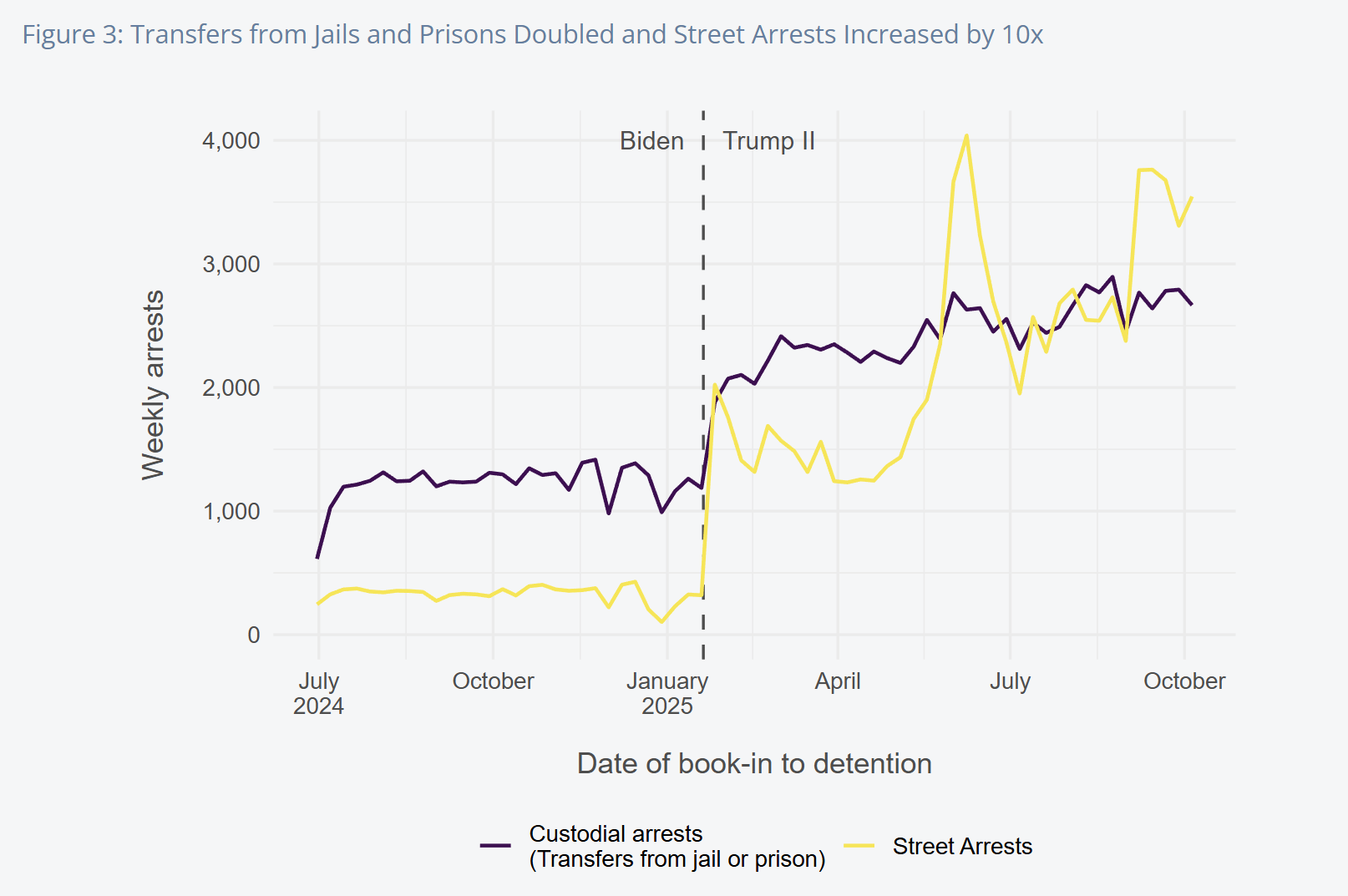
- New enforcement tactics, which are less focused on people with criminal convictions, led to an increase in street arrests in communities by a factor of 11.
- The chance of release from detention within 60 days of arrest fell from 16% to 3%.
- Voluntary departures increased by more than 21 times, as more people are abandoning their immigration cases.
Deportations from within the United States have more than quadrupled, by a factor of 4.6, during the first nine months of President Donald Trump's second administration compared to the last six months of the Biden administration, according to a new report released by the Deportation Data Project. The study also found Immigration and Customs Enforcement (ICE) overall arrests quadrupled, with the largest increase in street arrests and the rest representing transfers from criminal custody to ICE immigration custody.
The study utilizes data provided by ICE through Oct. 15, 2025, obtained through litigation filed by UCLA's Center for Immigration Law and Policy. It is the first published analysis released by the Deportation Data Project, a centralized repository of individual-level U.S. government immigration enforcement data based at UCLA and UC Berkeley Law School. The project is helping draw a clearer picture of the scale of arrests and deportations, as well as who the government is targeting, both locally and nationally.
Graeme Blair, professor of political science at UCLA and the project's codirector, said the study shows how new enforcement tactics are contributing to increased arrests and deportations.
"When we traced the sources of the ramp-up, we found that it stemmed from ICE adopting less-targeted approaches," Blair said. "Before this administration, ICE often focused its arrests on people convicted of crimes or on specific individuals it had identified. Now ICE is doing something new: It seems to be arresting anyone it can. This is evident in the data because at-large arrests in communities are up by a factor of 11, and arrests of people without any criminal convictions are up by a factor of seven."
Notably, the latest study documents the role of each stage of the enforcement process, finding that changes in detention policy are also contributing to the increased deportation numbers.
Specific to the detentions stage, the researchers found:
- The administration roughly tripled the number of detention beds for people arrested in the United States. That capacity increase was a result of new enforcement funding and a decrease of arrivals at the border that began under the Biden administration.
- Once arrested, few detainees were released. The chance of release from detention within 60 days of arrest, already rare in the last six months of the Biden administration at 16%, fell to just 3%.
- The rate of deportation within 60 days of initial detention increased roughly 25%, from 55% percent to 69%; the declining release rate accounted for most of that increase.
- As the release rate has decreased, voluntary deportations have increased by a factor of more than 21.
The study includes evidence showing more people who might have won their cases in immigration court in the past are giving up and accepting deportation.
"There's no way to tell for sure in the data whether someone lost their case or gave up and accepted deportation because they couldn't stand more time in detention," Blair said. "But one clue is that voluntary departures, which are one way to give up, have risen by a factor of over 20."
Despite the scale of these trends, the study demonstrates the administration is not close to its goal of deporting one million people per year if that goal refers to interior deportations. Data through the middle of October 2025 indicates the government likely deported fewer than 300,000 individuals in 2025.
"This is far from the administration's target," Blair said. "But the number of deported people is unprecedented for this century."


