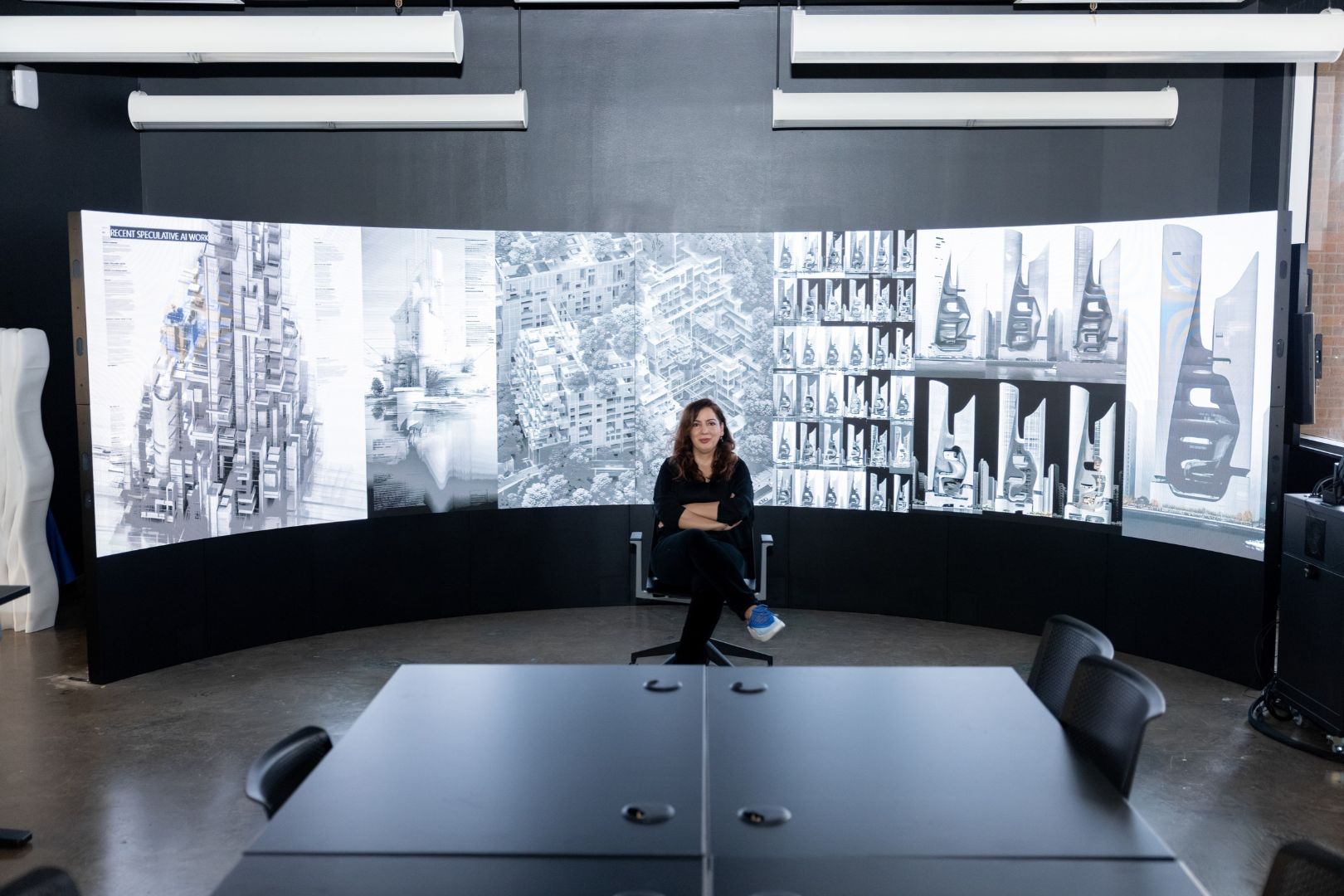
The first time the new LED video wall was switched on, no one had to tell the students what to do. They turned off the lights, closed the blinds and stood in front of their own work, now displayed at a scale the small portable screen they had been using could never match.
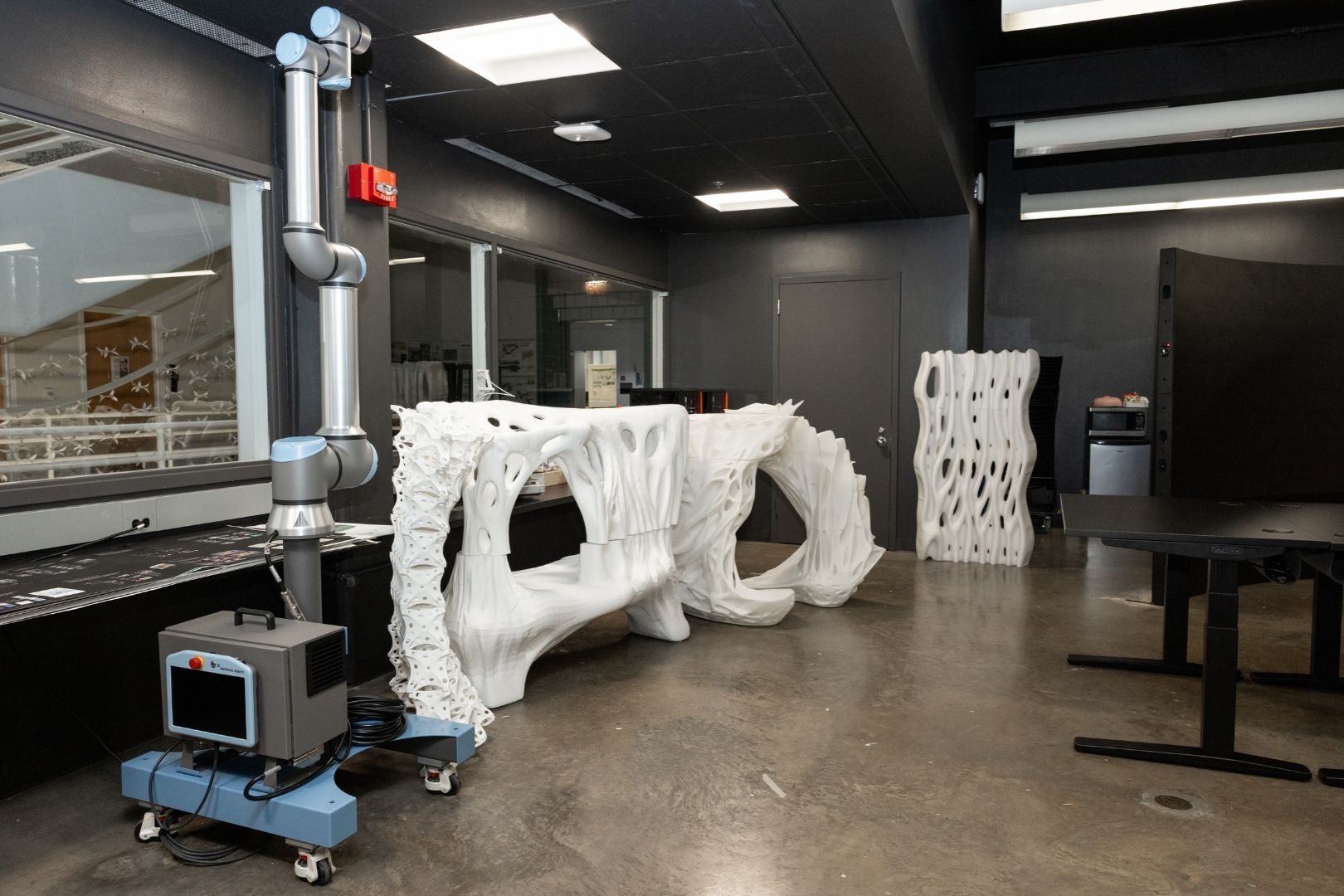
That moment marked the beginning of the Performative AI Lab, a new space on the third floor of The University of Texas at Arlington's College of Architecture, Planning and Public Affairs (CAPPA) building. Led by Shermeen Yousif, associate professor of architecture, the lab features a giant curved video wall with a robotic arm capable of bringing students' designs to life through 3D printing.
"With immersive environments," Dr. Yousif said, "you can walk inside the design project."
A new way to see the work
Students in the lab are using artificial intelligence to generate building designs, sometimes hundreds at a time. That's far too many to pin up on a board or display on a laptop. On the video wall, an entire class can compare options side by side to see how a design evolved from start to finish.
Before the wall was finished, Yousif's students presented their work on a small portable screen. The first class to use the new wall met in August, and the difference was immediately clear: Students could finally display the animations, videos and step-by-step diagrams their projects produce—details that a single portable screen can't capture.
"We initially conceived of the wall as a display surface; in practice, it has become a thinking surface," Yousif said.
Once installed, the robotic arm using a camera can scan a model, send the scan to AI programs that suggest new designs and display those options on the video wall for students to compare. The arm can then turn those designs into physical models.
The assembly team also programmed the arm to wave. The simple demonstration gave students an early glimpse of the robotic arm's capabilities. Yousif's team is now adding a device that will help the arm learn to perform tasks on its own.
Several students have since expressed interest in pursuing doctoral studies in the lab, while others have asked to participate in its research projects.
What students are building
One student team worked with Yousif on a project accepted for presentation at Association for Computer Aided Design in Architecture (ACADIA) 2026, a major international conference on technology in architecture. The team designed a structure based on how sound moves through it, then studied it at full scale on the video wall before building it with the robotic arm.
Another team designed an energy-saving office building for downtown Dallas, incorporating natural daylight, fresh-air flow and a rooftop garden. The AI model produced hundreds of floor plans, and the students evaluated which ones worked best.
The goal, Yousif said, is for students to stay in charge. They "don't just prompt a model and accept the output"; they establish their own design ideas and goals, guide the AI and evaluate its work.
More than a classroom
The room adapts with the work. With the blinds down and the lights off, students are surrounded by their designs. With the blinds open, it becomes a sunlit studio, while adjustable desks allow students to move from research to instruction to hands-on work in a single session.
Students say the darkened room draws them in and makes them want to stay longer.
"What surprised us most was how flexible the space proved to be," Yousif said.
In a traditional architecture studio, students develop a few design concepts and use computers primarily to illustrate their ideas. In the lab, they manage multiple AI tools while retaining control over the final decisions, a skill Yousif calls orchestration.
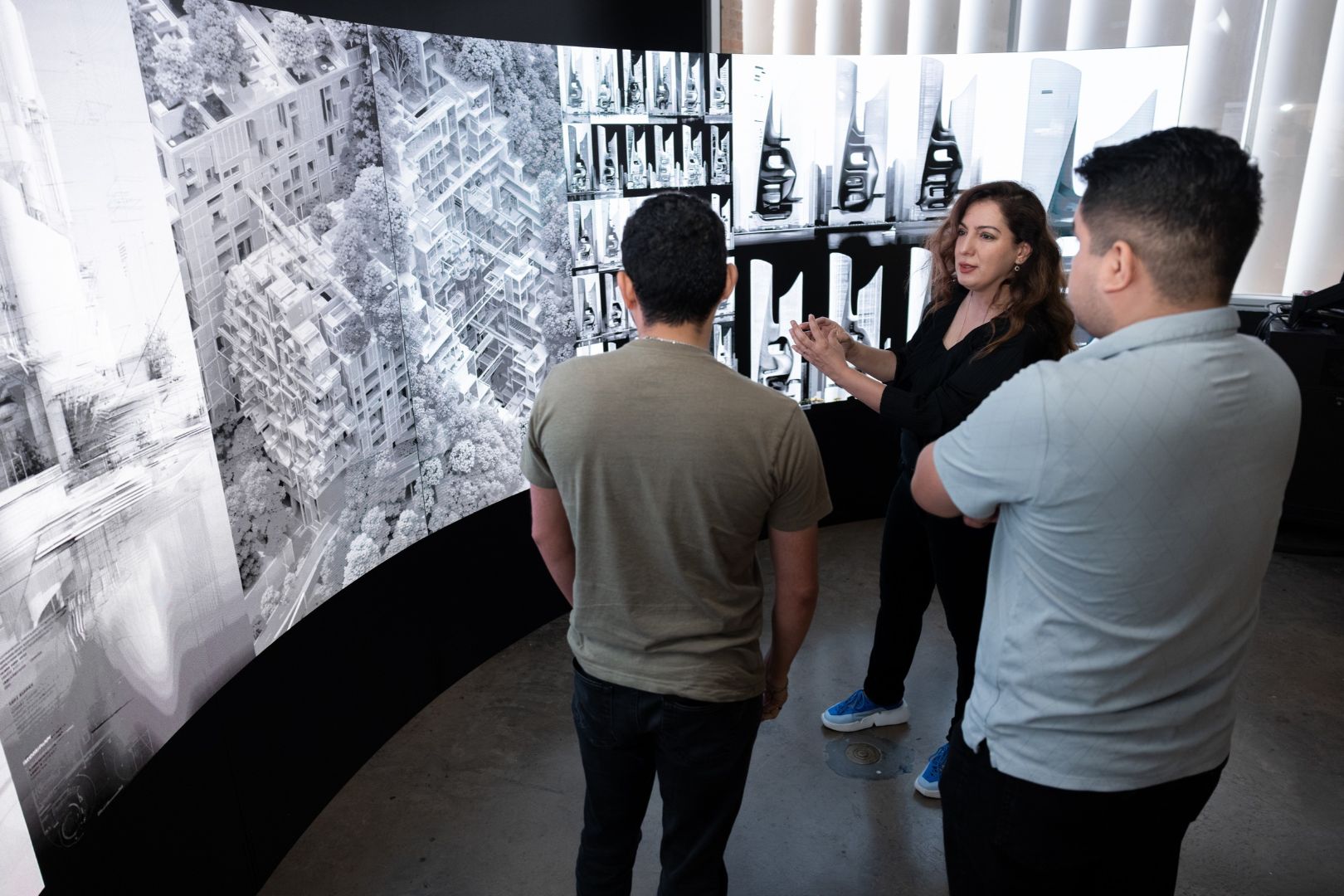
"The lab is where they learn to be leaders in their discipline," she said.
Research with real-world goals
Much of Yousif's research explores how AI-generated designs perform in real-world settings. With support from UTA's Research Enhancement Program, her students used AI to design structures based on how they interact with sound, then built them using the robotic arm. Those prototypes are now on display in the lab.
Another project explores how AI tools tend to overlook traditional, regional building styles, such as homes designed to stay cool without air conditioning or built using local materials. Yousif is co-editing a forthcoming book that examines how AI can incorporate these architectural traditions rather than overlook them.
Open to the community
The lab's windows overlook the CAPPA building's central atrium, allowing passersby to watch the work taking place.
"By establishing this lab, Dr. Yousif positions UTA at the forefront of architecture's technological and ecological future," said David Franco, director of the School of Architecture.
CAPPA Dean Ming-Han Li called the lab a major step for the college.
"We are strengthening our research culture and preparing our graduates to lead in a rapidly changing profession," he said.
Yousif is also working with UTA computer scientists, and an AI design company has led workshops for students. Representatives from the city of Arlington and the American Institute of Architects-Dallas, a professional group for architects, have participated in student project reviews in the lab.
Several Dallas-Fort Worth architecture firms have expressed interest in bringing their teams to the lab for workshops, and a private sponsor is in talks to support research. Yousif hopes visitors leave imagining how AI could enhance their own work.
What's next
This semester, students are reimagining vacant office buildings in downtown Dallas and will showcase their work in a public exhibition. Another exhibition is planned for January and, pending approval, a new certificate program in AI and architecture could launch in the lab in spring 2027.
A symposium on AI in architecture is also being planned for fall 2027. In the meantime, Yousif's team will use the robotic arm to build its first full-scale prototypes and evaluate how AI-generated designs perform in the real world.
"What I hope people take away is that AI in architecture is not about replacing the designer," Yousif said. "It is about designing buildings that perform better for the people and the climate they serve."
About The University of Texas at Arlington (UTA)
The University of Texas at Arlington is a growing public research university in the heart of Dallas-Fort Worth. With a student body of over 42,700, UTA is the second-largest institution in the University of Texas System, offering more than 190 undergraduate and graduate degree programs. Recognized as a Carnegie R-1 university, UTA stands among the nation's top 5% of institutions for research activity. UTA and its 300,000 alumni generate an annual economic impact of $28.8 billion for the state. The University has received the Innovation and Economic Prosperity designation from the Association of Public and Land Grant Universities and has earned recognition for its focus on student access and success, considered key drivers to economic growth and social progress for North Texas and beyond.