
Abstract
A team of researchers at UNIST, in collaboration with the University of Cologne and Purdue University, has unveiled a rapid, sustainable method to create complex nanomaterials containing up to 30 different metals in just one minute at room temperature. By utilizing carbon dioxide (CO₂)-commonly known as a greenhouse gas-this innovative process provides an eco-friendly way to produce advanced materials with a wide range of technological applications.
Professors Seungho Cho and Sukbin Lee from the Department of Materials Science and Engineering, along with Professor Junghwan Kim from the Graduate School of Semiconductor Materials and Devices Engineering, led the demonstration of this method to synthesize high-entropy nanostructures-materials composed of multi metals that offer enhanced durability and catalytic activity. These properties make them highly promising for use in batteries, semiconductors, and other advanced technologies.
Traditionally, making such multi-metal materials required extremely high temperatures and pressures, which increased production costs and limited scalability. This new approach, however, turns CO₂ dissolved in water into a natural bridge that facilitates the uniform mixing of different metals under ambient conditions.
The process involves bubbling CO₂ into water to produce carbonic acid, which then releases carbonate ions (CO₃²⁻). When hydroxide ions are added, these carbonate ions easily connect with various metal ions-ranging from rare earth elements like neodymium to transition metals like copper and iron-forming nanometer-sized metal carbonate particles in just one minute of stirring.
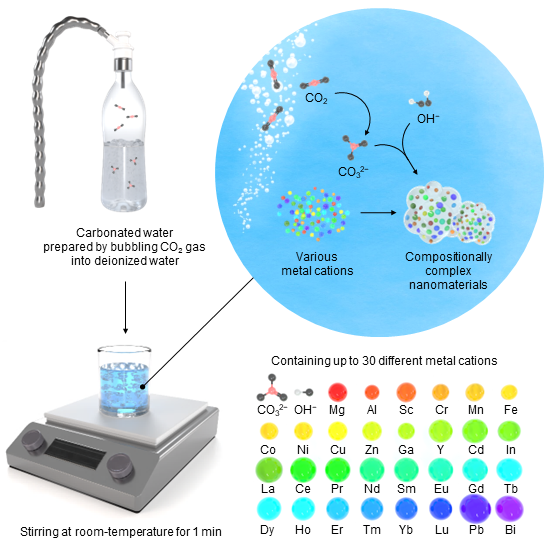 Figure 1. Schematic of the greenhouse-gas-driven, energy-efficient route for synthesizing compositionally complex nanomaterials.
This method allows for the creation of complex nanomaterials that, according to traditional principles, would be difficult to combine due to differences in atomic size and other factors. Microscopic analysis revealed that these materials have a highly disordered, non-crystalline structure, which could improve their performance in catalytic and energy storage applications.
Professor Sukbin Lee explained, "The disordered structures produced by this method could be beneficial for catalytic reactions and energy storage. We plan to explore various combinations of metals, including catalysts for hydrogen production and battery electrodes."
Professor Seungho Cho highlighted the environmental benefits, stating, "Creating multi-metal nanomaterials at room temperature cuts costs and reduces CO₂ emissions." He further noted, "Our ultimate goal is to develop a flexible, cost-effective process for making a wide range of materials without restrictions on composition-contributing to both technological progress and environmental sustainability."
This collaborative research involved Professor Sanjay Mathur at the University of Cologne, Germany, and Professor Haiyan Wang at Purdue University. Key contributions were made by UNIST researchers Miri Kim and Dr. Min-Ji Kim from the Department of Materials Science and Engineering at UNIST, along with Yizhi Zhang from Purdue University, who served as the study's first author.
The findings of this research were published online in Nano Letters on November 21, 2025. The study has been supported by the National Research Foundation (NRF) of Korea, the Ministry of Science and ICT (MSIT), UNIST InnoCORE program, the Korea Planning & Evaluation of Industrial Technology (KEIT), and the Electronics and Telecommunications Research Institute (ETRI).
Journal Reference
Miri Kim, Min-Ji Kim, Yizhi Zhang, et al., "Greenhouse-Gas-Driven Room-Temperature Synthesis of Compositionally Complex Nanomaterials via Anion-Cation Arrangement Control," (2025).


