What the research is about
When an electric current flows through a metal, voltage normally appears only along the direction of the current. However, in certain magnetic materials, a voltage can also emerge in a direction perpendicular to the current. This phenomenon is known as the anomalous Hall effect.
The key lies in a property of electrons called spin, which can be thought of as a tiny magnetic moment carried by each electron. In materials with a structure known as a kagome lattice-a network of corner-sharing triangles-these spins do not align neatly. Instead, they form slightly twisted arrangements. It has long been known that such twisting can bend the path of electrons. However, when temperature or the number of electrons (how densely they fill available states) changes, the sideways voltage produced by the anomalous Hall effect does not simply increase or decrease-it can even reverse direction. The reason for this behavior had not been fully understood.
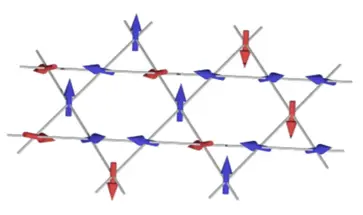
Associate Professor Hiroaki Ishizuka of Institute of Science Tokyo (Science Tokyo), in collaboration with Professor Masafumi Udagawa of Gakushuin University, theoretically analyzed how electrons move while scattering off these spins. The greatest challenge was that nearby spins and more distant spins influence electrons at the same time, making the phenomenon too complex for a simple explanation.
The research team aimed to describe what seemed like separate and complicated behaviors within a single theoretical framework. They succeeded in deriving, for the first time, a general formula that determines the magnitude of this sideways voltage.
Why this matters
A key achievement of this study is explaining why the direction of the sideways voltage can reverse. The answer lies in the wave-like nature of electrons. Electrons behave not only as particles but also as waves. Waves have regions where they reinforce each other and regions where they cancel out. When the number of electrons changes, the pattern of these waves also changes. As a result, the direction of the sideways voltage can switch.
The study also clarified why the effect changes in a complicated way with temperature. Interactions between nearby spins and those between more distant spins act simultaneously, producing behavior that cannot be described as a simple increase or decrease. Furthermore, in magnets where neighboring spins tend to point in opposite directions, applying a strong magnetic field makes such reversals more likely.
What's next
The theoretical framework developed in this study can be applied to real materials. It provides a way to detect and analyze internal magnetic states that cannot be fully understood by measuring magnetization alone. In the future, this insight may contribute to the development of new electronic technologies that utilize not only the electric charge of electrons but also their spin.
Comment from the researcher
I believe that electric current flowing through a magnet reflects, in great detail, how spins behave inside the material. By decoding these signals, we can take an important step toward designing new functional materials.
(Hiroaki Ishizuka, Associate Professor, Department of Physics, School of Science, Institute of Science Tokyo)