
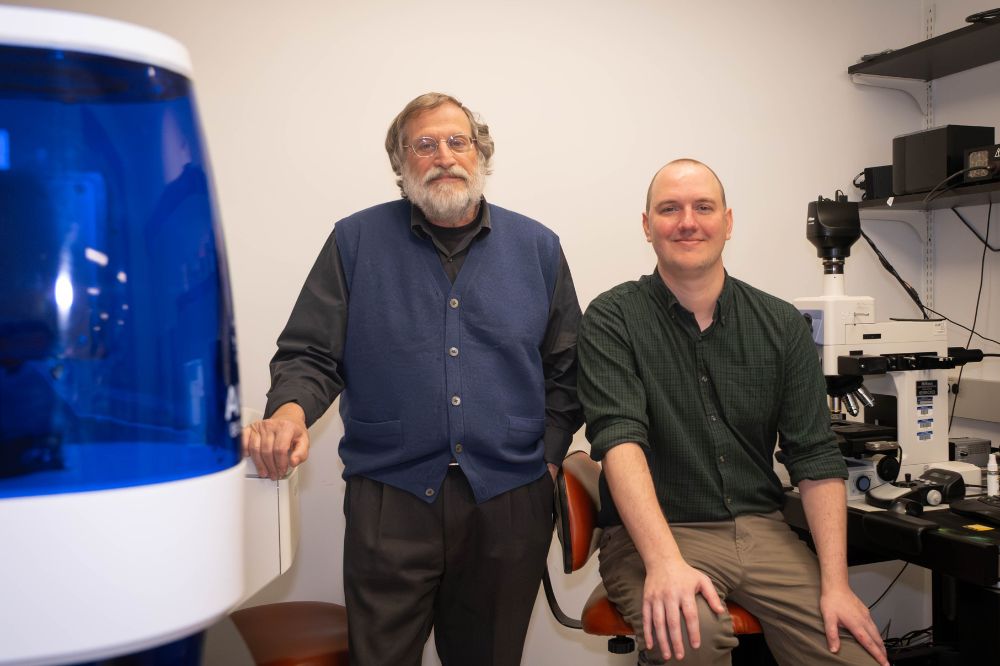
Jeffrey V. Ravetch (left) and Andrew T. Jones (right) showed that the anti-inflammatory activity of IgG is enhanced by co-engagement of type I and II Fc receptors. (Credit: Lori Chertoff)
Autoimmune diseases are some of the most difficult to treat. There are limited therapies that target specific conditions, so most medications take a broad stroke approach that wholly suppresses the immune system-which in turn leaves patients vulnerable to infectious diseases.
One exception is IVIG (intravenous immunoglobulin) therapy, which involves infusing patients with very high doses of naturally occurring IgG antibodies that can counteract the impact of inflammatory cells. It's often prescribed off-label to treat more than 80 autoimmune diseases for which no other medications alleviate symptoms. However, it's sourced from donated human blood, so supply shortages are an ongoing concern, and IV treatments are long, tedious, frequent, and expensive.
But improvements may be on the way. Discoveries made by scientists from Rockefeller University's Leonard Wagner Laboratory of Molecular Genetics and Immunology, headed by Jeffrey V. Ravetch, have led to a new drug called NVG-2089 that is currently in phase 2 clinical trials. It's as effective as IVIG at a tenth of the dose.
Now the same team has pushed the envelope, engineering a further modification of the natural molecule that could be orders of magnitude more powerful than IVIG. They published their results in Science.
We spoke to Ravetch and first author Andrew Jones about their findings.
How did this research come about?
Jeffrey Ravetch: It began around 2000, when we identified components of the mechanism behind IVIG's anti-inflammatory activity. That led to us being able to develop NVG-2089. And yet we still didn't fully understand how these components came together.
Andrew Jones: We thought that if we had a better understanding of that anti-inflammatory pathway, we could potentially create a next-generation therapeutic that could surpass NVG-2089 in effectiveness. We also developed humanized mice that express human Fc receptors to work with.
JR: My lab began developing these mice about 15 years ago. It's really hard to do-the multiple mouse Fc receptors have to be deleted and replaced by human ones, and it requires multiple rounds of knockouts and transgenic integration. But it was essential if we really wanted to understand the role Fc receptors play in IVIG activity.
Why is that?
JR: There are significant differences between the species when it comes to Fc receptors. People have indiscriminately applied immune guidelines from one species to another and assumed they work the same way. But they don't-and the differences underlie many antibody drug failures. Our mouse model has turned out to be a very valuable tool for developing human antibody-based therapeutics. Many biotech and pharmaceutical companies have licensed the strain from Rockefeller University, and we have sent dozens of academic labs the mice without charge. The strain has been widely used to develop antibodies that are now in clinical practice.
So what did your experiments reveal?
AJ: We observed that the coordinated binding of an Fc receptor called FcγRIIB and a carbohydrate-binding protein called DC-SIGN was key to the anti-inflammatory activity of IVIG. They enhance the signaling ability of an IgG antibody that is sialylated, which is a specific sugar modification to the carbohydrate attached to IgG that is critical in driving anti-inflammatory activity.
We then engineered these sialylated IgG antibodies-which we're calling V11 sFc-to have enhanced binding to FcγRIIB, synthesized them in the lab, and infused them into mice into which we had induced arthritis. We could tell by measuring the thickness of their joints that the swelling decreased about three days after infusion.
JR: And we achieved this result using a hundredth of the dose of IVIG in these mice.
AJ: We saw similar results in another experiment using a mouse model for multiple sclerosis. The V11 sFc molecules prevented cell destruction, and as a result dampened neuro-inflammation.
It's important to note that even though we use the word engineered to describe V11 sFc molecules, this is a naturally occurring biological mechanism we're enhancing. IVIG is just a concentration of our own IgG antibodies that possess a small fraction of a particular change in their sugar content that makes them anti-inflammatory, and that's the way the body maintains homeostasis. So what we're doing is exploiting a pathway that has evolved to prevent uncontrolled inflammation. We're simply allowing this homeostatic mechanism to dominate.
How could this improve treatment for autoimmune patients?
JR: If V11 sFc develops into a drug, it could be a powerful replacement for IVIG therapy for a wide array of autoimmune disorders, especially when it comes to patient experience. Right now people often spend hours hooked up to an IV to get IVIG-and this can happen several times a week or month. Potentially they could get the same effective treatment in an hour or so once a month. And the treatment doesn't compromise the immune status of the patient. Rather than eliminating autoantibodies and autoreactive T cells, we're raising the threshold for these pathogenic elements to trigger inflammation.


