
Researchers from Department of Electrical and Computer Engineering under the Faculty of Engineering at the University of Hong Kong (HKU) and the Centre for Advanced Semiconductors and Integrated Circuits (CASIC), have achieved a major breakthrough in cryogenic electronics. The team have developed a programmable neuromorphic hardware platform that operates near absolute zero, providing a potential solution for scaling up quantum computers and enabling deep-space exploration.
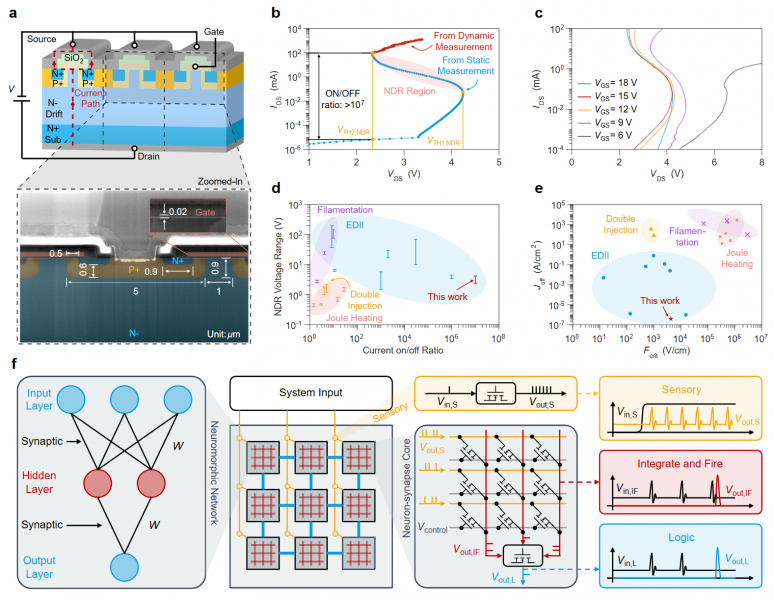
Led by Professor Yuhao Zhang and PhD student Xin Yang, the team has discovered an innovative way to generate and control negative differential resistance (NDR) in industry-standard Silicon Carbide (SiC) MOSFETs. For the first time, they have demonstrated that a single transistor can mimic the energy-efficient "spiking" behavior of biological neurons at temperatures as low as 10mK.
Modern quantum computers rely on complex electronics to control qubits, which are extremely sensitive and must be maintained at millikelvin temperatures. Current silicon-based controllers generate excessive heat and consume high levels of power, forcing them to be placed far from the qubits. This separation creates a wiring bottleneck that limits the scalability and performance of quantum systems.
"Our work introduces a hardware platform that can be integrated alongside quantum processors," said Professor Zhang. "By using the unique carrier dynamics in silicon carbide, we can create circuits that are thousands of times more energy-efficient than conventional electronics, significantly reducing the thermal load on cryogenic systems".
The researchers discovered that when SiC MOSFETs are cooled below 2K, they exhibit a potent "S-shape" NDR behavior fueled by electron-donor impact ionization (EDII). Unlike existing technologies that rely on heat to function, this mechanism is intrinsic to the material's atomic structure, making it exceptionally stable and repeatable across different manufacturing batches.
"This is a robust and scalable approach," said Mr Yang. "Because SiC is already used globally in electric vehicles and power grids, we can leverage existing industrial foundries to manufacture these cryogenic chips on 300-mm wafers".
The study proves that these neurons can be "cascaded" to form larger networks, paving the way for complex, local data processing at cryogenic temperatures. This technology is expected to enhance the performance of quantum error correction and real-time quantum control.
Beyond quantum computing, these rugged circuits are ideal for deep-space exploration, where electronics must survive the extreme cold of the lunar surface or the outer reaches of our solar system.
The discovery has been published in Nature Communications in an article titled "Cryogenic neuromorphic circuits using gate-controlled negative differential resistance in silicon carbide".


