
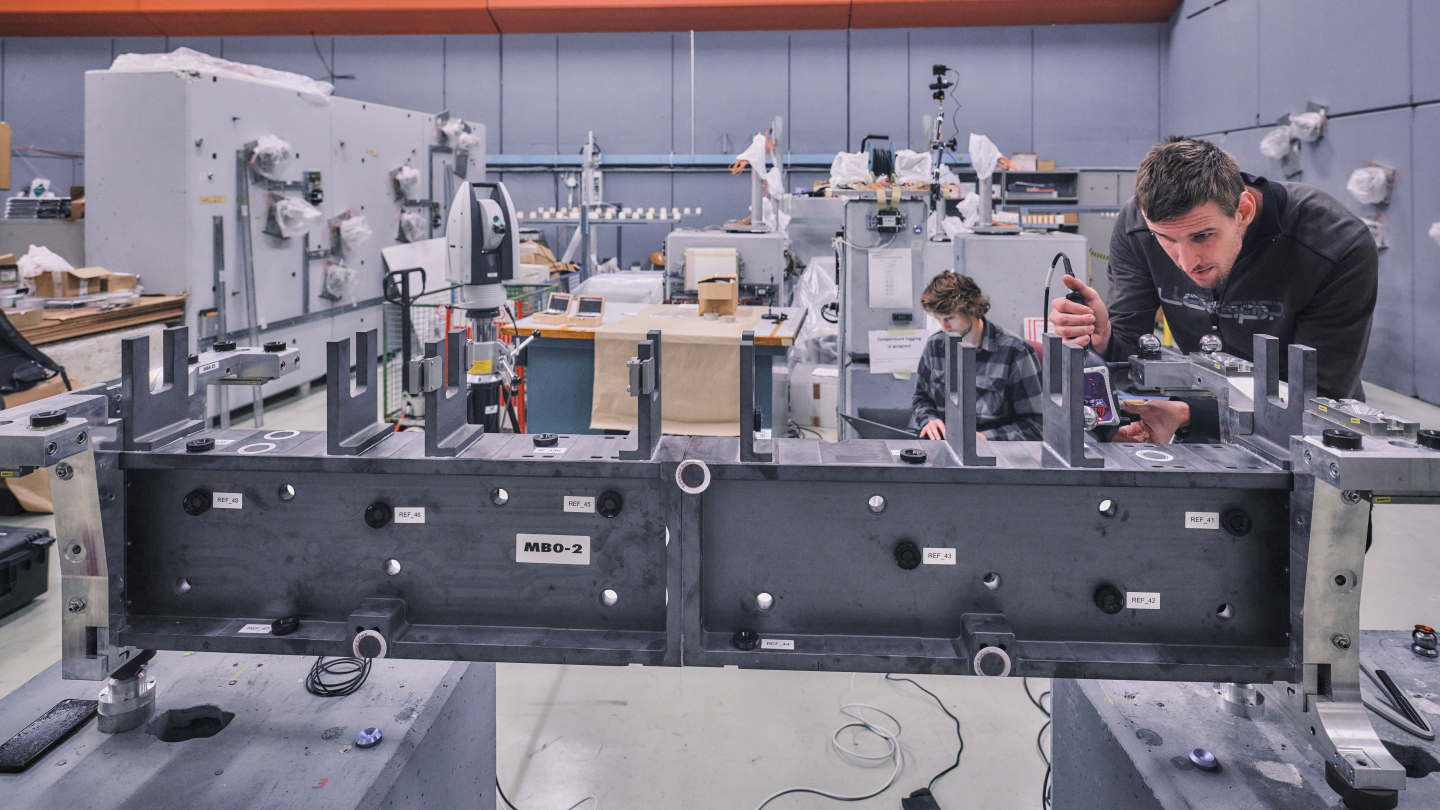
A team from the European Spallation Source taking precise measurements of the silicon carbide girder at CERN. (Image: Maximilien Brice/CERN)
Uncertainty is inherent to the scientific process. The measurements that scientists make are only as good as the tools they use to make them. Taking uncertainty into account is part of everyday life for all scientists at CERN, but it is especially important when measuring the dimensions of accelerator and detector components. However, in the world of metrology, the science of measurement, not all laboratories agree on how uncertain they should be.
This is why, over the past few months, eleven laboratories from across Europe have come to CERN to make extremely precise measurements of the same sample object, a silicon carbide girder. By comparing their results, they will be able to come to an agreement on how to determine the uncertainty in their measurements. Many factors influence measurement uncertainty, including the measurement method used, the skills of the operators and the environment in which the measurement is taken.
Precision measurements are extremely important for accelerator laboratories, and CERN is no exception. The Large Hadron Collider (LHC) uses magnets to accelerate beams of protons and direct them onto a collision course. Extreme precision is needed to make this possible given that the components must be aligned with a tolerance of 150 microns over 200 metres. That is a margin of error equivalent to the thickness of a single sheet of paper. The concept of alignment precision is often interpreted inconsistently, and this can lead to unrealistic tolerances that can potentially have a significant negative impact on accelerator performance.
With the High-Luminosity LHC (HL-LHC) and potentially the FCC on the horizon, there are increasing demands for even higher precision. Many other accelerator laboratories are experiencing similar increases in precision requirements.
"We are all looking to become more and more precise and accurate and we are all hitting our limits," said Patrick Bestmann, a surveying engineer at CERN. "The main issue is that, if somebody asks you how precisely you can do something, a multitude of answers are all correct, depending on the definition."
For this reason, engineers at a number of European laboratories have organised what is officially called an interlaboratory comparison (ILC), a process recognised by the International Organization for Standardization to help laboratories to ensure measurement consistency and identify potential errors or biases. For this particular ILC, the laboratories all measured a silicon carbide girder, which was built as a prototype for CERN's proposed Compact Linear Collider.
Now that all the laboratories have completed their measurements of the girder, they will submit them along with their uncertainties. The data will then be compared statistically to identify any outliers.
"It's not about assigning blame or criticism, but about awareness. If someone regularly overestimates their uncertainty, they need to know, and the same is true if they underestimate it", said Bestmann.
The laboratories hope to publish the results and present their findings in 2026 in a peer-reviewed paper. Going forward, all the participating laboratories can be sure that, when it comes to uncertainties, they will all be aligned, just like their accelerators.


