
125 years ago, Wilhelm C. Röntgen received the world's first Nobel Prize. As one of 14 Nobel Prize winners from the University of Würzburg, he is now the focus of an exhibition that honours Würzburg's Nobel Prize history.
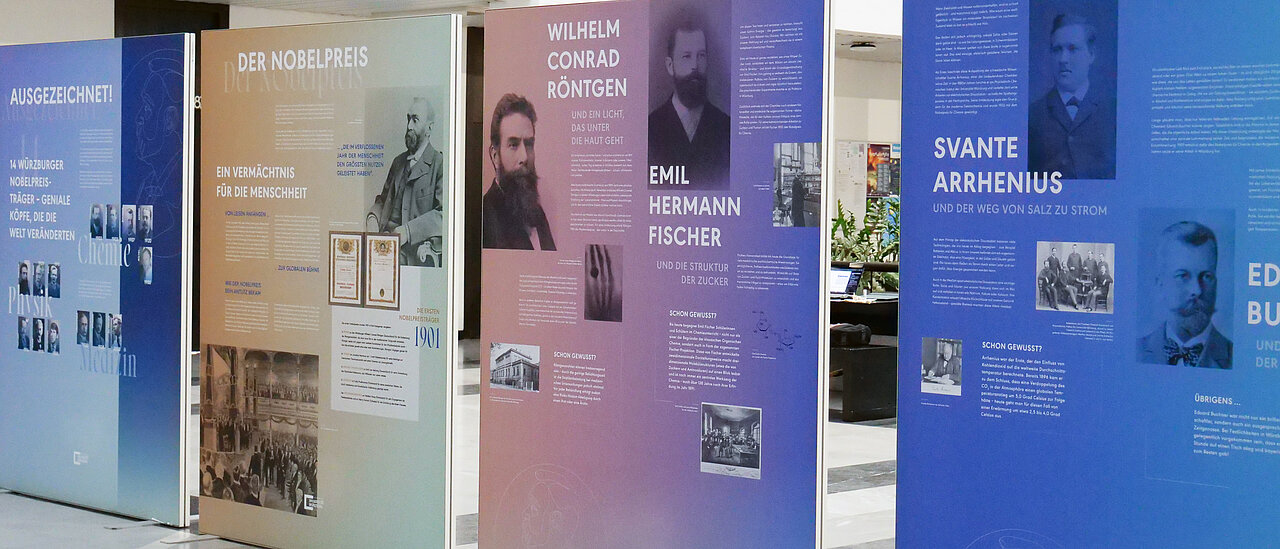
Röntgen was the first of a total of 14 scientists who conducted research or taught at Würzburg University (JMU) and were honoured with the Nobel Prize. Their achievements are the focus of the exhibition "Excellent! 14 Würzburg Nobel Prize Winners - Ingenious Minds that Changed the World", which can be seen at several publicly accessible locations in Würzburg in 2026.
"With this exhibition, we are honouring an extraordinary success story," said University President Paul Pauli at the opening of the exhibition on Tuesday. "It is representative of the excellent research at our university, of scientific curiosity and of the courage to try new approaches." Würzburg's Head Mayor Martin Heilig added: "May this exhibition inspire many people. And who knows: perhaps someone is studying or researching at this university who will soon be honoured as the 15th Nobel Prize winner from Würzburg? We certainly have the potential for this in Würzburg."
Scientific breakthroughs that still have an impact today
The exhibition comprises twelve easy-to-understand information panels. They present the key discoveries of the Würzburg Nobel Prize winners in a compact format and show how their research continues to have an impact today - in medicine, in technology and the natural sciences and in everyday life. In addition to Röntgen, the exhibition also portrays the world-famous chemist Svante Arrhenius, who laid important foundations for modern electrochemistry, and the physician Harald zur Hausen, whose research into human papillomaviruses (HPV) paved the way for the development of a vaccine against cervical cancer.
Another focus of the exhibition is on the history of the Nobel Prize and a look at excellent research at the University of Würzburg in the past and today. At the same time, it addresses the role of women in research and addresses the question of why there have only been men among the prize winners from Würzburg to date. The exhibition was developed by the university's press office together with the university archives.
Bringing science and society together
The exhibition can be seen at several locations in the city over the course of 2026 and is free of charge: In January and February, it can be viewed in the atrium of the Neue Universität at Sanderring 2, from 16 March to 10 April in the Mozartareal of the City of Würzburg, from 13 April to 7 May in the Central Lecture Hall and Seminar Building Z6 at the Hubland South Campus and from 15 to 26 June in the foyer of the Rudolf Virchow Centre at the Grombühl Campus. Further stations are planned and will be publicised on the University of Würzburg website .
Exhibition as part of the application for excellence
With the exhibition, the University of Würzburg is not only looking at its history, but also at its future development. JMU is currently in the final phase of one of the toughest scientific competitions in Germany, the Excellence Strategy of the federal and state governments. The goal: funding as a "University of Excellence", combined with millions in funding over several years.
"I am delighted that the Nobel Laureate Exhibition marks the start of this important year," says Pauli. "It shows that excellent research has a long tradition in Würzburg and is also the basis for the scientific work of the future."
"Würzburg has long proven that it is excellent - this is not only demonstrated by the 14 Nobel Prizes it has won in the past," emphasised Heilig. "JMU's ambition to become one of the top universities is not only good for science. It is also a driving force for the entire region."
Background: In November 2025, the university submitted its application for funding as a University of Excellence. This was preceded by a funding commitment from the German Research Foundation for two research alliances on quantum physics and nucleic acid research (we reported) - the prerequisite for applying to become a University of Excellence. The next and decisive step in the competition is now an on-site visit by an international panel of experts in mid-April.


