
Researchers have identified an early immune "checkpoint" that could help explain why the same virus can affect people so differently.
Age, genetics and lifestyle are known to influence how people respond to viral infections. Scientists also know that differences in immune responses play an important role, but exactly how these factors shape the course of an infection has remained unclear. Now, new research from Hokkaido University, using mouse models, suggests that a critical part of the answer may lie in how the immune system responds during the first 24 hours after infection.
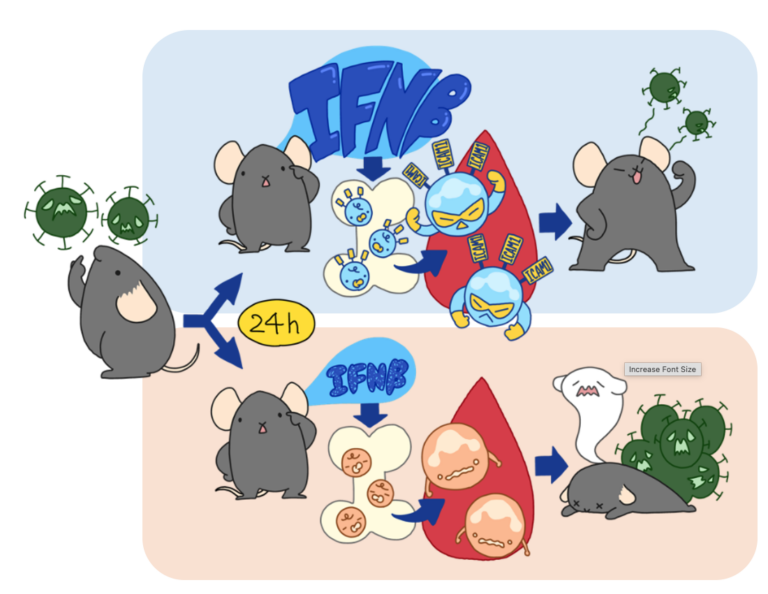
Published in iScience, the study shows that, in mice, a powerful early immune response can determine whether an individual survives a severe viral infection. The researchers identified a previously unrecognized immune "checkpoint" that shapes the body's antiviral defenses and could guide the development of future treatments for severe viral diseases.
Using genetically identical mice raised in the same controlled environment, the researchers infected the animals with a lethal virus called vesicular stomatitis virus (VSV). Some mice survived while others did not.
The team discovered that the surviving mice released a rapid burst of type I interferon (IFNβ), an immune signaling protein that helps coordinate the body's defense against viruses. Mice that generated this early interferon response were much more likely to survive.
The early interferon response triggered another group of immune cells called neutrophils. Specifically, it induced a distinct population of neutrophils expressing the cell-surface marker ICAM1, which exhibited heightened inflammatory signaling and an enhanced antiviral immune profile.
When the researchers blocked type I interferon during the first 24 hours after infection, most of the mice died. But, blocking them two days after infection had little effect.
The findings suggest that there is a critical window early in infection during which the immune system decides to establish an effective antiviral response.
"Biological variability should not always be viewed as experimental noise," says lead author of the study Associate Professor Tomohiko Okazaki. "Instead of treating differences between genetically identical individuals as experimental noise, we viewed them as a source of biological insight. That approach allowed us to uncover an early immune checkpoint that would have been difficult to identify using conventional comparisons."
The findings indicate that treatments designed to strengthen or mimic this early immune response could improve outcomes in severe viral infections. Although the study was conducted in mice and further research is needed to determine whether the same mechanism operates in humans, the work provides a clue into why identical infections can produce dramatically different outcomes.
"Since the COVID-19 pandemic, there has been growing interest in understanding why viral infections can produce dramatically different outcomes among individuals," Okazaki said. "Age and underlying medical conditions are well-known risk factors, but they do not fully explain this variability. Our findings identify an early immune mechanism that may help account for these differences and could inform future therapeutic strategies."
Original article:
Saito et al., "Type I IFN Dynamics Orchestrate Protective ICAM1⁺ Neutrophil Heterogeneity as an Early Checkpoint for Survival in Lethal Viral Infection." iScience. 19 August 2026.
DOI: 10.1016/j.isci.2026.117189
Funding:
This work was supported by grants from the Ministry of Education, Culture, Sports, Science, and Technology of Japan (MEXT), the Japan Agency for Medical Research and Development (AMED), the Japan Science and Technology Agency (FOREST program), and foundations including the Mitsubishi Foundation, Naito Foundation, Astellas Foundation, and others.


