
Preparing for severe weather season
The Bureau regularly works with First Nations interpreters in the Northern Territory to translate weather information during press conferences.
In October 2025, staff from the Bureau's Darwin office held a collaborative workshop on communicating during severe weather events attended by the Northern Territory Government's Aboriginal Interpreter Service
This session was the fourth of its kind as a result of a multi-year effort from the Bureau's Community Engagement team.
It included opportunities for the interpreters to discuss their experiences with severe weather. As well as share information about the communities that are a part of their language groups.
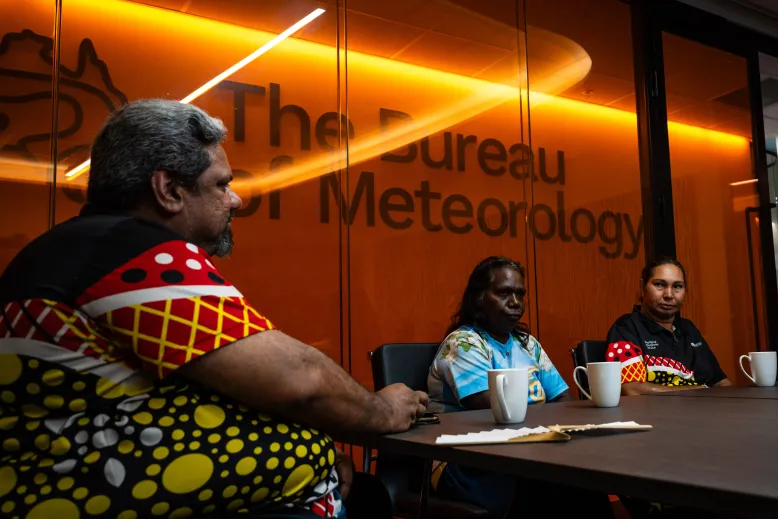
Members of the Northern Territory Government's Aboriginal Interpreter Service at the workshop in the Darwin office. Credit: Patch Clapp.
The Darwin team and the interpreters discussed what to expect during the 2025-26 wet season.
They also covered the best practises for communicating weather information to their communities.
Decision Support Services Officer Patch Clapp said the workshops proved vital when major weather events affected the Northern Territory during the wet season.
"Conducting workshops with the Aboriginal Interpreter Service members over multiple years has laid a strong foundation for working with them when severe weather events occur," he said.
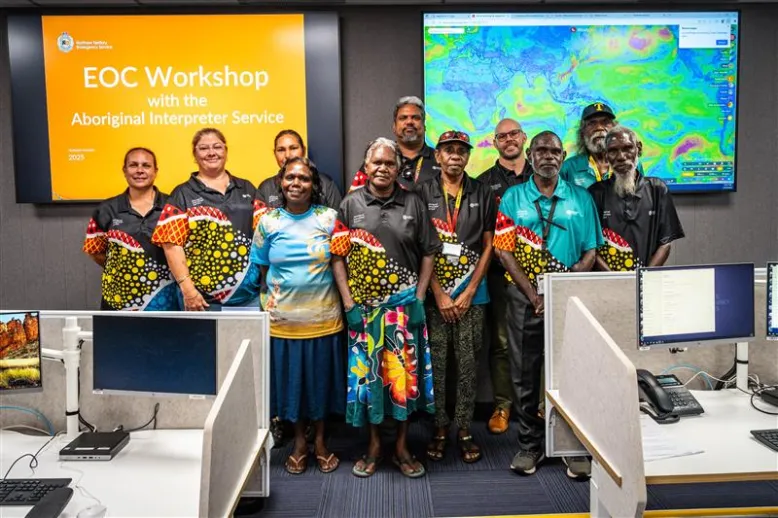
Caption: EOC Workshop with the Aboriginal Interpreter Service. Credit: Patch Clapp.
Interpreting during severe weather
Bureau staff also worked with the Northern Territory Government's Public Information Group, Emergency Services staff and First Nations Media to stage mock press conferences to test out their live interpreting skills.
These skills were used just a month later when Severe Tropical Cyclone Fina impacted Darwin and remote parts of the Top End, including the Tiwi Islands, North and South Goulburn Islands and Cobourg Peninsula.
In the very remote Northern Territory, 72.5% of the population are Indigenous, according to the 2021 census.
Of this population, 86.8% speak an Indigenous language at home, with 10.4% speaking only English.
This makes it vital for interpreters to communicate weather information to the community in-language.
Interpreters speaking Tiwi, Yolngu Matha and Maung were all involved in communicating to the public during Severe Tropical Cyclone Fina.
Collaborating with Yolngu Radio
Sylvia Nulpinditj, Yolngu woman from north-east Arnhem Land and co-manager of Yolngu Radio, explained the process of translating weather warnings into Yolngu Matha.
"When we receive weather information from the BOM I sit down with my colleague to go through the weather information. We need to look at it because it's all technical," she said.
"We need to break it down into the English that we can work from, like a plain or simple English.
"And then that's where Yolngu Matha comes on board to then give the announcement, the important message.
"It's time consuming because in the next five minutes, if it's really serious, the messages can change."
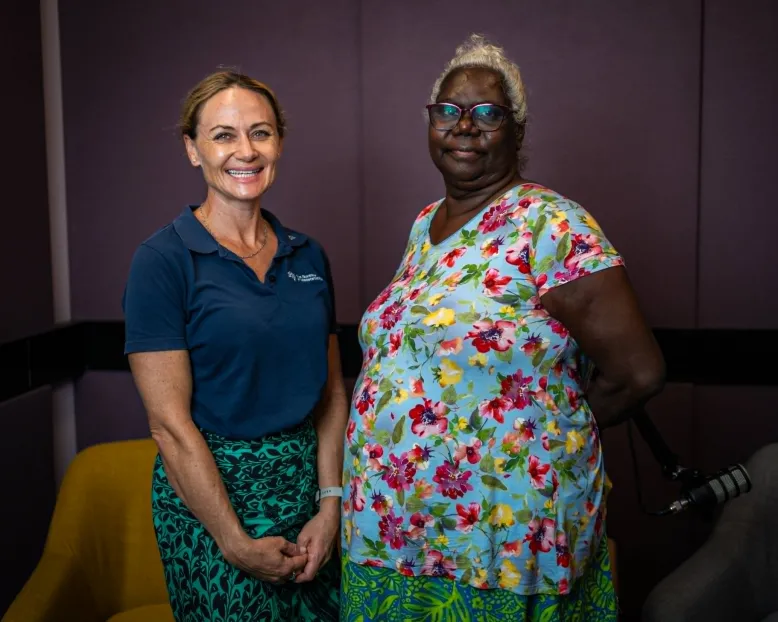
Bureau of Meteorology NT HPR Manager Shenagh Gamble with Yolngu Radio presenter Sylvia Nulpinditj. Credit: Patch Clapp.
Yolngu Radio and their social media channels is the only news source available in-language for the regional Yolngu communities, including homelands.
With these locations being prone to cyclones and other severe weather, this makes the Bureau's work to communicate weather information through Yolngu Radio a vital partnership.
"These relationships mean that local broadcasters and organisations can get clear weather messages to communities that need to hear them well ahead of any weather event," Patch Clapp said.
Reflecting on National Reconciliation Week
Sylvia Nulpinditj said National Reconciliation Week was a time for both First Nations and non-First Nations people to work together, as modelled by the Bureau's work with her and other Indigenous interpreters.
"I think reconciliation is an important time of the year to come together as a community of people of all walks of life and just get together and share that two worldviews of knowledge and understanding," she said.
"Because it needs to start there, and we need to build up our relationship based on that, and that's why reconciliation is part of that."


