
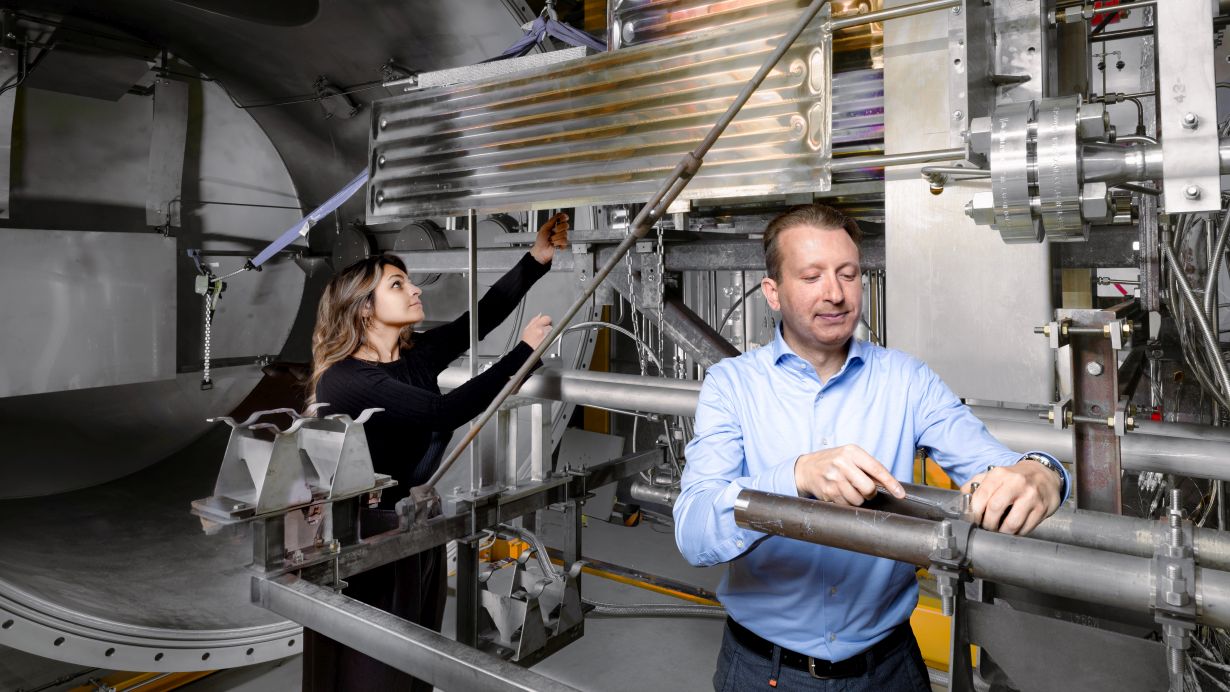
Future fusion power plants will need a 'first wall' that can be produced at industrial scale and withstands the extreme heat and radiation inside a reactor. In a project coordinated by laser fusion company Focused Energy, researchers at Karlsruhe Institute of Technology (KIT) are working with partners in academia and industry to develop new materials and production processes for the first wall. Germany's Federal Ministry of Research, Technology and Space (BMFTR) is funding the joint project with about EUR 11 million.
With their promise of igniting a star here on Earth, nuclear fusion power plants offer great hope for clean and virtually unlimited energy production. "One of the biggest technological hurdles for future power plants is the 'first wall,' which shields against the hot plasma and has to withstand enormous temperatures and neutron bombardment," said Dr. Carsten Bonnekoh of the Institute for Applied Materials (IAM). Partners from academia and industry are developing the required materials and production technologies in the joint project DINERWA. They also aim to produce components for testing under conditions similar to those in a reactor.
Materials for Extreme Conditions
The project's main focus is on developing durable structural and functional materials that can resist the high temperatures and neutron fluxes inside reactors as long as possible so that the costs of first wall maintenance and associated power plant shutdown can be minimized. In addition to new oxide dispersion-strengthened (ODS) steel alloys and copper-based materials, the project team is also investigating nanostructured tungsten and high-entropy alloys. Furthermore, the team is working on new production processes and joining techniques for assembling the materials in complex modules. "Our aim is to take a major step toward making fusion power plants economically viable by substantially extending the first wall's service life and enabling the industrial production of its parts," said Professor Wolfgang Theobald, Experimental Lead at Focused Energy, a laser fusion company, and DINERWA project manager.
KIT is supervising the scientific research for materials development, with IAM researchers developing and characterizing the new ODS steels and copper alloys. The partners then apply the lab results to the production of components for tests at KIT's HELOKA (Helium Loop Karlsruhe) facility for high heat flux testing, where they can be analyzed under the conditions expected in a fusion reactor. "We aim to show that these materials perform well not only in the lab but also remain stable under real operating conditions," said Bonnekoh, who heads the research effort at KIT. "We're establishing the basis for actually using today's experimental materials in tomorrow's reactor components."
components for fusion power plants. (Foto: Amadeus Bramsiepe, KIT)
About DINERWA
The project has received about EUR 11 million from the BMFTR, which backs research on basic fusion technologies leading to fusion power plants. DINERWA exemplifies the close cooperation between research institutes and industry in fusion research and will serve as a basis for future demonstration plants. In addition to Focused Energy, the laser fusion company coordinating the project, KIT's industrial partners include CEP Freiberg, a producer of copper-based powder-metallurgical high-temperature materials; Hermle Maschinenbau GmbH, which specializes in additive manufacturing with metal powder application (MPA); and Zoz GmbH, a producer of powder-metallurgical steels. Research partners are the GSI Helmholtzzentrum für Schwerionenforschung, which uses ion beams to analyze the radiation hardness of materials, and SCK CEN, a research institute in Mol, Belgium.
More about the KIT Energy Center
In close partnership with society, KIT develops solutions for urgent challenges - from climate change, energy transition and sustainable use of natural resources to artificial intelligence, sovereignty and an aging population. As The University in the Helmholtz Association, KIT unites scientific excellence from insight to application-driven research under one roof - and is thus in a unique position to drive this transformation. As a University of Excellence, KIT offers its more than 10,000 employees and 22,800 students outstanding opportunities to shape a sustainable and resilient future. KIT - Science for Impact.


