

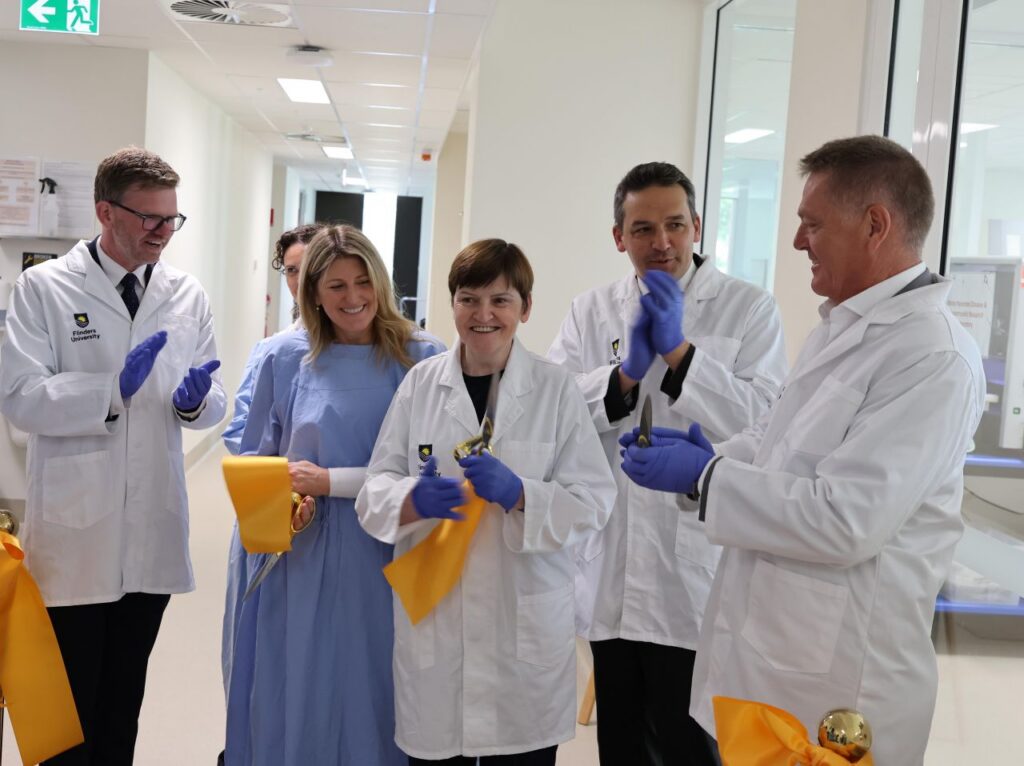
Flinders University has opened a new $3 million Motor Neurone Disease (MND) Research Centre of Excellence, supported by the South Australian Government, at the University's state-of-the-art Health and Medical Research Building, further cementing South Australia's reputation as a leader in world-class medical research and innovation..
The South Australian Government has invested $1.8 million over three years (until 2028-29) to establish the Ian Davis MND Biomarker Research Centre of Excellence alongside $449,268 from FightMND and a $732,015 in-kind contribution from Flinders.
Around 150-200 South Australians live with MND, with approximately 25 per cent likely to be living in rural and remote areas.
The complex disease has no cure, with symptoms varying significantly from person to person and worsening over time, often resulting in devastating, life-changing impacts and disability.
The Centre will focus on discovering and developing non-invasive biomarkers to help determine whether treatments are working in clinical trials.
The research is led by internationally recognised MND biomarker expert Associate Professor Mary-Louise Rogers and her multidisciplinary team, recently recognised for their outstanding work with the Excellence in Collaborative Innovation Award at the 2026 South Australian Science Excellence and Innovation Awards.
Flinders University Vice-Chancellor Professor Colin Stirling said Flinders is committed to improving lives through research and that this Centre will help to accelerate earlier diagnosis, stronger clinical trials and better outcomes for people living with MND.
"Flinders is ranked number one in Australia for Good Health and Wellbeing, reflecting our focus on research that benefits people and communities," Professor Stirling said.
"Associate Professor Mary-Louise Rogers and her team have established Flinders as a global leader in MND biomarker research, advancing our understanding of this devastating disease and helping accelerate new therapies.
"This partnership between the South Australian Government, FightMND and Flinders is advancing the research needed to improve care and bring hope to people affected by MND."
Associate Professor Mary-Louise Rogers said understanding MND progression and treatment response is critical to bringing new therapies to patients sooner.
"Our team discovered the world's first urinary biomarker for MND progression. This investment will help us build on that breakthrough using powerful new technologies.
"The Centre will give researchers new tools to detect disease signals earlier and better understand how potential therapies are working."

Minister for Health and Wellbeing Blair Boyer said Motor Neurone Disease is a devastating condition that has an enormous impact on those diagnosed, as well as the families and loved ones who support them.
"This Centre will help researchers identify whether treatments are working sooner, potentially accelerating the development of more effective therapies and giving hope and practical solutions to people living with MND," Minister Boyer said.
"South Australia is home to exceptional scientists and researchers who are dedicated to advancing medical breakthroughs and making a real difference to the lives of people living with devastating diseases like MND.
"This new Centre of Excellence is another important step forward, delivering world-class research infrastructure and specialist capabilities that will put our state at the forefront of MND research."
Minister for State Development Chris Picton said with no cure currently available, research is critical to better understanding how MND progresses and developing treatments that could improve and extend people's lives.
"Our government is delivering on its commitment to support South Australians affected by this cruel disease, both through investment in vital research and practical assistance that helps people access the care and equipment they need," Minister Picton said.
"South Australia continues to build its reputation as a national leader in medical research, innovation and scientific discovery.
By investing in cutting-edge technology and bringing together leading researchers, we are also strengthening the state's capacity to attract clinical trials, industry partnerships and further investment."


