
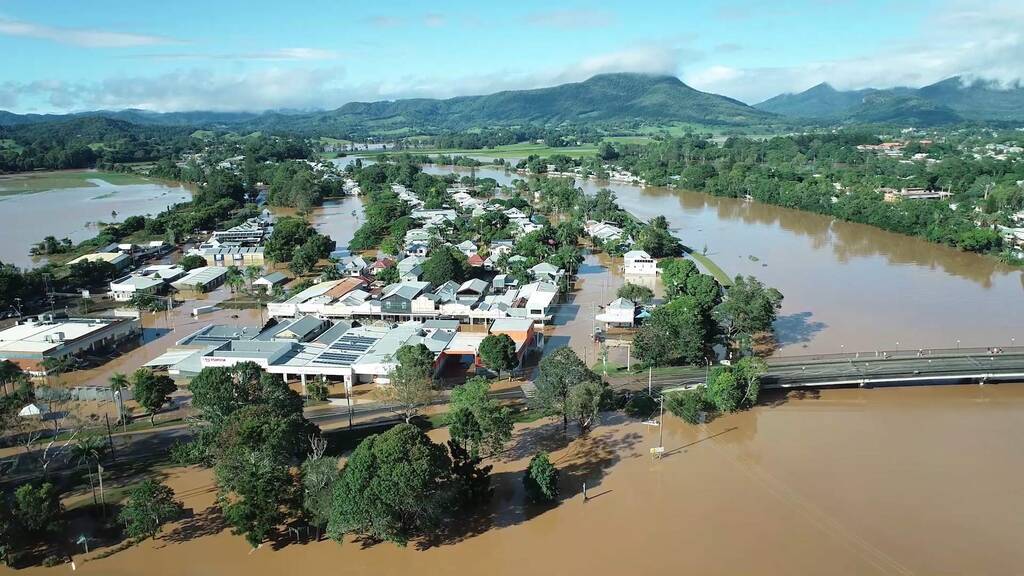
The extent of flooding in Murwillumbah during the February/March 2022 floods.
Tweed Shire Council welcomes the release of CSIRO's Northern Rivers Resilience Initiative flood mitigation report, focused on detailed flood modelling and mitigation scenarios for the Richmond River catchment around Lismore. While the report is an important step for the region, its modelling does not extend to the Tweed River and coastal creeks catchments, among the areas hit hardest in 2022.
The disasters that prompted the report did not stop at a catchment boundary. The 2022 floods, the 2024 floods and Ex Tropical Cyclone Alfred in 2025 affected communities right across the Northern Rivers, including the Tweed.
Home to almost 100,000 people across roughly 1,300 square kilometres in area, the Tweed saw flooding reach communities the length of the shire, from Tweed Heads to Chinderah, Tumbulgum and Murwillumbah, out to the hinterland villages and down the coast to Bogangar and Pottsville. The Tweed River at Murwillumbah peaked at 6.5 metres in 2022, more than 2,100 homes were damaged and around 1,600 residents were displaced. At the height of the event, Murwillumbah could only be reached by boat.
Tweed Shire Council has worked closely with its flood-affected communities over the past 4 years to deliver a range of flood resilience projects. This work recognises that future flooding is inevitable and that the experiences of local residents must not be forgotten.
"While the scale of the problem in the Richmond required federal agency involvement, the Tweed pursued an update and expansion of our Tweed Valley Flood Study, which was completed in 2024. We are now using that data to look at our options to face the challenge of more frequent and more destructive flood events," said Danny Rose, Manager – Roads and Stormwater for Tweed Shire Council.
"We have secured significant State and Federal funding to deliver one of the region's largest flood recovery programs, and the State's Floodplain Management Program has approved funding for a Flood Study update for the Tweed Coastal Creeks, and Risk Management Studies and Plans for the Tweed Valley and the Coastal Creeks," he said.
The Tweed's flood recovery program has restored almost 5,000 damaged sites across 3 events, with $186.7 million invested to date. The program has rebuilt 3,989 road sites, 386 bridges and culverts and 175 parks, managed 29.5 kilometres of riverbank and planted more than 51,000 trees to hold the landscape together.
That work has not been about simply restoring what was there before.
"Our crews know this catchment. They know where the water goes and how fast it moves," said Troy Green, General Manager of Tweed Shire Council.
"Across nearly 5,000 sites we have not just repaired what was lost, we have rebuilt to a stronger standard wherever funding allowed. We have put rock protection along riverbanks to stop them washing away and lifted bridge structures higher above the water. In our sporting clubs and community halls, for example, we have used flood-resilient materials like epoxy floors and metal fittings, so that after the next flood they can be hosed out and back in use in days rather than stripped back and rebuilt. That is what 'build back better' looks like on the ground."
That work is now being told in full through Facing the River, Council's seven-part flood resilience media series running until 28 July 2026. The series sets out how the Tweed has rebuilt across its civic spaces, sporting grounds, community halls, roads, parks and natural environment.
"The work our crews have done is the foundation. The next step is bringing it together into a long-term vision, the updated Flood Risk Management Plans, so the way we manage flood risk keeps pace with what we now know about our catchments," said Danny Rose.
The Flood Risk Management Plan process refreshes Council's decade-old plans, drawing on the latest flood modelling, new data including LiDAR and river bathymetry, updated climate change projections and extensive community input to set out how the Tweed will manage flood risk for the long term. The plans will go on public exhibition later this year for the community to review and shape.
ABOUT THE FACING THE RIVER SERIES
Facing the River is Tweed Shire Council's seven-part flood resilience media series, running from 19 June to 28 July 2026. Each chapter is a standalone media release and media event, telling a different dimension of the Tweed's recovery and what the region has learned about facing the next flood.
- Week 1, Civic Heart: Friday 19 June 2026, 10 am
- Week 2, Sport and Wellbeing: Thursday 25 June 2026, 10 am
- Week 3, Community Hubs: Thursday 2 July 2026, 9:30 am
- Week 4, Infrastructure and Connectivity: Thursday 9 July 2026, 10:30 am
- Week 5, Neighbourhood Liveability: Friday 17 July 2026, 10 am
- Week 6, Working with Nature: Thursday 23 July 2026, 10 am
Week 7, Trading Turbulent Waters for Solid Ground: Monday 28 July 2026, 10 am


