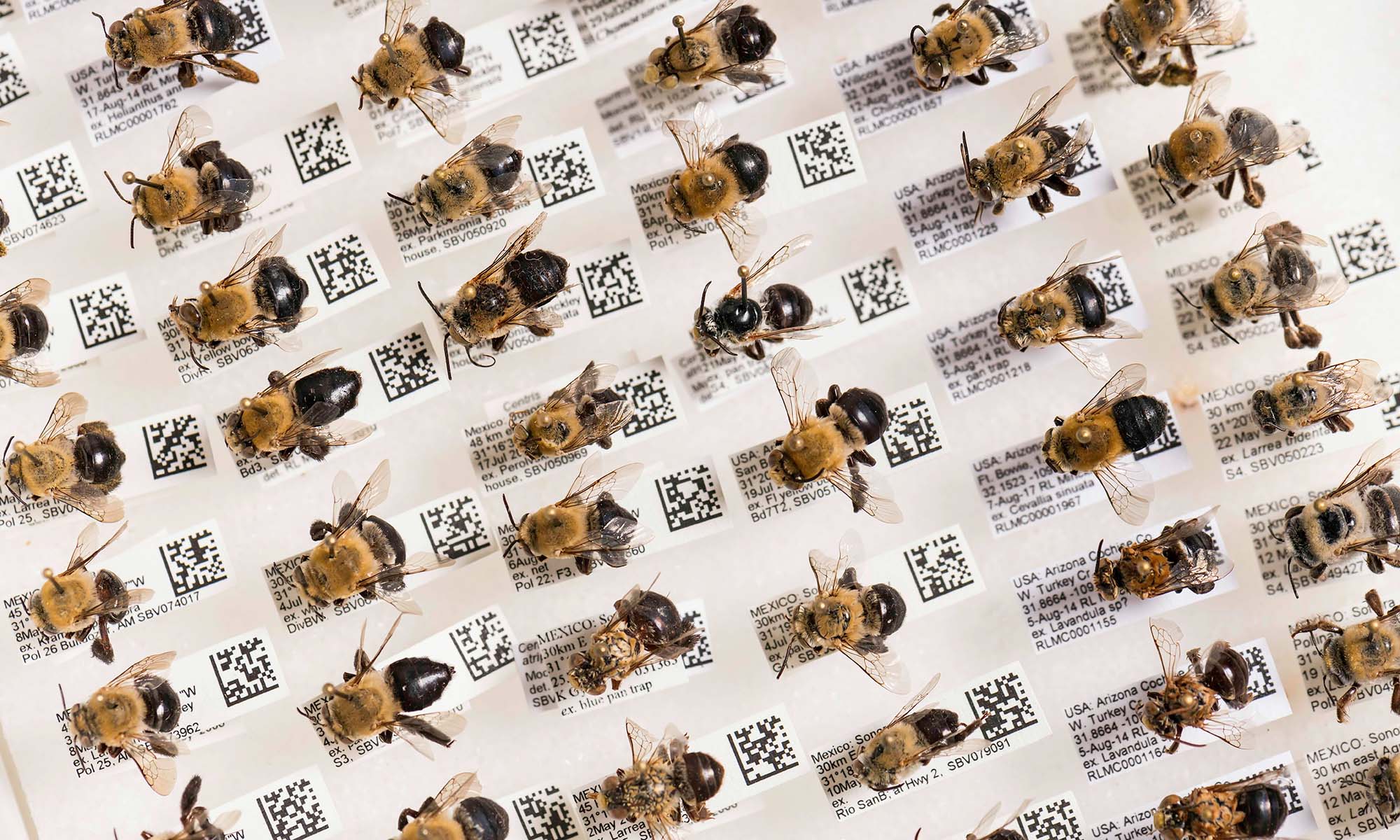
Professor Bob Minckley answers common questions about the surprisingly diverse-and downright weird-world of bees.
Nearly everyone knows the western honeybee (Apis mellifera)-that fuzzy, golden brown, black-banded bee. It's a top-of-mind bee for its honey production and broad importance in agriculture. Not to mention the way it gutted a generation that grew up having seen the 1991 film My Girl and, more recently, the way Jerry Seinfeld's Bee Movie (2007) anthropomorphized the insect. But those also happen to be among the reasons why entomologist Bob Minckley, a professor of instruction in biology at the University of Rochester, didn't include them in his new edited book, The Book of Bees: A Life-Size Guide to Bees Worldwide (University of Chicago Press).

Minckley's book celebrates the differences of more than 400 kinds of bees with bold photography and details about each species' history, behavior, and interactions with flowers and humans. While the western honeybee didn't make the cut, two subspecies did: the Cape honeybee (Apis mellifera capensis) and the Africanized honeybee (Apis mellifera scutellata).
"When I decided I wanted to work on bees, I also decided I wasn't going to work on honeybees," Minckley says. "So, I really never paid attention to social bees because there are so many solitary bees. Then I decided to write this book, and I had to read all this literature on social bees that is actually very cool. I thought, 'Why didn't I read this when I was 25 years old?' It was a lot of fun-and a little embarrassing-learning about all the bees I had been ignoring."
Minckley is well known for his long-term field studies on solitary bees and bee biodiversity, documented in his coauthored book The Solitary Bees: Biology, Evolution, and Conservation (Princeton University Press, 2019). He has also amassed a collection of 62,000 bees, one of which is a sweat bee, Lasioglossum minckleyi, named in his honor.
Have a question about bees? Minckley's an excellent resource.