
ANSTO has supported research that has revealed for the first time marine reptile ichthyosaurs consumed pterosaurs before becoming prey themselves to giant marine predators.
This extraordinary fossil discovered near Richmond in Outback Queensland has provided one of the clearest behavioural snapshots ever recovered from Australia's Cretaceous fossil record.
Published today in the peer-reviewed journal Gondwana Research, the study documents a complex three-tier food web operating within Queensland's ancient Eromanga Sea more than 100 million years ago.
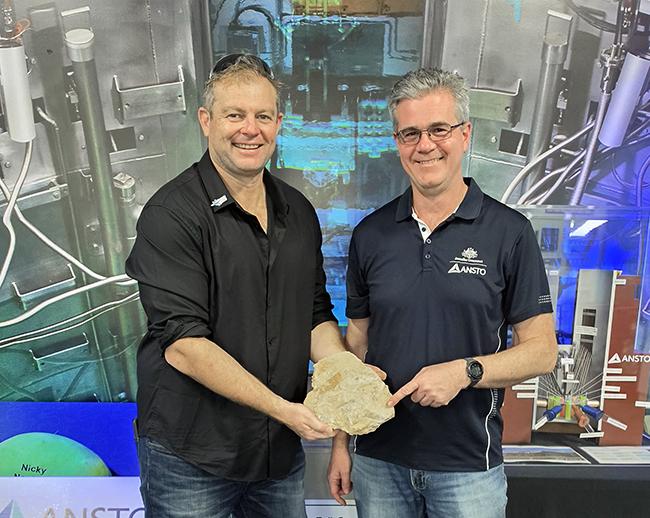
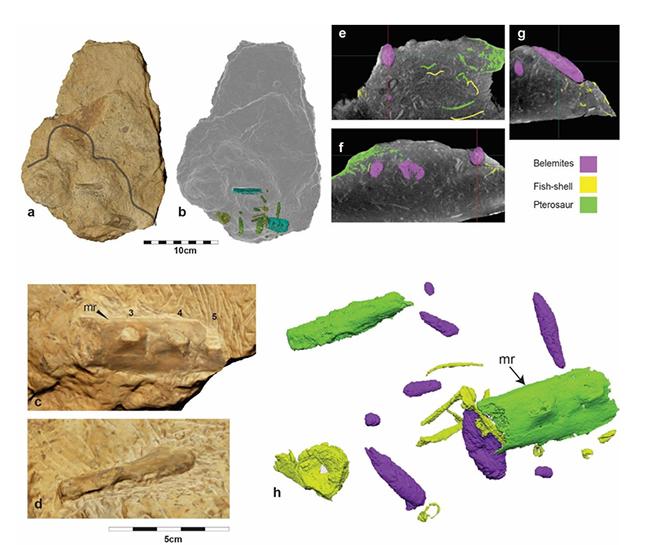
During excavation, researchers recovered several dense concretions immediately behind the skull. Rather than mechanically preparing the material and risking damage, the team led by University of New England Research Associate Dr Matt White collaborated with Dr Joseph Bevitt at ANSTO's Australian Centre for Neutron Scattering, to use advanced neutron imaging to digitally examine their contents.
The scans revealed fish remains, cephalopods and fragments of a pterosaur lower jaw preserved together within the concretions. Their location directly behind the skull, combined with the diversity of prey remains, strongly supports the interpretation that the concretions represent fossilised gut contents.
Co-author Dr Bevitt, an expert in the analysis of fossil remains using synchrotron and neutron techniques, said, "Australian fossil digs, and the volunteers that work so hard to carefully excavate these remains, continually surprise us. Not just quality specimens, but also unforeseen insights into ancient ecosystems. Every time Matt White calls me to say he's got another specimen to collaborate on, it's my birthday all over again."
Dr White said the fossil immediately stood apart from other Australian ichthyosaur discoveries.
"What startled me was not only the size of the animal, but the way its skeleton had been damaged," Dr White said.
"The vertebrae were split; ribs were missing and numerous bones displayed large crushing bite marks. One vertebra even preserved a rib jammed against a broken margin, strongly suggesting forceful jaw processing rather than simple post-mortem damage."
"The only predator known from the Eromanga Sea capable of producing injuries of this magnitude is the giant pliosaur Kronosaurus queenslandicus."
While fossil skeletons commonly reveal anatomy, direct evidence of behaviour is exceptionally uncommon.
Palaeontologists often use the advanced imaging techniques at ANSTO to analyse precious fossil remains, as the approach is non-destructive and provides information not available by other methods.


