
Science Meets Parliament WA has brought together researchers and decision-makers to strengthen the role of science in shaping Western Australia's future, with Premier Roger Cook urging scientists to take their place in public debate.

Held in Perth on 21-22 October, the inaugural event took Science & Technology Australia's (STA) flagship program beyond Canberra for the first time. Across two days, STEM professionals explored how policy decisions are made, practised communicating their research and connected directly with WA parliamentarians.
The event brought together 122 participants from 20 STEM sectors. Research represented ranged from using silkworms to patch eardrum perforations in children and microorganisms to recover valuable metals and restore damaged landscapes, to using the world's largest radio telescope to investigate the universe's deepest mysteries.
Delegates heard that scientific expertise can help shape better decisions, but making that contribution requires relationships, clear communication and an understanding of the challenges facing policymakers.
 Hon Stephen Dawson MLC and Hon Dr Parwinder Kaur MLC
 Dr Sarah Tynan
 Science Meets Parliament WA delegates
 Professor Peter Klinken AC, Hon Dr Parwinder Kaur MLC, Professor Sharath Sriram, Hon Stephen Dawson MLC, Ryan Winn
STA Director of Policy and Government Relations Dr Sarah Tynan encouraged attendees to approach those conversations with practical contributions.
"Parliamentarians know the problems. So come to them with solutions."
The opening sessions at Government House introduced delegates to WA's parliamentary system and offered a parliamentarian's view of working life, from competing demands and busy diaries to the important role of advisers.
The Hon Dr Parwinder Kaur MLC encouraged the audience of STEM professionals to share their stories and explain the solutions their work could offer. The Hon Tim Clifford MLC emphasised being clear and direct about the purpose of a meeting and connecting research to industry and community needs.
Former ministerial adviser Sharon Webb, from AAMRI WA, urged delegates to prepare carefully.
"Understand how your science aligns with current government challenges and priorities."
She also encouraged researchers to build connections with advisers, find champions for their work and recognise that policy change takes time.
Those lessons flowed into practical pitch sessions, where delegates worked on explaining their research clearly to different audiences. The focus was on making the significance of their work understandable and giving decision-makers a reason to keep the conversation going.
Building respectful relationships was also central to Working with Community: An Introduction to First Nations Knowledges for Researchers, featuring Aunty Sharon Wood-Kenney and Professor Peter Klinken AC.
Aunty Sharon encouraged delegates to make space for listening, and invite delegates to join the path of two-way science.
Professor Klinken reflected on what he had learned, especially during his time as WA Chief Scientist.
"One of the great joys for me from learning from Noongar people, and Aboriginal people in general, is that everything is connected."
He encouraged researchers to connect their specialist knowledge with the wider issues facing society and take the time to build relationships with Aboriginal people.
Sessions on government departments and parliamentary inquiries explored how to make evidence useful while protecting its integrity.
Colleen Egan MLA joined a panel with WA' s current and immediate past Chief Scientists Prof Sharath Sriram and Emeritus Professor Peter Klinken, discussing the importance of scientists delivering clear, accurate and accessible evidence. Evidence that avoids self-interest, and contributes to informed bipartisan policy decisions in the best interest of the state.
Science has a clear role in progressing not just scientific agendas, but also addressing broader issues of social wellbeing and economic prosperity.
Professor Sriram reinforced the importance of clear communication: "Cut through the jargon. Think of the main points."
 Professor Sharath Sriram and Hon Dr Parwinder Kaur MLC
 Hon Roger Cook MLA
 Science Meets Parliament WA Gala Dinner at the Western Australian Musuem
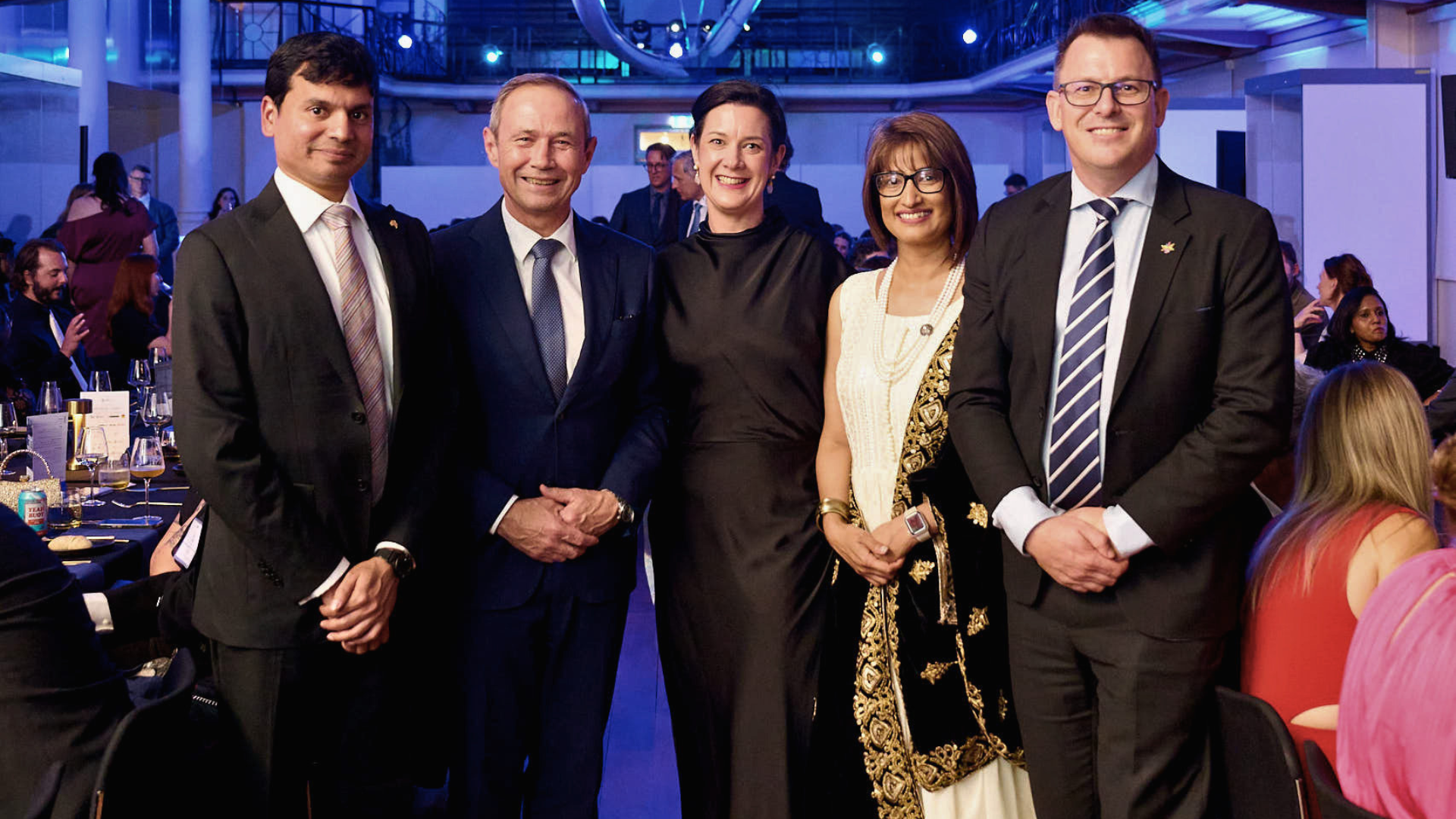 Professor Sharath Sriram, Hon Roger Cook MLA, Lucy Guest, Hon Dr Parwinder Kaur MLC, Ryan Winn
The first day concluded with the Gala Dinner at WA Museum, bringing delegates together with parliamentarians, senior policy advisers and science sector leaders. MCs Dr Kaur and Professor Sriram guided the evening.
Premier the Hon Roger Cook MLA highlighted science's contribution to food security, health, the energy transition and environmental challenges.
He positioned scientists as essential guides through an increasingly uncertain and complex world.
"The only way, ultimately, that we can make sense of this chaos is through science," he said.
He also challenged scientists to build community confidence in their disciplines at a time when public trust in science is under pressure.
On day two, participants took their preparations into 23 meetings with WA parliamentarians at Parliament House, discussing their research and its relevance to the state.
STA CEO Ryan Winn said the event was about building lasting connections between scientific expertise and public decision-making.
"Western Australia has extraordinary scientific expertise. Science Meets Parliament helps researchers build the relationships and confidence to bring that expertise into policy conversations and helps parliamentarians connect with people whose work can inform better decisions."
Science & Technology Australia thanks the WA Office of the Chief Scientist, Parliamentary Friends of SMARTT, the Department of Energy and Economic Diversification, and all partners, speakers and delegates who made the inaugural event possible.


