
France and the United Kingdom have committed additional funding to the Climate Risk and Early Warning Systems initiative, which seeks to ensure that people most at risk in low-income countries have access to life-saving early warnings to reduce the risks from weather-related hazards.
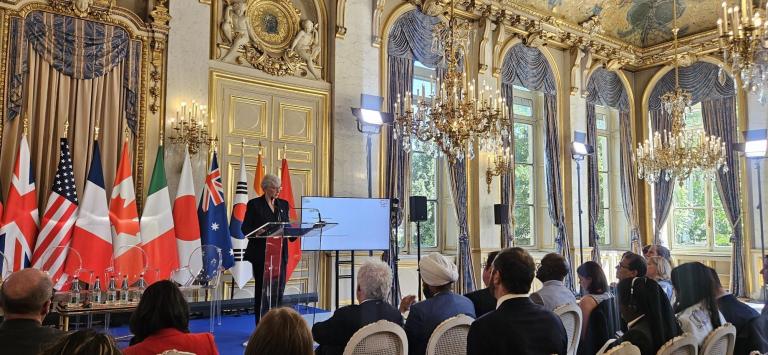
French Minister of State for Francophonie, International Partnerships and French Nationals Abroad, Éléonore Caroit, and Baroness Chapman of Darlington, UK's Minister for International Development and Africa, announced the financial contributions at a G7 Development Ministers meeting in Paris on 30 April. They called on other G7 countries to support the collective efforts by the Climate Risk and Early Warning Systems (CREWS) initiative to strengthen forecasts and warnings in low-income countries.
Éléonore Caroit stated: "CREWS initiative has already strengthened the resilience of 77 countries and more than 400 million people through early warning systems. Investing US$ 800 million in these systems prevents up to US$16 billion in losses per year, and divides disaster-related mortality by six."
The announcement of additional contributions of 3 million euros by France for 2026 and a similar contribution by UK to the CREWS trust fund, allows the initiative to move closer to achieving its objective of closing the early warning capacity gap in Least Developed Countries and Small Island Developing States by 2030.
Fifty years after the G7 was first created to tackle global economic and political issues, the G7 Head-of-State Summit will be held in Evian, France on 15-17 June 2026.
In the build-up, France convened the G7 Development Ministers meeting in Paris, recognizing the shared interest in increasing resilience to protect populations, economies and infrastructure from disasters.
CREWS contribution and impact
Through its technical assistance, 400 million people have access to life saving early warning services. CREWS has successfully leveraged US$ 2.8 billion from the World Bank and other financial institutions, while also facilitating access to climate finance for the countries it works with.
To achieve its goal of bridging the early warning capacity gap, CREWS draws on the best available expertise- from the World Meteorological Organization, the UN Office for Disaster Risk Reduction the International Telecommunications Union, the Red Cross and Red Crescent movement, and development banks.
WMO Deputy-Secretary-General, Ko Barrett, emphasized that "CREWS is one of WMO's most important partners in turning science into action. WMO has implemented CREWS projects worth US$ 67 million since 2017, supporting national meteorological and hydrological services in more than 70 countries to deliver life-saving early warning systems."
Why supporting early warning system matters
The G7 meeting heard that weather-related hazards are causing severe damage, and economic and social losses are increasing globally. Early warning systems are a shared development priority because they can reduce disaster-related mortality by up to six times; every dollar invested in early warning systems can yield up to US$ 10 in benefits; and a 24-hour warning of a coming storm can cut the ensuing damage by 30%.
Many countries, especially those most vulnerable to extreme weather events, still lack the necessary capacity to ensure timely warnings reach people and trigger early actions to save lives and livelihoods.
Jagan Chapagain, Secretary-General and CEO of the International Federation of Red Cross and Red Crescent Societies (IFRC) called at the meeting on G7 ministers "to continue the dialogue on how to reduce demand on the humanitarian system - and related financial aid - by better-timing limited humanitarian supply." "It's early action that makes early warning work," he said. "And that saves lives."
The IFRC is a membership organization of 191 National Societies and 17 million community level volunteers. It is in the final stage of being accredited to CREWS.


