
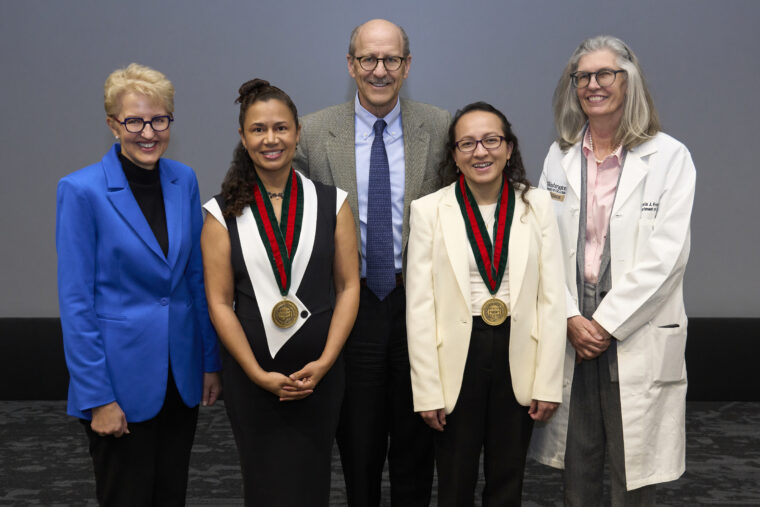
Monica Chang-Panesso, MD, a physician-scientist advancing the understanding of how damaged kidneys repair themselves, and Hysell Oviedo, PhD, a neuroscientist uncovering how the brain interprets sound and language, each have been installed as a Roger M. Perlmutter Career Development Assistant Professor at WashU Medicine.
The professorships - funded by the Merck Foundation - are named for Roger M. Perlmutter, MD, PhD, a distinguished alumnus of WashU Medicine's Roy Vagelos Medical Scientist Training Program who later led global research and development at Merck. He is now chairman and chief executive officer of Eikon Therapeutics, a late-stage clinical biopharmaceutical company focused on developing breakthrough therapeutics for cancer and neurological diseases. Perlmutter has credited his experience at WashU Medicine as transformational in developing the skills to address critical biomedical research questions and pursue a career in science and drug discovery.
Chang-Panesso and Oviedo were installed by David H. Perlmutter, MD, executive vice chancellor for medical affairs, the Spencer T. and Ann W. Olin Distinguished Professor and the George and Carol Bauer Dean of WashU Medicine.
"In honoring Roger's legacy, the Merck Foundation is advancing the work of two early-career scientists who are pursuing promising medical research," Dean Perlmutter said. "Creating opportunities for scientists to focus on discovery and develop as independent investigators is central to our mission and a value that has distinguished WashU Medicine for many decades. These professorships for Dr. Chang-Panesso and Dr. Oviedo will help nurture their potential, much as the Roy Vagelos Medical Scientist Training Program helped shape Roger's own path as one of the most impactful physician-scientists of his generation."
Advancing kidney repair
Chang-Panesso studies the mechanisms of kidney regeneration and repair - work aimed at understanding how aging alters the body's ability to heal itself after injury or illness. Using a combination of animal models and transcriptomics, the analysis of gene expression, she aims to identify strategies to enhance kidney recovery and regeneration. Her approach allows for insights into gene expression, function and regulation that affect kidney repair response long term.
Chang-Panesso's research already has led to the identification of a specific protein that promotes kidney cell division and repair. However, once kidney cells are damaged, some don't fully recover - a failure that could drive the transition from acute kidney injury to chronic kidney disease, which increases the risk of other serious health issues and can lead to kidney failure.
She has received several honors for her work, including a Mentored Clinical Scientist Research Career Development Award in 2020 from the National Institute of Diabetes and Digestive and Kidney Diseases of the National Institutes of Health (NIH), the Ruth L. Kirschstein National Research Service Award Individual Postdoctoral Fellowship in 2014, and the Nathan Hellman, MD, PhD, Memorial Award in 2013, when she was a nephrology fellow at Brigham and Women's Hospital/Massachusetts General Hospital.
Chang-Panesso earned a bachelor's degree in biochemistry from the University of Texas in Arlington and her medical degree from Texas Tech University. She completed her residency at UT Southwestern Medical Center. In 2015, after her nephrology fellowship, Chang-Panesso came to WashU Medicine to continue her postdoctoral research fellowship in the Division of Nephrology in the Department of Medicine. She joined the faculty in 2016 as an instructor and was promoted to assistant professor in 2018.
"Dr. Chang-Panesso's research has significantly advanced our understanding of renal physiology, particularly the mechanisms of regeneration following acute kidney injury," said Victoria J. Fraser, MD, the Adolphus Busch Professor of Medicine and chair of the WashU Medicine John T. Milliken Department of Medicine. "Her dedication and innovative approach make her an invaluable asset to our Division of Nephrology, continually inspiring excellence and driving progress in the field."
Illuminating how the brain processes sound, speech
Oviedo's research centers on how the brain decodes vocal communication. Using mouse models, she has discovered the first blueprint of "semantic" (left-hemisphere) and "prosodic" (right-hemisphere) pathways that mirror the human brain's specialization for language and emotion. Oviedo is investigating how the brain becomes specialized for understanding speech during early development, and why this process can break down in people with communication disorders.
"This appointment reflects Dr. Oviedo's extraordinary contributions to neuroscience," said Linda Richards, PhD, the Edison Professor of Neuroscience and chair of the Department of Neuroscience. "Her studies have deepened our understanding of how the brain processes sound and how disruptions in these activities may contribute to neurodevelopmental disorders."
Oviedo earned bachelor's degrees in biology and French literature from Stockton University in Galloway, N.J., and a PhD in neuroscience from New York University. Following her postdoctoral fellowship at Cold Spring Harbor Laboratory, Oviedo was an associate professor in the City College of New York's biology department before joining the WashU Medicine Department of Neuroscience in 2023.
During her postdoctoral research at Cold Spring Harbor, Oviedo began uncovering the auditory cortex's specializations for breaking down and making sense of sound. As a faculty member at the City College of New York, she studied how the two hemispheres of the brain operate independently and cooperatively to lead to a cohesive understanding of speech. This led to her discovery of specialized functions each hemisphere contributes to in computing various aspects of speech. Her work has been supported by a Whitehall Foundation Research Grant, a National Science Foundation CAREER award, and R21 and R01 grants from the NIH's National Institute on Deafness and Other Communication Disorders.
About Roger M. Perlmutter
Roger M. Perlmutter has a longstanding connection to WashU. He earned his medical and doctoral degrees from WashU in 1979. A member of the WashU Medicine National Council since 2005, he received WashU's Distinguished Alumni Award in 2018. Perlmutter's family includes two more WashU graduates: His wife, Joan Kreiss, MD, an infectious disease specialist, earned a medical degree from WashU Medicine in 1978, and his son, Noah, earned an undergraduate degree from Arts & Sciences in 2020.
Before assuming leadership roles in the pharmaceutical industry, Perlmutter was a professor in the departments of immunology, biochemistry and medicine at the University of Washington, Seattle. He also served as a Howard Hughes Medical Institute investigator and chaired the Department of Immunology there. He is a fellow of the American Academy of Arts and Sciences and the American Association for the Advancement of Science, and past president of the American Association of Immunologists.
Perlmutter joined Merck Research Laboratories in 1997 as executive vice president of basic and preclinical research. From 2001 to 2012, he served as executive vice president and head of research and development at Amgen. He returned to Merck in 2013, serving as executive vice president and president of Merck Research Laboratories until his retirement in 2020. In 2021, he became chief executive officer of Eikon Therapeutics, a company that employs super-resolution microscopy to pursue the discovery of new medicines.
During his academic and corporate careers, Perlmutter has supervised the discovery, development and subsequent approval of novel medicines addressing major inflammatory and endocrinologic diseases, as well as a breakthrough oncology therapy that works with the immune system to help fight certain types of cancer.


