
A study led by the IBB-UAB, the ICM-CSIC and the University of Bergen has revealed how the repurposing of an ancestral gene saved the embryos of cod's ancestors from extinction, enabling them to form the large populations that, millions of years later, would change the course of human history.
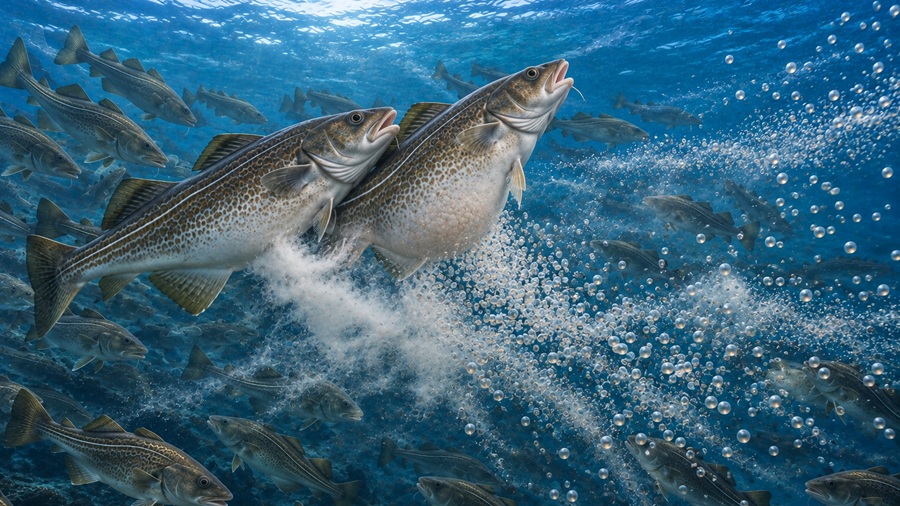
A new study published in Proceedings of the National Academy of Sciences (PNAS) —led by researchers from the Institut de Ciències del Mar (ICM-CSIC) and Institute of Biotechnology and Biomedicine of the Universitat Autònoma de Barcelona (IBB-UAB), Spain, and the University of Bergen (UoB), Norway— has revealed that codfishes and their relatives in the order Gadiformes lost genes essential for egg buoyancy and the survival of their embryos, yet survived by adaptively recruiting mechanisms that aid egg ovulation in freshwater fishes.
Key role of hydration and buoyancy in marine fish eggs
The scientists have studied how codfish fish eggs float in the water column where ocean currents transport them across considerable distances. These and other studies have revealed that the origins of many marine fish populations are closely connected to the physical and biological processes of the ocean itself. The reason the eggs float is because, unlike the eggs of freshwater fishes, the marine fish eggs become engorged with >90% water during the final stages of egg development thus making them less dense than seawater. It is like inflating a life vest just before release. Without this massive influx of water, the eggs act like stones and sink out of the water column to non-survivable depths. Consequently, any mechanism that affects this process on a population level is an existential threat to the lineage as it would not be able to complete its life cycle.
Such a mechanism was discovered in codfishes. The mechanism in question involves the loss of water channel (aquaporin) genes (aqp1ab1 and aqp1ab2) that mediate the process of egg hydration in all other marine fishes that produce floating eggs. Aquaporins are proteins that are regulated to enter or exit membranes in order to accelerate or reduce water transport in cells, respectively. For water to move through an aquaporin inserted in a membrane, the concentration of dissolved solutes needs to be higher on one side of the membrane. Fish oocytes achieve this by breaking down yolk proteins to their building blocks – free amino acids.
This generates the concentration gradient required for water entry into the oocyte, a feature that the scientist found was conserved in codfishes. Surprisingly, however, codfish eggs such as those of Atlantic cod have the highest water contents (93- 97%) of any species allowing them to float even in low salinity environments such as the Baltic Sea. By lacking the aqp1ab-type water channel genes that mediate the process in other marine fishes, it was a mystery how they achieved this extraordinary feat.
Even more paradoxically, codfishes repeatedly hydrate their eggs many times over a spawning season at a rate approximately 20 times that of natural diffusion. The huge volumes of eggs released form the basis of a sustainable population, which in the Northwest Atlantic collapsed in catastrophic fashion due to overfishing and mismanagement. Understanding how codfish eggs do things differently and survive in the oceans was therefore a key goal of the scientists.
Functional gene co-option as the solution
To resolve the apparent paradox, the scientists looked for other genes in distantly-related freshwater and marine fishes that could have been recruited to the hydration process during egg formation in the cod. This uncovered a different aqp4-type water channel in the same chromosome in which the original aqp1ab-type water channels were lost.
The studies showed that the aqp4 channel is utilized by primitive freshwater species to aid ovulation, a process in which mature oocytes are released from ovarian follicles to become unfertilized eggs. In these fishes, aqp4 is inserted in the outer oocyte membrane during meiotic maturation to allow a small increase in water content, which causes the oocyte to swell slightly and the rupture of the surrounding follicle cells for the release of the newly formed egg. The role of aqp4 in this process was confirmed using a specific inhibitor of the channel, which prevents ovulation.
However, they noted that unlike other marine species, the related Atlantic cod Aqp4 channel is also localized in the outer membrane of the oocyte, and that its inhibition prevents the massive hydration of the oocyte during meiotic maturation. Consequently, it was revealed that codfishes survived extinction by functionally co-opting (repurposing) the ovulatory pathways of ancestral freshwater fishes to the hydration of their marine eggs. Based upon observations that close relatives of the Gadiformes still retain intact aqp1ab-type genes, the timing of this event seems to have occurred 60-84 million years ago.
"Finding that codfishes lost the standard water channels used by almost all other marine fish was a complete mystery," says Dr. Joan Cerdà, researcher at ICM-CSIC and IBB-UAB. "What fascinated us was discovering how evolution hijacked an entirely different channel—originally used just for egg ovulation in freshwater ancestors—and repurposed it into the mechanism of oocyte hydration to assure egg buoyancy. It shows how remarkably flexible genetic toolkits can be when facing existential evolutionary dead ends."
Reference article: Dobriban, E. (2026). The Benjamini–Hochberg procedure can fail to control the FDR for correlated two-sided Gaussian tests. Proceedings of the National Academy of Sciences, 123(41), e2626267123. https://doi.org/10.1073/pnas.2626267123


