
On a planet full of cool rocks, Ethan Penner '21, MS '22, discovered one of the coolest - freshly cooled, as it happened.
The slab of black basalt came from Iceland, which he visited on a Binghamton University trip during his master's program. A year after a volcanic eruption, the ground proved cool enough for walking; Penner discovered the rock and brought it home.
At his New Jersey apartment, he hoisted up the basalt, corded as if it were made from bundled ropes. On the back, he traced shining crystals: a mix of feldspar and olivine.
"There are certain minerals that only form in certain places. To get an igneous mineral that came straight from a volcano really blew my mind," he said. "It's definitely the coolest spot that I've ever found a rock."
When he's not working at his day job at an environmental consulting company, the geological sciences alum is known as Rock Man Ethan (rockmanethan) to his 1.7 million followers on TikTok and 130,000 on Instagram. And his social media star continues to shine: Penner is among National Geographic's inaugural Creator Cohort, which brings together content creators in conservation, wildlife photography, science, and history.
Over the course of the six-month program, Creator Cohort members will participate in brand events and activities and make content directly for National Geographic, highlighting their initiatives and programs. They'll also head to some amazing places - although, for specifics, you'll have to tune in and see what unfolds.
Penner's claim to fame is the catchy series "What's Inside that Rock?" in which he finds cool rocks and breaks them open with a hammer to see what's inside. He also creates videos that discuss geological discoveries and geology-related news, or which explain concepts and principles central to the discipline.
"I want to push geology as far as it can go," he said. "In the end, my goal is to bring people content that helps them and inspires them to pursue their passions."
From rocks to likes
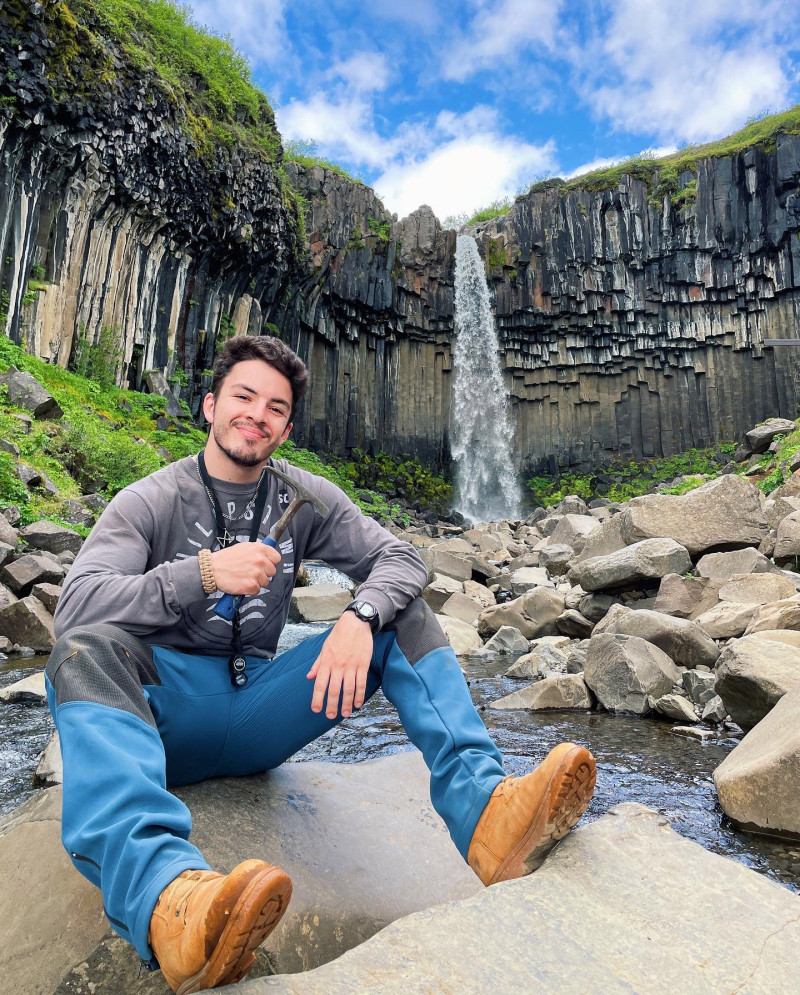
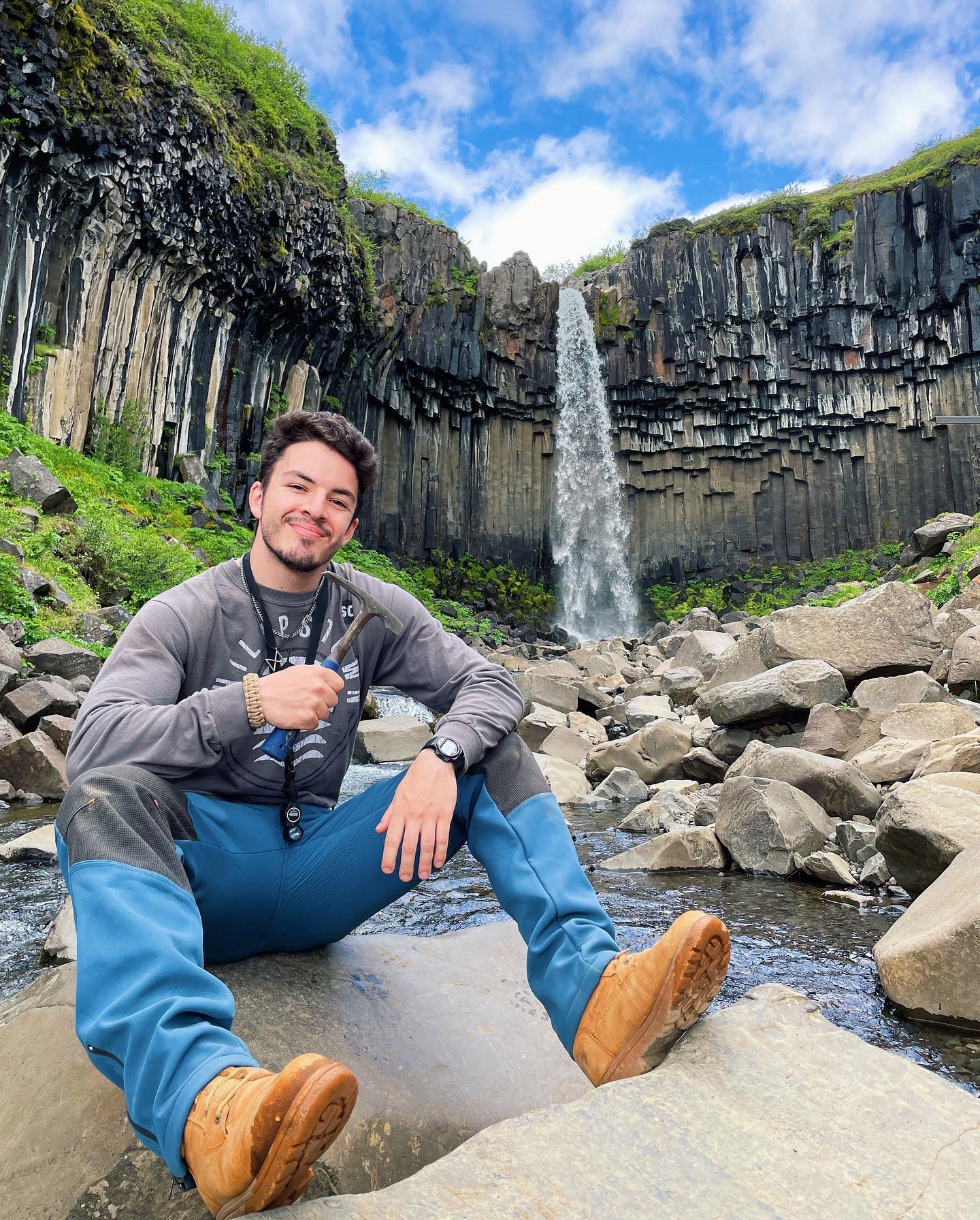
Originally from Garrison, NY, Penner's love for the outdoors drew him to Earth Sciences as a child. His family encouraged his interest; his uncle gave him a rock collection, and his parents took him on trips to Howe Caverns, he said.
Drawn to Binghamton for its science programs, he participated in the First-year Research Immersion's environmental visualization stream, which introduced him to the use of drones, geographic information systems and data processing to solve complex environmental problems. His team focused on methane emissions and had the opportunity to present their research at an academic conference, he said.
On the social media front, Penner began sharing fun photos in high school, drawn by the prospect of connecting with others. In 2020, he created his rockmanethan accounts as a creative outlet during the pandemic, sharing some of the knowledge he acquired in class.
His first viral video was part of his "What's Inside that Rock?" series. In his parents' backyard, he picked up a plain rock; a sharp tap of the hammer revealed the shine of quartz within. He was shocked when it received 5,000 likes.
"At the time, that was huge for me. I didn't even know 5,000 people. For the first two or three episodes, I was running around and shouting into my phone, telling people what I found and how excited I was," he said. "There was something about that equation of 'guy breaking open a rock with a hammer and showing off crystals' that made sense for the algorithm, and people watched it."
Practice makes perfect, and Penner has since become skilled at finding cool rocks and cracking them open, revealing minerals and even tiny fossils. He's gone beyond the backyard to other places, wherever he happens to be.
Along the way, he forged connections with organizations such as the Society of Exploration Geophysicists, the Association of American Petroleum Geologists, the Geological Society of America, and eventually National Geographic.
The research experience Penner received at Binghamton is an essential ingredient for his success, he said.
"I know how to ask a question and find the right sources," he said. "At the end of the day, I want to be someone who relays information, makes it fun and gives the proper sources due credit because that's what science is about."
He'll undoubtedly discover even more cool rocks during his time with National Geographic, although he admits that the Icelandic basalt would be hard to beat. Maybe lava fresh from the eruption, he quipped.
The partnership with National Geographic is the ultimate dream come true for a science-related content creator. It's opened up a wide vista of possibilities, for which Penner is grateful.
"I never expected any of this to happen," he said. "Every day that I get to post content online and interact with thousands of people - I never take it for granted."


