
Gold is generally associated with pyrite (iron disulfide, FeS2), and pyrite-induced gold precipitation is critical to the formation of high-grade gold deposits. However, the role of pyrite in precipitating gold from fluids has not been well understood.
Now, using in situ liquid-phase transmission electron microscopy under conditions that excluded the influence of dissolved oxygen and electron beams, scientists have achieved the first nanoscale, real-time observation of the reaction between pyrite and gold-bearing solutions, providing critical insights into gold enrichment by pyrite.
The new study reveals that a dense liquid layer at the pyrite-water interface is the key driver of gold nanoparticle precipitation from undersaturated gold-bearing solutions.
The research was led by Profs. ZHU Jianxi and XIAN Haiyang from the Guangzhou Institute of Geochemistry of the Chinese Academy of Sciences, in collaboration with researchers from the Jiangxi Academy of Sciences, Xiamen University, and East China University of Technology. The findings were published in Proceedings of the National Academy of Sciences (PNAS) on January 22.
Specifically, the results showed that a dense liquid layer forms on the pyrite surface following its reaction with a low-concentration gold-bearing solution (10 parts per billion, ppb). The negative correlation between the thickness of pyrite core and dense liquid layer indicates that the production of this layer depends on pyrite dissolution. This discovery sheds light on the mechanism of gold nanoparticle nucleation on pyrite surfaces.
Further in situ liquid-phase experimental results indicated that gold nanoparticles primarily form within the dense liquid layer at the pyrite-water interface, confirming the layer as the core zone for gold precipitation. Thermodynamic modeling revealed that while the bulk solution far from the pyrite is not supersaturated with gold, the interfacial dense liquid layer is supersaturated. This finding validates that gold precipitation is governed by the dense layer rather than the bulk solution. Based on gold solubility phase diagrams, pyrite dissolution reduces oxygen fugacity within the dense liquid layer, thereby triggering gold precipitation.
The concentration mechanism associated with the dense liquid layer is applicable to both hydrothermal gold deposits (e.g., orogenic, Carlin, and epithermal types) and supergene gold concentration. In hydrothermal gold deposits, mixing hydrothermal fluids with meteoric water generates oxidized gold-bearing fluids, which subsequently interact with pre-ore pyrite to induce gold precipitation. In supergene processes, percolating natural waters leach and concentrate gold to ppb levels, with gold precipitation occurring via subsequent interaction with pyrite.
The study was supported by the National Natural Science Foundation of China, the Jiangxi Provincial Natural Science Foundation, the Guangdong Basic and Applied Basic Research Foundation, and other funding sources.
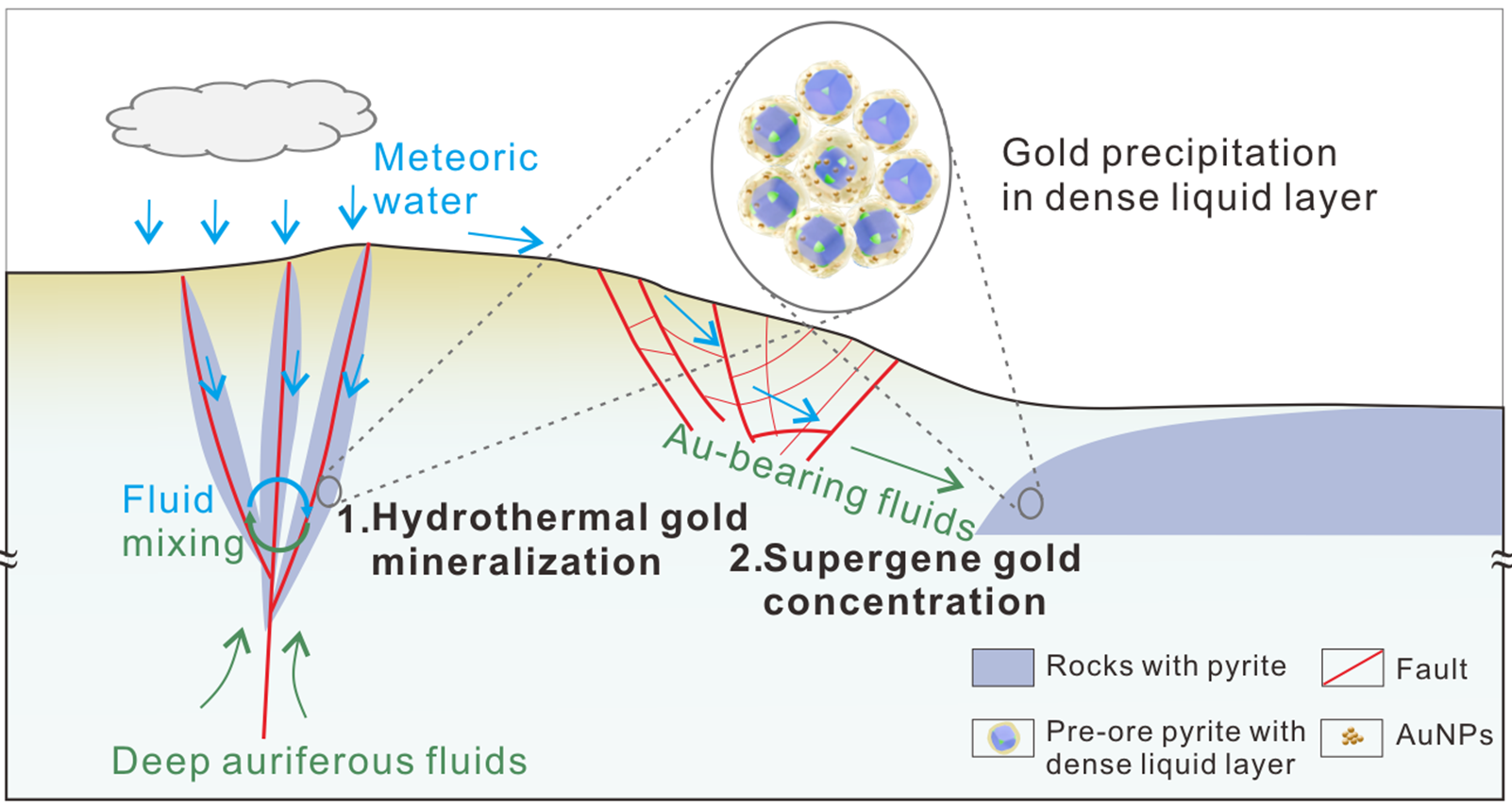
Schematic diagram of gold enrichment in the dense liquid layer during hydrothermal mineralization and supergene concentration. (Image by ZHU Jianxi and XIAN Haiyang's team)


