
How do you tackle corruption in a country grappling with insecurity, weak institutions and widespread impunity? In Haiti, the Government and the United Nations are betting on the country's youth.
Corruption and related financial criminality come in many forms in the embattled Caribbean island nation, according to the regular quarterly report of the UN Secretary-General. They include:
- Money laundering
- Financial crimes
- Illicit trafficking of weapons and ammunition
- Financing of armed groups
- Political and business collusion with gangs
- Non-transparent public contracting in security, customs, immigration and penitentiary services
- Impunity that enables corruption and organized criminal networks
Learning to choose integrity
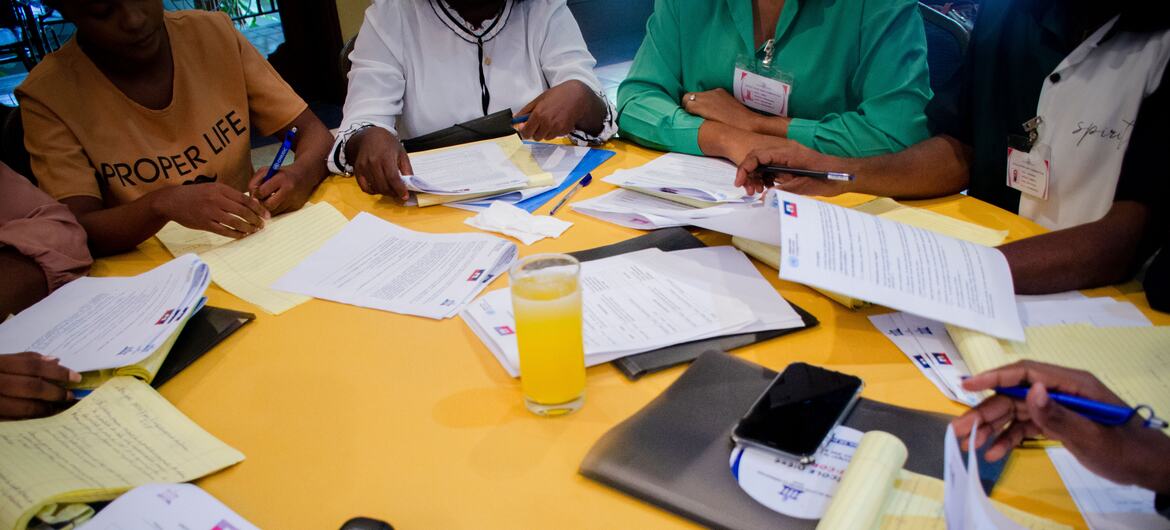
Recently, 60 students and young civil society leaders - selected from 180 applicants - took part in the first Summer School on Anti-Corruption, organized by Haiti's Anti-Corruption Unit (ULCC) with support from the UN Office on Drugs and Crime ( UNODC ).
During an intensive week of lectures, interactive workshops and practical exercises, participants learned how to identify, prevent and report corruption.
Using real-life scenarios, they confronted ethical dilemmas, deciding whether to report corrupt practices depending on the role they had been assigned. They also practiced filing complaints through the ULCC's anti-corruption hotline (5656), gaining firsthand experience with official reporting mechanisms.
For Adamson Junior Lavéus, the programme was transformative.
"As a citizen, this activity enabled me to understand the phenomenon of corruption through its various manifestations: extortion, illicit enrichment, misappropriation of public assets, and bribery, among others," he said in a testimonial collected by UNODC .
Beyond expanding his knowledge, the training reinforced his belief that everyone has a role to play.
"Civic education is essential. It contributes to the empowerment of Haitian society and allows us to build our foundations on moral values."
The programme's success has sparked strong interest. This year, a second Summer School is being organized, attracting hundreds of applications within just a few days.
Investing in the next generation
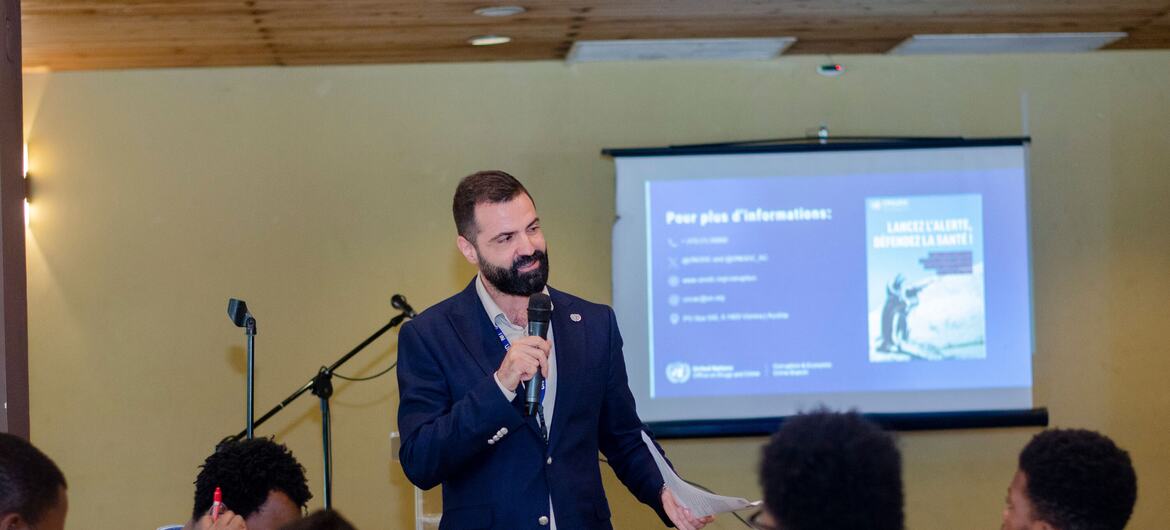
For Adrian Banu, UNODC 's anti-corruption adviser in Haiti, the Summer School is far more than a training programme. In a country where more than half the population is under 25, it is an investment in the generation that will one day rebuild public institutions.
"This is not work that will yield an impact in a year or two," he said in an interview with UN News. "It is work whose results might only be seen in 20 years, but it is work that can truly bring about profound societal change."
The initiative forms part of a broader prevention strategy. With UNODC support, around 50 integrity clubs have already been established in schools across Haiti, where students take part in role-playing exercises, short plays and awareness campaigns highlighting the consequences of corruption and the importance of civic responsibility.
"In doing so, young people are developing a genuine culture of integrity," Mr. Banu emphasized.
Strengthening justice
The strategy also focuses on reinforcing Haiti's justice system.
In late May, with United Nations support, the authorities inaugurated two specialized judicial units: one dedicated to financial crime and corruption, and another focused on mass crimes, particularly sexual violence. Twenty-five specially trained magistrates have been appointed to investigate and prosecute these complex cases.
"What can change the situation regarding impunity in Haiti is the creation of a system," Mr. Banu explained. "These judicial units are not a magic bullet, but rather a solution within a broader system."
According to him, progress is already visible. Thanks to stronger cooperation between institutions, the ULCC has referred 68 investigation reports to judicial authorities over the past four to five years - more than during the previous 17 years combined.
UNODC is also helping strengthen protections for magistrates, witnesses and whistleblowers in an environment where gang violence makes investigations especially dangerous.
The agency is supporting the development of legislation to better protect those who report corruption.
"When I had someone before me who wanted to blow the whistle, the first question was: 'How can you protect me if I share something sensitive with you?'" recalled Mr. Banu, a former police investigator in Romania.
Protecting magistrates remains another priority. Measures such as improving courthouse security and providing specialized equipment are under consideration, although no safeguard can fully eliminate the risks posed by Haiti's current security situation.
A long-term commitment
For Mr. Banu, fighting corruption is ultimately a long-term undertaking. The young people being trained today could become tomorrow's leaders, helping build institutions founded on transparency, accountability and integrity.
Drawing on more than thirteen years of anti-corruption experience, he points to Romania as proof that change is possible.
"Thirty years ago, corruption was far more prevalent there," he said. While challenges remain, the country's anti-corruption system has become "functional".
That experience underpins his optimism for Haiti.
"Progress - I would say it is possible, even in Haiti."


