
After years of knee pain threatened to limit the active life she loved, Anne found a team at UConn Health's Women's Center for Motion & Performance that listened to what she wanted and helped her get moving again.
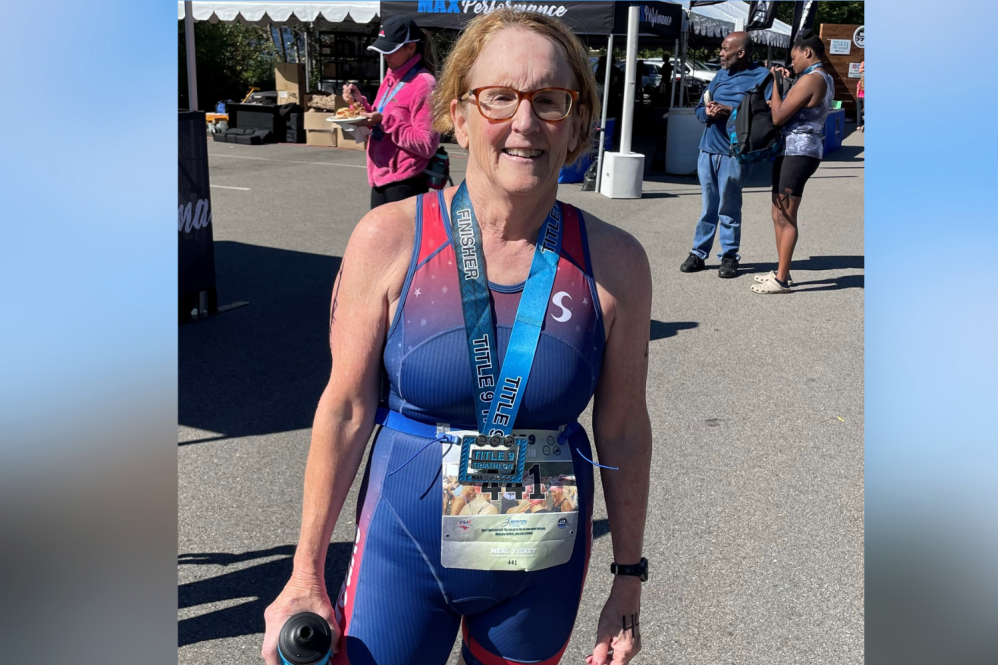
Ann Franczyk (photo provided by Ann)
Ann Franczyk has never been someone who was content to sit on the sidelines.
A longtime runner, cyclist, swimmer and triathlete, she has spent much of her life in motion. Now in her 70s, that hasn't changed. She still wants to ride her bike, challenge herself and remain active for years to come.
So when a right total knee replacement in May 2023 left her with persistent pain, stiffness and severely limited range of motion, being told that there was nothing obviously wrong with the implant wasn't enough.
"I'm an athlete," Franczyk says. "I'm extremely active still, and I wanted to continue to be."
Over the next two years, she searched for answers. She sought multiple opinions, including consultations with specialists in New York and Massachusetts. Imaging did not reveal an obvious mechanical problem with the knee replacement, yet Franczyk continued to experience lateral knee discomfort and significant difficulty bending her knee.
Her limited flexion made even cycling, one of the activities she loved most, difficult. At one point, her knee flexion measured approximately 87 degrees. To complete a pedal stroke, she had to compensate by lifting her hip.
"I was back to cycling a little bit, but it was very painful," she says. "I had very limited flexion."
What frustrated Anne almost as much as the physical limitations was the feeling that her goals were no longer being taken seriously.
Then, while searching online for another option, she discovered UConn Health's Women's Center for Motion & Performance.
"The whole idea was that the goal is to keep women active through their lifetime," Anne recalls. "I thought, 'That kind of feels like me.'"
More Than Treating a Knee
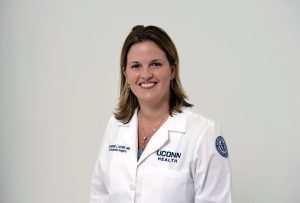
That philosophy is precisely what Dr. Kathrine Coyner, director, envisioned for the Women's Center for Motion & Performance at UConn Health.
The Center serves women across ages and activity levels from competitive high school and collegiate athletes to women returning to exercise after having children, navigating changes associated with perimenopause and menopause, or simply trying to remain active as they age.
"We're not just treating the college and professional athletes of the world," says Coyner, an orthopedic sports medicine surgeon at UConn Health. "It's really anybody who wants to be active or wants to get active."
The Center focuses on women experiencing musculoskeletal problems who may benefit from more than a single appointment or specialty. Its coordinated model connects patients with services that can include orthopedics, physical therapy, sports psychology, nutrition, endocrinology and other expertise depending on the individual.
Nurse navigator, Kayla Callanan, helps patients move through that system, rather than leaving them to figure out the next step on their own.
Coyner says that distinction can make an enormous difference. A patient with hip pain, for example, may need physical therapy, help with weight management and other services before surgery would ever be considered. Simply giving that patient several recommendations and expecting her to navigate separate appointments on her own can mean that weeks later, little has changed.
The Center is designed to close those gaps.
"It's a coordinated care model," Coyner says. "I think that's what makes us successful."
And surgery isn't necessarily the goal.
Coyner says one of the lessons she has learned through the Center is how many women benefit from having someone look at the larger picture, connect them with the right resources and understand what they are trying to get back to doing.
Finding Someone Who Listened
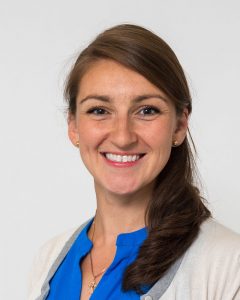
Franczyk's first appointment at UConn Health was with orthopedic surgeon Dr. Olga Solovyova in April 2025.
Franczyk came prepared with a complicated history and plenty of questions after seeing several other specialists. Rather than being discouraged by that history, she says Solovyova took the time to listen.
"She gave me a lot of time. She was very understanding," Franczyk says. "She said, 'I'm here for you. Ask me any questions you want to ask.'"
At that point, Franczyk was not interested in another major operation, and Solovyova did not believe revision knee replacement was appropriate. Instead, the team continued looking for other ways to improve her function.
Franczyk was referred to additional specialists within UConn Health, including Dr. Allison Schafer, medical director, Women's Center for Motion and Performance and eventually to Coyner to discuss whether arthroscopic surgery might offer another option.
What Franczyk appreciated was that Coyner didn't promise a perfect outcome.
"She was very honest," Franczyk says. "She said, 'I cannot guarantee you that I can completely eliminate your discomfort. But I feel very confident that I can give you improved flexion.'"
For Franczyk, that mattered.
Coyner also understood something equally important: Franczyk wasn't asking to simply get through her daily activities without pain. She wanted to keep cycling and challenging herself.
"You're clearly a very active lady and continue to want to be," Franczyk remembers Coyner telling her.
It was a simple acknowledgment, but after years of searching for answers, it meant a great deal.
"I just felt like, for the first time, I was seen and heard," Franczyk says.
A Commitment to Getting Back in Motion
On Jan. 19, 2026, Coyner performed a knee arthroscopy procedure, removing scar tissue that was contributing to Franczyk's restricted motion.
But Coyner made clear beforehand that surgery would only be one part of the process.
Franczyk would need to make a significant commitment to rehabilitation: physical therapy at UConn Health five days a week for the first three weeks, followed by at least three days a week for another three weeks.
Franczyk and her husband didn't hesitate.
With his support, she committed to the rehabilitation program, working closely with UConn Health physical therapist Greg Gomlinski and the rest of the rehabilitation team.
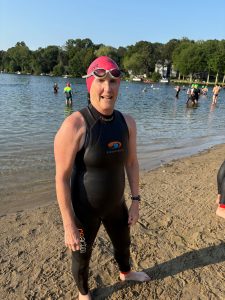
The work paid off.
Franczyk says her knee flexion has improved from approximately 87 degrees before surgery to roughly 115 to 120 degrees. She still experiences some discomfort and recognizes there are limits to how hard she wants to push her knee, but the improvement has allowed her to return more comfortably to something that matters deeply to her: cycling.
Recently, she completed a 35-mile ride.
"I can more comfortably ride my bike now than I could before," she says.
For Franczyk however, the numbers only tell part of the story.
"The bigger thing was the fact that I really felt like I was seen," she says. "I was really seen as a person."
Understanding What Women Want to Get Back To
That philosophy is central to the approach at the Women's Center for Motion and Performance.
Women can experience musculoskeletal conditions differently and may have different concerns about how an injury affects everyday life. A shoulder problem, for example, isn't simply about range-of-motion measurements; it can affect whether someone can fasten a bra, lift a child or perform other daily activities.
Coyner believes listening to those details and understanding what matters to an individual patient is essential.
The Center's broader approach also reflects a changing understanding of women's musculoskeletal health across the lifespan. For younger athletes, that might mean addressing an injury while considering nutrition, mental health, and safe return to sport. For women in their 40s and 50s, it may include understanding how hormonal changes associated with perimenopause and menopause can intersect with musculoskeletal health. For older women like Franczyk, it can mean recognizing that aging does not erase the desire to remain athletic.
"People want to be active," Coyner says. "They want to stay active."
Coyner knows that personally. A former Division I basketball player herself, she understands the mindset of athletes who don't necessarily define success as simply being able to walk without pain.
That connection resonated with Franczyk.
"She's an athlete, so she understands athletes," Franczyk says of Coyner.
Today, Franczyk isn't expecting her knee to feel exactly as it did decades ago. She knows there are hills she may choose not to climb and limits she needs to respect.
But she is riding.
She points to friends in their 80s who are still cycling, not casually pedaling a few miles, but getting out on the road and continuing to challenge themselves.
That's the future she wants for herself.
And it's exactly the kind of goal the Women's Center for Motion & Performance was created to support not defining what women should be capable of at a particular age but listening to what they want to keep doing and helping them find the safest path to continue doing it.
For Franczyk, finding that kind of care made all the difference.
"I wanted to continue to be active," she says. "At least now, I can more comfortably ride my bike. And that is very much attributed back to Dr. Coyner."


