
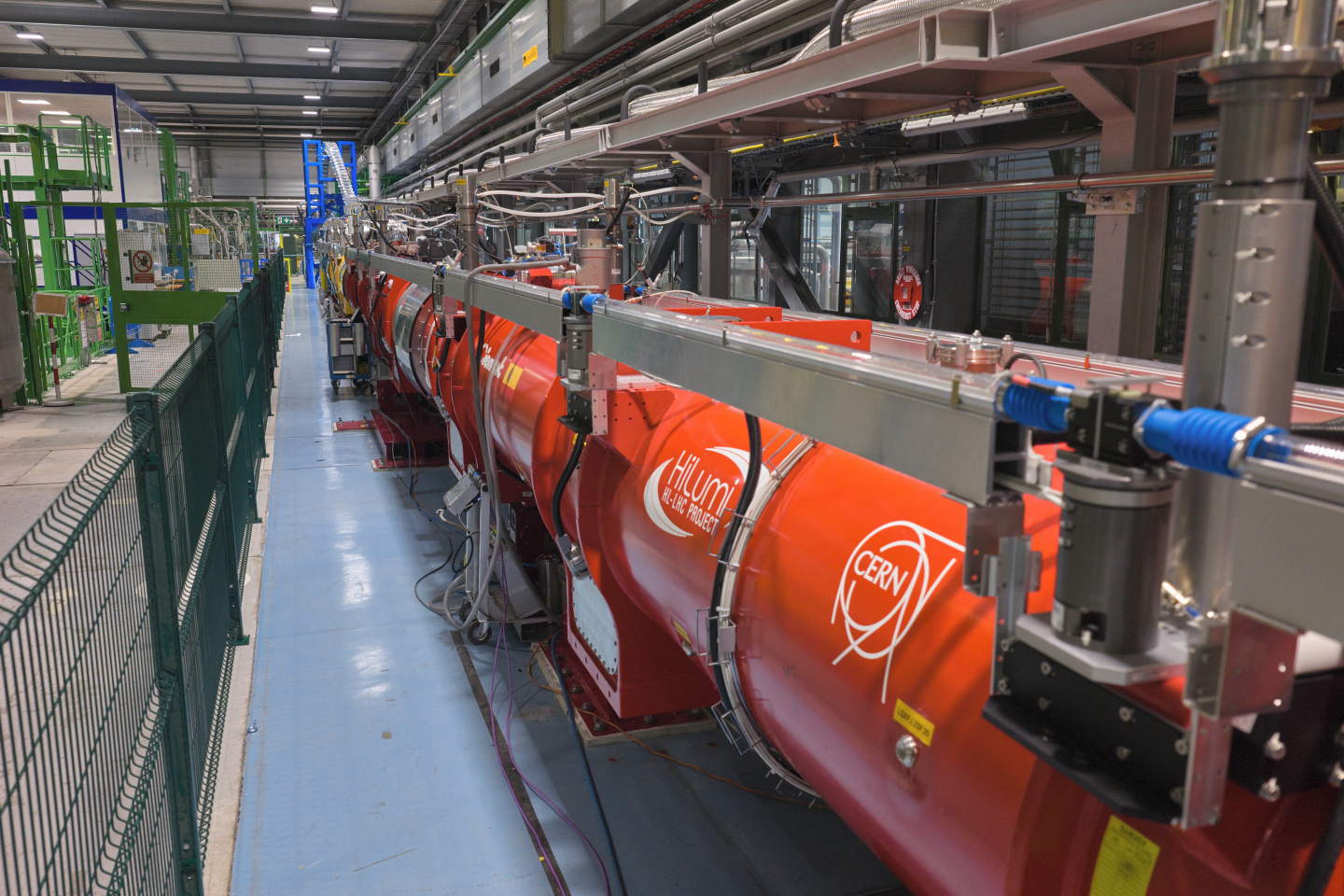
The test bench for the High-Luminosity LHC, the IT (Inner Triplet) String facility, has reached a major milestone. On 8 July, its new quadrupole magnets - known as the inner triplet magnets - successfully reached their nominal operating current of 16 230 amperes. Designed to focus the beams more tightly than ever before, thereby increasing the collision rate and the accelerator's luminosity, these magnets are key components of the High-Luminosity LHC, which is scheduled to begin operation in 2030.
The new magnets represent a significant step forward compared with the niobium-titanium inner triplet magnets currently installed in the LHC. They feature a much larger aperture, which has increased from 70 to 150 millimetres, and their niobium-tin superconducting coils allow them to operate at magnetic fields of 11.3 teslas, around 35% higher than those achieved by the current generation of magnets.
Another remarkable achievement is that the magnets reached their nominal current without experiencing any transition from the superconducting to the conducting state, a phenomenon known as a quench. This result confirms both the performance of the new technology and its ability to retain its training, or "memory".
Before a superconducting magnet can be put into operation, it normally undergoes a process known as training, which consists of gradually increasing the intensity of the current during successive powering cycles. In the early stages, the magnet typically experiences transitions from the superconducting to the conducting state, the so-called quenches. The initial quenches typically occur below the nominal current and are often triggered by small mechanical instabilities within the magnet. As the powering cycles are repeated, the coils and their support structure progressively accommodate the electromagnetic forces acting on the magnet, resulting in a more mechanically stable configuration and higher attainable currents. Magnet training is performed on individual magnets using dedicated test benches before installation in the accelerator. The ability of a magnet to retain its trained performance is referred to as its "memory".
"Good memory is a key performance requirement for accelerator magnets, as it minimises commissioning time, cryogenic consumption and operational delays", explains Susana Izquierdo Bermudez, who leads CERN's Large Magnet Facility, where the new superconducting magnets were developed and assembled.
All 17 electrical circuits of the IT String have now been successfully powered to their operating currents. The separation dipole - a magnet that will steer the two particle beams apart after they collide in the HiLumi LHC experiments - reached its nominal current after only a few training quenches, demonstrating excellent performance. The corrector magnet circuits also reached their target currents, both individually and in combined operation. These magnets are made of niobium-titanium, the same superconducting material used in the current LHC magnets.
The magnets are protected by a dedicated system designed to safely extract the energy stored in them if a problem occurs. During the test campaign, the protection systems performed as expected, safely extracting and dissipating up to 38 megajoules of stored magnetic energy into the helium bath that keeps the magnets at their operating temperature of 1.9 K (-271 °C).
"The successful powering of all circuits marked the completion of the IT String hardware commissioning phase," explains Samer Yammine, responsible for IT String operations. "The campaign generated a vast amount of data that we are now analysing to better understand how all the systems interact."
The ongoing analyses cover all major subsystems, including the superconducting magnets, cold powering system, power converters, quench detection and protection, cryogenics, vacuum, controls and alignment. The results will contribute to optimising the commissioning and future operation of the HL-LHC.
An additional series of dedicated tests will be carried out to further investigate superconducting circuits, machine cycles, electromagnetic coupling and alignment. The IT String will be then warmed up to room temperature, before being cooled down again in preparation for a new round of testing.
"This second operational campaign in September will primarily focus on validating the commissioning procedures and analysis tools, as well as demonstrating the reproducibility of the integrated system performance", concludes Marta Bajko, Head of the IT String facility. "We will test the systems under conditions close to those of the future HiLumi LHC."


