
Dyllan Furness, College of Marine Science
A new study led by researchers at the University of South Florida's College of Marine Science has found that certain populations of the seaweed sargassum have experienced a significant decline over the past decade. This was true even as an increased abundance of sargassum in the tropical Atlantic caused large mats of the seaweed to inundate beaches across the Caribbean and Gulf regions.
The abundance of sargassum in the Atlantic's north Sargasso Sea has plummeted since 2015, according to the paper published this week in Nature Geoscience. Sargassum from the Gulf, which annually supplies the Sargasso Sea, has also decreased substantially.
The findings point to ocean warming as a possible cause of the decline and suggest a dramatic shift in sargassum's distribution, which could affect the health of marine ecosystems.
"What is fascinating is that two opposite patterns occurred in the Atlantic Ocean," said Chuanmin Hu, professor of oceanography at the USF College of Marine Science and senior author of the study. "The tropical Atlantic has seen a significant increase in sargassum in the past decade, but at the same time the Sargasso Sea has a lot less sargassum than it used to."
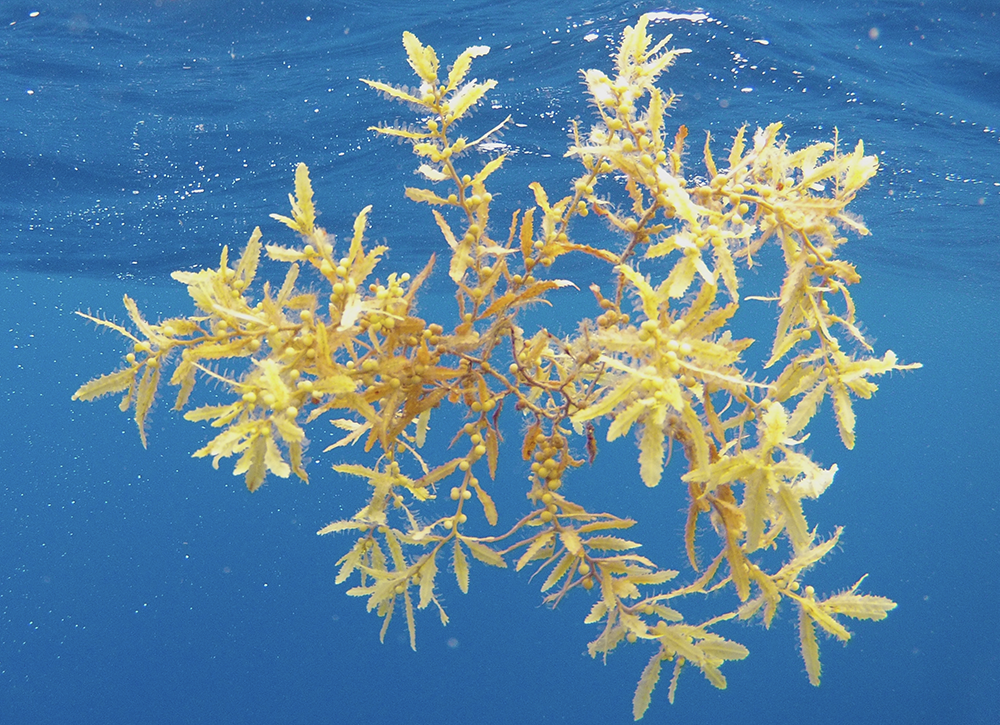
A floating clump of healthy Sargassum natans var. wingei, one of three common holopelagic morphotypes in the North Atlantic. Credit: Jeff Schell.
Much like rainforests, large floating mats of sargassum support high levels of biodiversity. They serve as an important habitat for turtles, crabs, shrimp, fish, and seabirds, some of which are specially adapted to inhabit the mats of seaweed.
However, once sargassum mats wash ashore and decay, they can emit a foul odor, harm marine life, and disrupt coastal communities. Cleanup efforts in the United States alone have cost businesses and governments millions of dollars annually.
Hu has used satellites to study sargassum since 2006 and spearheaded the discovery of the Great Atlantic Sargassum Belt in 2019. His Optical Oceanography Lab is a global leader in sargassum research, providing satellite imagery and monthly bulletins that inform stakeholders about sargassum biomass seen from space.


