
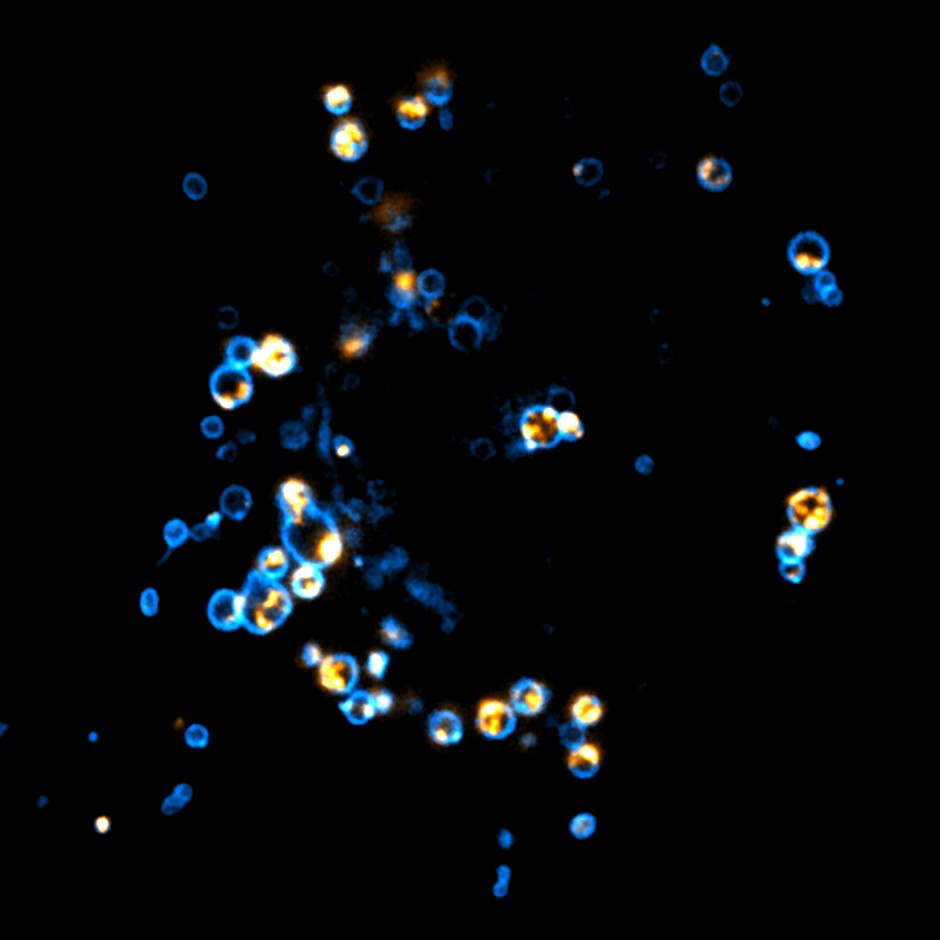
Researchers from the Department of Chemistry at The University of Hong Kong (HKU) and their collaborators have discovered a barrier that may prevent some promising nucleic acid medicines from reaching their targets inside subcellular compartments. Published in Nature Cell Biology, the findings could help guide the development of more effective drug delivery strategies.
The discovery involved tiny membrane-bound sacs inside cells called endolysosomes, which help process and break down material brought into the cell. Scientists have traditionally viewed their interior as a liquid-filled space, meaning that when the surrounding membrane is damaged, the contents should be able to enter the surrounding cellular fluid, known as the cytosol. However, the researchers found that when endolysosomes are damaged, their contents do not simply leak into the surrounding cellular fluid. Instead, selected proteins rapidly gather into dense, solid-like condensates, creating an additional barrier that can keep proteins and nucleic acid medicines trapped inside endolysosomes, even after the surrounding membrane has been breached.
This discovery is especially relevant to nucleic acid medicines, including antisense oligonucleotides (ASOs). ASOs are short, chemically modified strands designed to bind to specific RNA messages and change the production of selected proteins. To work effectively, ASOs must reach their targets in the cytosol or, in some cases, the cell's nucleus. However, most internalised ASOs remain trapped inside endolysosomes after entering cells.
Uncovering a Hidden Barrier to Drug Delivery
To understand why, the research team used advanced imaging techniques, including super-resolution live-cell imaging, electron microscopy and cryo-electron tomography, to examine what happens inside damaged endolysosomes. The researchers damaged endolysosomes in several ways, including chemical permeabilisation, osmotic stress and exposure to silica crystals.
The researchers then tracked fluorescent tracers and natural cellular cargoes (materials normally transported to endolysosomes) to observe how they responded to damage. They found that materials dispersed throughout the lumen (the internal space of an endolysosome) rapidly gathered into bright foci, and selected luminal proteins formed dense, insoluble assemblies. This response was observed following different types of damage and in different cell types, suggesting it may be a general response to endolysosomal stress.
The team then investigated whether condensates could explain why therapeutic ASOs remain trapped inside leaky endolysosomes. They found that making the membranes more permeable increased ASO activity. However, super-resolution microscopy showed that most of the ASO signal remained inside the endolysosomes. Advanced imaging further showed that the ASOs inside these damaged endolysosomes were effectively immobilised, supporting the idea that condensates were holding them in place.
Together, these findings suggest that damaging the membrane of an endolysosome is not enough to allow ASOs to escape. Even when the membrane becomes permeable, the medicines can remain trapped in the condensates that form inside. This means that ASOs face two barriers: the surrounding membrane and the dense internal structures that hold them in place.
This finding points to a new direction for drug development. Future strategies could aim to reduce the tendency of ASOs to become trapped in condensates or help them bypass or escape from these structures. Such approaches may improve productive delivery and reduce the amount of drug needed.
The study's corresponding author, Professor Haibo JIANG from the HKU Department of Chemistry, said: "Our study shows that a damaged endolysosome is not simply an open container. Its changing internal environment can reorganise its contents and hold on to therapeutic molecules. Understanding this hidden barrier may help us design more effective nucleic acid medicines."
For details of the research, please refer to the journal paper "Endolysosomal damage promotes intraluminal protein condensate formation that limits cytosolic leakage", published in Nature Cell Biology.
About the Research Team:
The study was conducted by researchers from The University of Hong Kong (HKU), Ionis Pharmaceuticals, the University of California, Los Angeles, and the Francis Crick Institute. Xu LI, a PhD student in the HKU Department of Chemistry, is the first author. The corresponding authors are Professor Haibo JIANG from the HKU Department of Chemistry, Professor Tao NI from the HKU School of Biomedical Sciences, LKS Faculty of Medicine, and Dr Maximiliano G. Gutierrez from the Francis Crick Institute. Professor Xiaoyu LI, from the HKU Department of Chemistry, is also among the authors.
The research was supported by the Hong Kong Research Grants Council General Research Fund, the National Natural Science Foundation of China, the Laboratory for Synthetic Chemistry and Chemical Biology under the Health@InnoHK programme, and the Francis Crick Institute's funding. The work was conducted at the JC STEM Lab of Molecular Imaging, funded by The Hong Kong Jockey Club Charities Trust.


