
An international team of astronomers, including researchers from the Department of Physics and the Hong Kong Institute for Astronomy and Astrophysics (HKIAA) at The University of Hong Kong (HKU), has discovered a previously hidden phase of high-energy activity following the merger of compact stars.
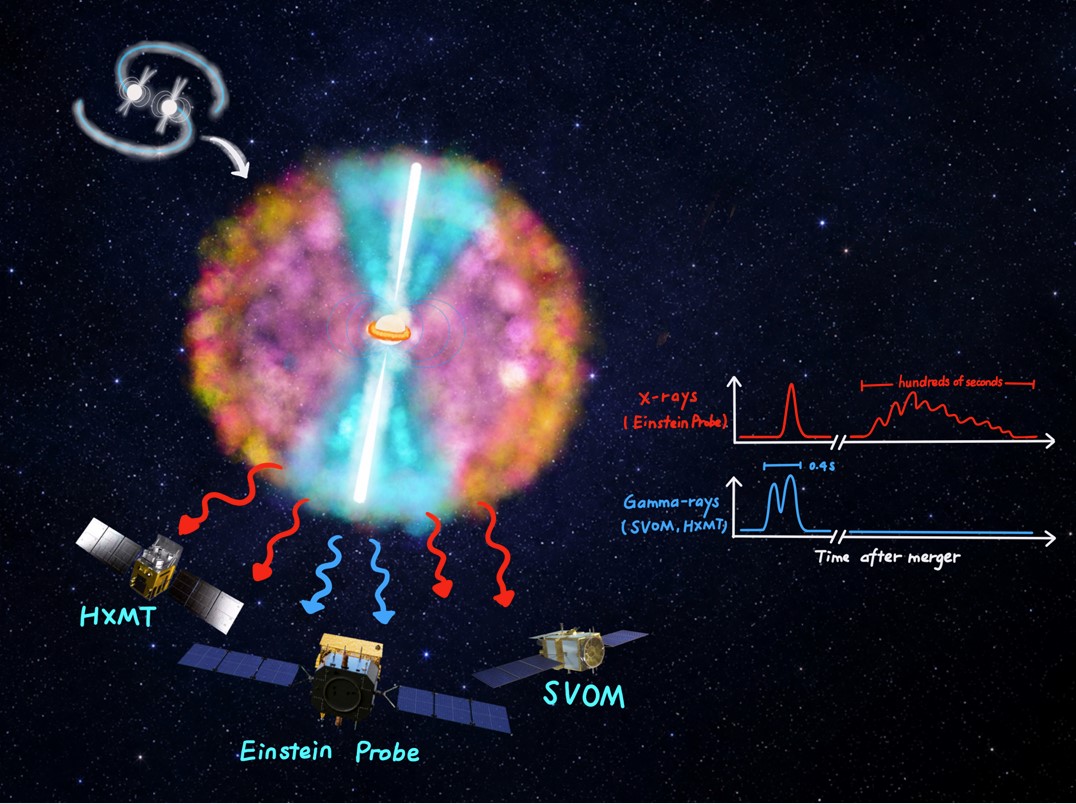
This fleeting cosmic explosion, known as EP250704a in X-rays and GRB 250704B in gamma rays, was jointly captured by the China-led Einstein Probe (EP), the Space Variable Objects Monitor (SVOM) and Insight-Hard X-ray Modulation Telescope (HXMT).
EP's wide-field X-ray telescope detected the event from its onset and continued to observe several episodes of soft X-ray emission after the gamma-ray signal disappeared. While the gamma-ray burst lasted only about 0.4 seconds, the source continued to shine in soft X-rays for nearly ten minutes, revealing a phase of activity that conventional gamma-ray observations would likely have missed. These findings have been published as a cover article in Science Bulletin.
How Einstein Probe Revealed the Hidden X-ray Phase
Short gamma-ray bursts are commonly associated with the merger of compact objects such as neutron stars. As the two objects spiral together and collide, they release an intense burst of high-energy radiation. Traditionally, astronomers have identified these events mainly through gamma rays. Most X-ray telescopes can only turn to a burst after a gamma-ray detector has first located it, meaning the earliest X-ray emission may already be over by the time observations begin.
Einstein Probe changes this picture by continuously monitoring a wide area of the sky at soft X-ray energies. In this case, it revealed that what appeared to be a brief gamma-ray event was accompanied by much longer-lasting X-ray activity.
Yi-Han Iris Yin, a PhD student at HKU Department of Physics and the Hong Kong Institute for Astronomy and Astrophysics (HKIAA), is a co-corresponding author of the study. She led the analysis of the high-energy prompt emission and contributed to the physical interpretation of the event.
Yin's analysis of the X-ray signal revealed key insights into the merger's aftermath:
The source remained active long after the gamma-ray burst. The soft X-ray emission continued for nearly ten minutes after the brief gamma-ray flash.
The X-rays point to continued central engine activity. Their rapid variability and changing spectrum indicate that the central engine created by the merger continued to release energy.
The remnant may be a magnetar. One possible explanation is a rapidly rotating, highly magnetised neutron star that continued to power the X-ray emission.
Similar X-ray activity may have been missed before. This suggests prolonged soft X-ray emission could be more common in compact-object mergers than previously recognised and may provide another way to study gravitational-wave sources.
Working with an international team led by An LI of Beijing Normal University (BNU) and Professor Bin-Bin ZHANG of Nanjing University (NJU), the researchers found that similar soft X-ray emission may have been present in previous short gamma-ray bursts but remained undetected because it was too soft and faint for conventional gamma-ray instruments.
"Einstein Probe is allowing us to uncover a part of compact star mergers that was hidden from previous gamma-ray observations," said Yin. "The short gamma-ray flash may represent only the beginning of the high-energy activity. By observing the Universe at soft X-ray energies, we can now follow these systems for much longer and obtain a more complete view of what happens during and after the merger."
Fostering Young Scientific Leadership
Professor Bing ZHANG, Founding Director of HKIAA and Chair of Astrophysics at HKU Department of Physics, co-authored the study and contributed to the physical interpretation of the event. He has long proposed that binary neutron star mergers could produce fast X-ray transients detectable by missions such as Einstein Probe. Beyond the scientific findings, Professor Zhang highlighted the significance of the study in nurturing young researchers and strengthening international collaboration.
"One of our goals at HKIAA is to create an environment where talented young researchers can take on scientific leadership and work at the forefront of international astronomy," Professor Zhang said. "It is particularly encouraging to see our PhD student Yi-Han Iris Yin taking a leading role as one of the corresponding authors in this international collaboration. Her contribution reflects the quality and potential of the young researchers we are training at HKIAA, and this collaboration also demonstrates how Hong Kong can connect with major scientific facilities and research teams in mainland China and around the world."
International Collaboration
The study brought together researchers from HKU, Nanjing University, the University of Rome "Tor Vergata", the National Astronomical Observatories of the Chinese Academy of Sciences (NAOC), the Institute of High Energy Physics of the Chinese Academy of Sciences, and many other institutions worldwide.
The co-first authors include BNU's An Li and colleagues from the Institute of High Energy Physics, the University of Rome "Sapienza", and the University of Chinese Academy of Sciences. The corresponding authors include NJU's Professor Bin-Bin Zhang, Professor Eleonora Troja from the University of Rome "Tor Vergata", HKU's PhD student Yi-Han Iris Yin, and colleagues from NAOC.
About the Missions
Einstein Probe (EP)
Einstein Probe is a space mission led by the Chinese Academy of Sciences (CAS), with international partners including the European Space Agency (ESA), the Max Planck Institute for Extraterrestrial Physics (MPE) in Germany, and the French National Centre for Space Studies (CNES).
Space Variable Objects Monitor (SVOM)
SVOM is a China-France joint mission led by the China National Space Administration (CNSA), CNES and CAS. It observes gamma-ray bursts and other transient phenomena in the high-energy Universe.
Insight-HXMT
Insight-HXMT is China's first space X-ray telescope and was jointly funded by CNSA and CAS.
For details, please refer to the journal paper "Minutes-long soft X-ray prompt emission from a compact object merger" published in Science Bulletin.


