
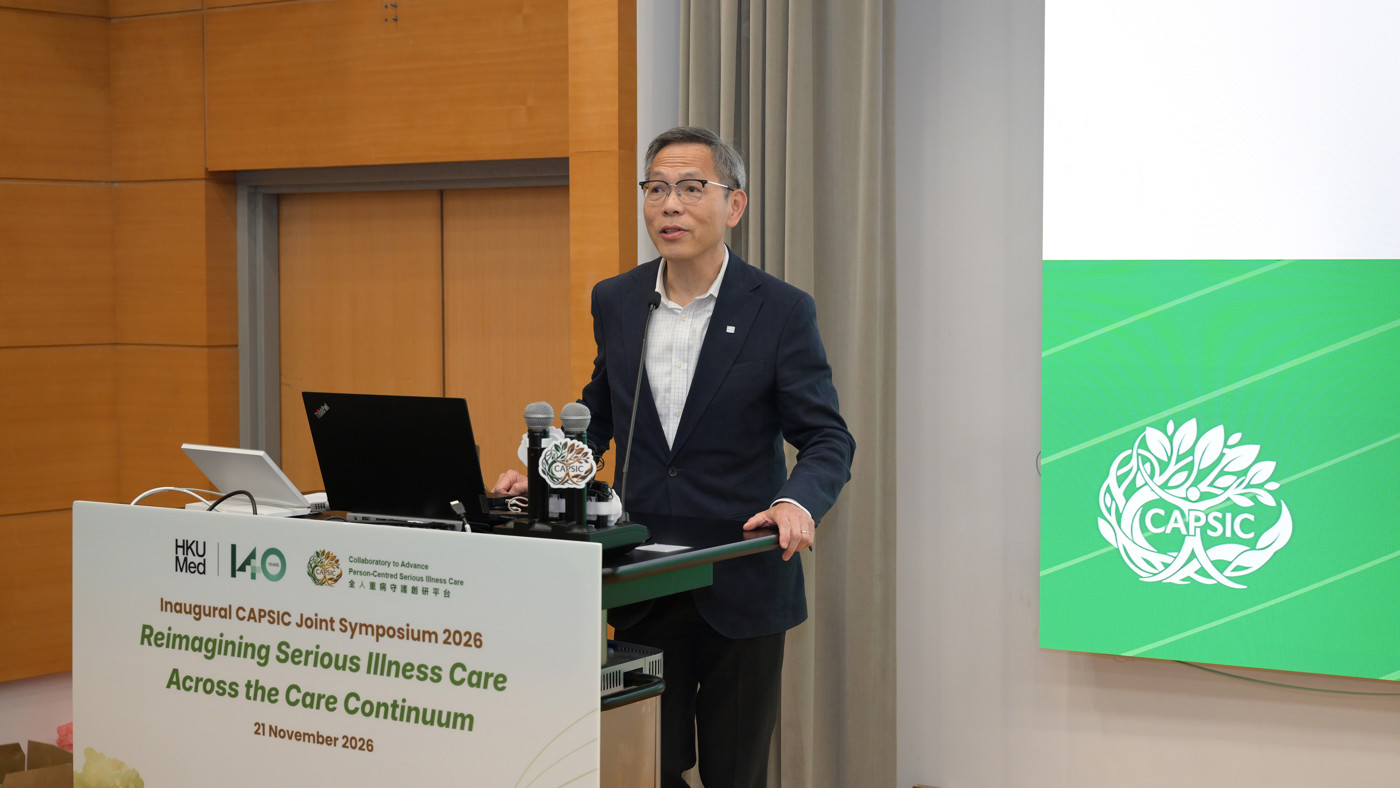
The LKS Faculty of Medicine of the University of Hong Kong (HKUMed) held the inaugural joint symposium of its newly established interdisciplinary platform, the Collaboratory to Advance Person-Centred Serious Illness Care (CAPSIC), on 21 November 2026. Themed 'Reimagining Serious Illness Care Across the Care Continuum', the event brought together international and local experts and professionals from diverse sectors to explore how Hong Kong can respond to the complex needs of seriously ill patients amid an ageing population, while promoting integrated care that connects hospitals, community services and home-based care to better support patients, families and carers.
The officiating ceremony was led by Professor Chak-sing Lau, Vice-President and Pro-Vice-Chancellor (Health) and Dean of Medicine at HKU. Distinguished guests included The Honourable Grace Chan Man-yee, Legislative Council Member (Social Welfare Functional Constituency); Dr Donald Li Kwok-tung, Chairman of the Elderly Commission; Dr Pang Fei-chau, Commissioner for Primary Healthcare, Health Bureau, the Government of the HKSAR; and Dr Maria Leung Kwan-wa, Chief Manager (Primary and Community Services) of the Hospital Authority. Also attending were Dr Jacqueline Yuen Kwan-yuk, Clinical Assistant Professor, Department of Medicine, School of Clinical Medicine and School of Public Health, HKUMed, and Lead Convenor of CAPSIC; and leaders from the co-organising professional bodies, namely the Hong Kong College of Family Physicians, the Hong Kong Geriatrics Society, and the Hong Kong Society of Palliative Medicine.
In his opening address, Professor Chak-sing Lau stressed that amid rapid technological advances and the increasing use of artificial intelligence, the future of medicine must remain anchored in humanity. Achieving this requires cultivating visionary leadership across all levels of medical research and education. The inaugural CAPSIC joint symposium serves as a forum for this mission, bringing together diverse stakeholders to exchange insights and collaborate on advancing person-centred serious illness care.
The opening session also brought patients' voices to the fore, featuring Mr Bill Wang, Immediate Past Chair of the Patient Liaison Advisory Group, International Society of Nephrology. He emphasised that building a health system that all patients can trust should be a shared priority: 'We built the architecture for safety. We have not yet built it for trust. The missing metric is not a number - it is the capacity to trust patients as experts in their own experience.'
Shifting from hospital-centric disease treatment to community-based holistic care
Professor Diane E Meier, Founder of the Center to Advance Palliative Care in the US, noted that healthcare systems oriented primarily around acute care and hospitalisation fail to address the long-term care needs of a growing population of older adults and patients with chronic or serious illnesses. Building truly person-centred services requires starting from the practical needs of patients and their families, re-examining resource allocation, and strengthening community care.
Professor Sean Morrison, Director of the National Palliative Care Research Center and Chair of the Department of Geriatrics and Palliative Medicine at the Icahn School of Medicine at Mount Sinai in the US, emphasised the value of geriatrics and palliative care from the perspectives of care outcomes and healthcare systems. He pointed out that palliative care helps improve the quality of life for both patients and their families while reducing healthcare costs. He also explored how palliative care can be scaled up and integrated into existing healthcare services to meet the needs of a super-aged society.
Dr Mervyn Koh, Chairman of the Division of Integrative and Community Care at Tan Tock Seng Hospital in Singapore, shared Singapore's experience in formulating and implementing its national palliative care strategy, outlining the challenges and lessons learnt during policy implementation. He noted that Singapore is rolling out initiatives to enable more patients to receive care in accordance with their personal values and preferences, including spending their last days in the comfort of their homes. This approach also reduces unwanted hospital transfers and associated healthcare costs.
Dr Lam Wai-man, Chairman of the Ethics and Policy Subcommittee of the Hong Kong Society of Palliative Medicine, reviewed the development of serious illness care in Hong Kong from the perspective of a senior palliative medicine specialist. As the population continues to age and care demands increase, he called on the Government to implement policies that strengthen coordination and unite stakeholders across the healthcare, social welfare, academic and community sectors to jointly advance more comprehensive serious illness care.
The symposium also featured a cross-sectoral panel discussion integrating perspectives from clinical care, social work, and elderly policies to explore the future direction of serious illness care in Hong Kong, as well as concrete strategies to foster interprofessional and inter-institutional collaboration. Participants noted that realising person-centred serious illness care requires not only policy alignment and public resource support, but also a broader societal and cultural shift that prioritises the development of primary healthcare and community services beyond hospital walls.
About the Collaboratory to Advance Person-Centred Serious Illness Care (CAPSIC)
CAPSIC is an interdisciplinary research and innovation platform within HKUMed. Established in response to the critical care gaps in Hong Kong's super-aged society, CAPSIC aims to advance serious illness care through impactful research and by translating evidence into training, practice and policy.


