
From North America to Patagonia: Researchers at the University of Würzburg have reconstructed how New World blackbirds spread across the Americas over millions of years.
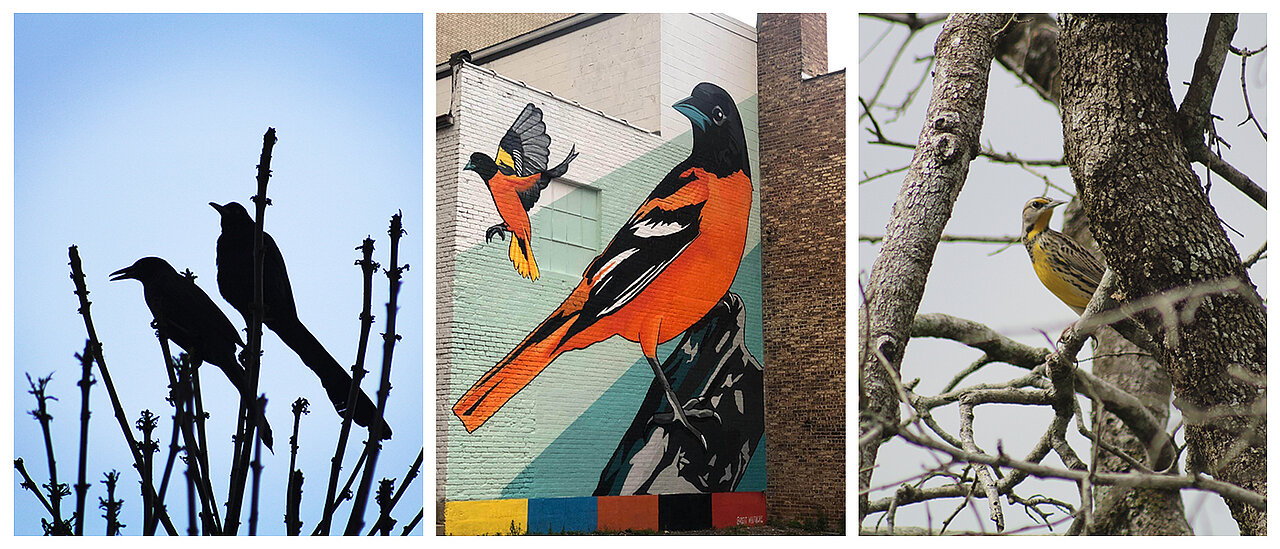
Where did the roughly 100 species of New World blackbirds alive today originate, and how did they spread across the Americas? Dr. Axel Arango Garcia and Professor Chaitanya S. Gokhale from the Chair for Computational and Theoretical Biology (CCTB) at Julius-Maximilians-Universität Würzburg (JMU) have reconstructed the evolutionary history of this family of birds. Their findings show that the ancestors of today's species most likely originated in North America and gradually spread southwards over millions of years. The study has been published in the journal Frontiers of Biogeography.
The New World blackbirds - scientifically known as "Icteridae" - are a family of more than a hundred species of songbirds that can be found from Alaska to Tierra de Fuego. Famous members include orioles, grackles and cowbirds, and together they occupy nearly every habitat in the Americas, from the Arctic taiga to the tropical rainforest.
Despite a rich history of ecological, behavioural, and evolutionary studies, the origin of icterids and their biogeographic history has been debated for decades. In 1946, ornithologist Ernst Mayr proposed that icterids originated in South America and spread north in a stepwise manner. In 2015, a study by Barker et al. challenged this hypothesis though. Pointing instead to a North American origin. However, the study left open how and when the birds later spread across the Americas.
Step by step southwards
For their study, the researchers combined distribution data and evolutionary trees for 104 of the 106 currently recognised species. Using a range of statistical models, they reconstructed when and by which routes their ancestors spread across the Americas.
The scenario that best fits the data is one of stepwise southward colonisation: around 7.5 million years ago, the birds reached Mesoamerica and the Caribbean, followed by Amazonia around 6.1 million years ago and the Andes shortly afterwards. Southern South America followed around 4.8 million years ago, with Patagonia reached around 2.7 million years ago. These dates closely reflect the sequence reconstructed in the original study.
"Our findings trace the spread of New World blackbirds across the Americas as a long, gradual process. What is particularly interesting is that their ancestors appear to have reached South America before the present-day Isthmus of Panama had fully formed," says Arango Garcia.
In South America earlier than previously thought
According to the model, the first dispersal into South America occurred around six million years ago - roughly three million years earlier than previous studies had suggested for this group of birds.
At that time, the present-day Isthmus of Panama had not yet fully formed. The birds may therefore have reached South America by crossing stretches of open water or via existing islands and land connections. At around the same time, open, grass-dominated habitats were expanding in South America. The scientific paper similarly discusses overwater dispersal or pre- or proto-isthmian land connections as possible routes.
"The spread of icterids into South America seem to coincide with the expansion of open, grass-dominated habitats there. It is therefore possible that the birds followed these suitable habitats southwards," says Axel Arango.
The study cannot, however, demonstrate that these environmental changes actually caused the birds' southward expansion.
New species mainly evolved locally
The analysis also shows that the colonisation of new regions alone does not explain why new species evolved. Instead, many species arose within regions that had already been colonised. The calculated rates of speciation were broadly similar in North and South America.
Which factors influenced the emergence of new species remains an open question. The authors point, for example, to specialisation in particular foods and habitats, social behaviour, or mate choice. Future studies could incorporate such traits directly into the models, allowing researchers to investigate more precisely why some evolutionary lineages produced more new species than others. This reflects the paper's conclusion that factors other than geography - potentially including ecological specialisation, social behaviour, and sexual selection - are likely to play an important role in diversification.
Rooted in the classroom
This project has roots in the classroom. Arango has used Icteridae for years as a teaching example. In his classes, icterids have been the protagonists to illustrate macroecological rules, walk students through phylogenetic data analysis, and show how to manage phylogenetic information. The analysis behind this paper took shape while the researcher was preparing course material for a workshop on parametric biogeography, funded by a grant from the "Bayerische Hochschulzentrum für Lateinamerika" (BAYLAT) .
"Even after years of working with icterids, it was still striking to discover that their lineages reached South America long before the land bridge closed, and to trace the exact dispersal routes they used to spread all the way to Tierra del Fuego," says Axel Arango.
Original publication
Arango, Axel & Gokhale, Chaitanya S. (2026): The historical biogeography of the New World blackbirds (Icteridae). Frontiers of Biogeography 19, e202331. DOI: 10.21425/fob.19.202331


