
A California field experiment shows why targeting high water users with the right incentives outperforms years of public messaging.
When Kristina Brecko arrived at Stanford University in the fall of 2012 to start her PhD, she was already scanning the weather forecast-not for rainfall, but for snow. An avid snowboarder, she and her graduate study advisor, Wesley Hartmann, a skier, were eager to get into the mountains.
There would be no great skiing that winter. California was entering what would become one of the most severe droughts in its history.
"I liked to snowboard," Brecko says. "And so it was very salient that there really wasn't any good snow that year."
The drought, which stretched from 2012 to 2017, transformed daily life across the state. Cities pleaded with residents to conserve water and let lawns go brown, rip out grass, stop watering altogether. Billboards and public campaigns urged restraint. Many complied. But some of the state's heaviest water users, often homeowners with sprawling green lawns, did not.
For Brecko, now an assistant professor of marketing at the University of Rochester's Simon Business School, the disconnect raised a question that would shape years of research. California was awash in public opinion messaging. Was any of it effective?
"There was a lot of messaging happening, telling people to reduce their water usage," she recalls. "And I had these question-it's all marketing, but is it working? What exactly is working and for whom?"
Rather than focusing on the people who had already embraced conservation-those willing to let their lawns die or remove them entirely-Brecko and Hartmann became interested in the holdouts-that is, the households with the highest water consumption. Their findings, published in the Journal of Marketing Research, argue that those households should not be shamed or ignored. Instead, they should be targeted.
Harm reduction over abstinence
The study borrows a concept from public health: the idea of harm reduction. Instead of demanding abstinence-no drugs, no cigarettes, no lawns-the approach aims to reduce damage among people unlikely to completely quit a harmful action.
In California's drought-stricken suburbs, the harm was outdoor irrigation. The tool was a smart irrigation controller, a device that automatically adjusts watering schedules based on weather, soil conditions, and plant needs. The question was whether such a device could significantly reduce water use without undermining more aggressive conservation efforts, like turf removal.
"There're always going to be people who are just not going to do it," Brecko says, referring to lawn removal. "Because it goes totally against their preferences."
Working with Redwood City Public Works, the researchers tested whether offering irrigation controllers (at either steep discounts or for free) could change behavior among residents who wanted to keep their lawns green. Crucially, the study took place toward the end of the drought, after years of aggressive messaging and rebates for turf removal had already circulated.
"By the time we ran our study, people had had the chance to adopt the most effective solution-at least those people who would do it," Brecko explains.
That timing mattered. Those most committed to conservation had already removed their turf. That meant the researchers could now focus on everyone else.
Field tests in thirsty times
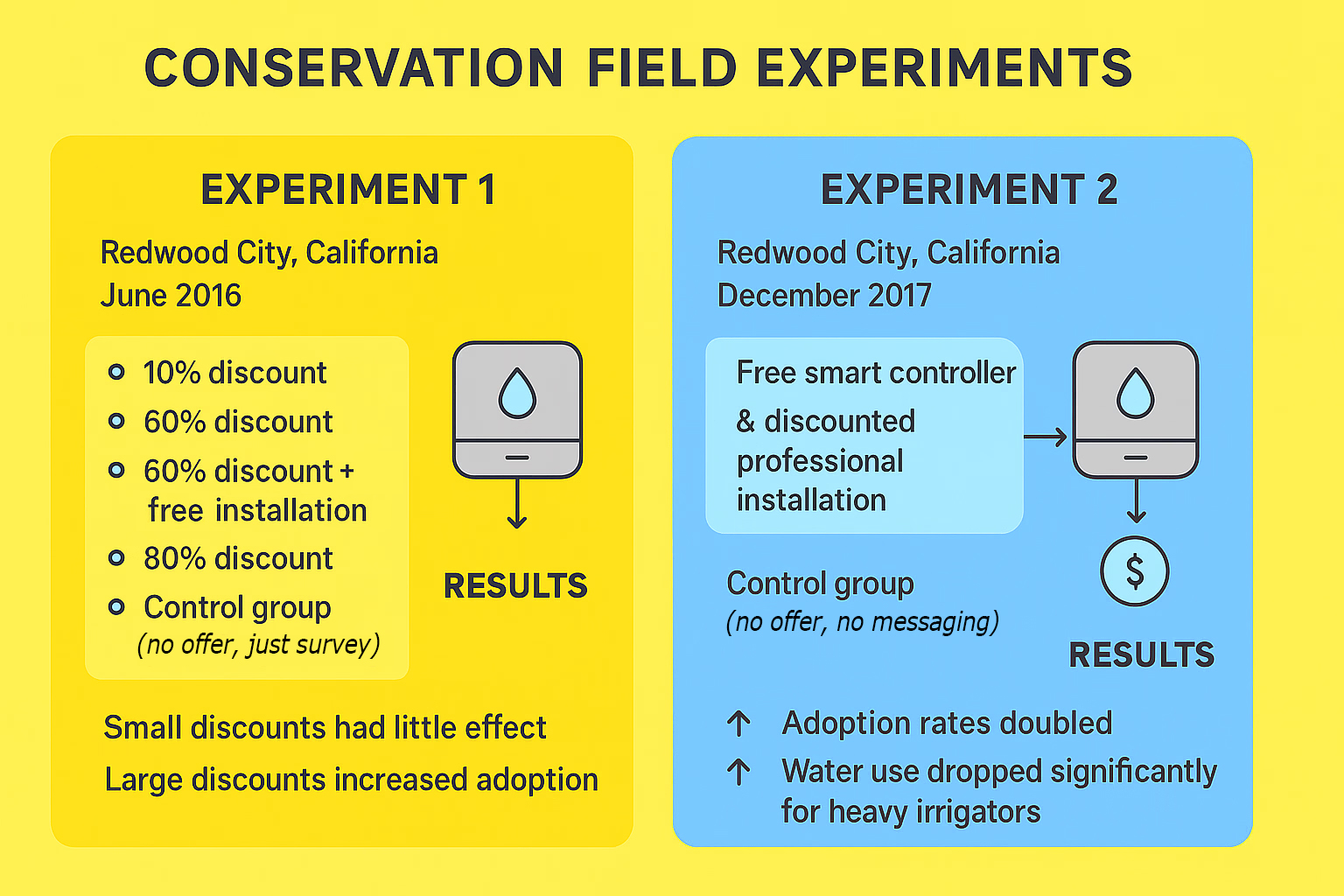
The team ran two large-scale field experiments in Redwood City. In 2016, roughly 7,000 households were offered discounts on smart irrigation controllers, ranging from 10 percent to 80 percent. Some homeowners were also offered free professional installation.
Adoption was slower than expected.
"I think people just weren't sure," Brecko says. "The device was relatively new, and even the utility company wasn't sure what effect it would have on water usage."
The second experiment, in 2017, scaled up dramatically. About 19,000 households were randomly assigned to receive a free smart irrigation device, available in limited quantities. The process was designed to be as easy as possible: Residents received emails and accessed a dedicated online portal where discounts were applied instantly-no rebates, no paperwork.
The response was swift. Clearly, price and convenience mattered. Messaging alone did not. "Incremental discounts aren't really going to do the trick," Brecko notes. "We learned that we needed to overcome some barriers to adoption."
Who adopted-and who saved
The devices appealed most to people who used the most water, with heavy irrigators adopting the device at the highest rates.
"It allows you to keep the green lawn that you care about." Brecko says, "But it might allow you to also contribute to that social goal that we care about."
Once installed, the controllers delivered substantial and lasting savings. Water use dropped by about 26 percent (from a regular irrigation baseline) during shoulder seasons-early spring and fall-when manual systems often overwater because homeowners forget to adjust them. The reductions persisted for nearly four years, the researchers found.
Among the heaviest irrigators, the water savings were large enough to offset the typical $250 cost of the device in roughly six months. The conserved water alone could cover a household's annual indoor needs. But just as important, the study found no evidence that smart controllers undermined more aggressive conservation.
"We don't see any difference in turf removal rates," Brecko says. "And we see no increases in consumption among non-irrigator households."
In other words, harm reduction did not "cannibalize abstinence," the duo writes.
A middle road for climate behavior
For policymakers, the findings challenge the all-or-nothing approach that often dominates environmental messaging. The most effective solution-to simply rip out the lawn-will never appeal to everyone.
"My initial inclination is to say everyone should do the thing that's most powerful," Brecko says. "But the thing is, we all have really different preferences."
While some people care deeply about conservation, others may have competing priorities and care more about their yard's aesthetics, their kids' being able to play on grass, or the curb appeal of their home. Stigmatizing the latter group or ignoring their strong preferences, can leave them unnecessarily out of conservation efforts.
"Not that those high users don't care about conservation, it's just that they might care about something else more," says Brecko. "If you don't engage them, they might do nothing."
The lesson, she argues, is not to abandon high-impact solutions, but to sequence and supplement them. If you want people who use the most water to conserve, you may have to let them keep what they love, while reducing the shared costs of doing so.
"They get the thing that they care about," Brecko says. "And you, as the conservation-oriented person, get the conservation, too."


