
A hybrid photocatalyst system from Science Tokyo tackles an overlooked flaw in artificial photosynthesis to dramatically improve CO2-to-formate conversion. Unlike conventional designs where light degrades the molecular catalyst, the new system selectively excites the semiconductor and transfers electrons to the catalytic site. By preventing light-induced damage, it raises efficiency to 27.7%, a leap that could help turn CO2 into valuable chemicals for a carbon-neutral society.
Stabilizing Photocatalyst System to Enable Highly Efficient Artificial Photosynthesis from CO2
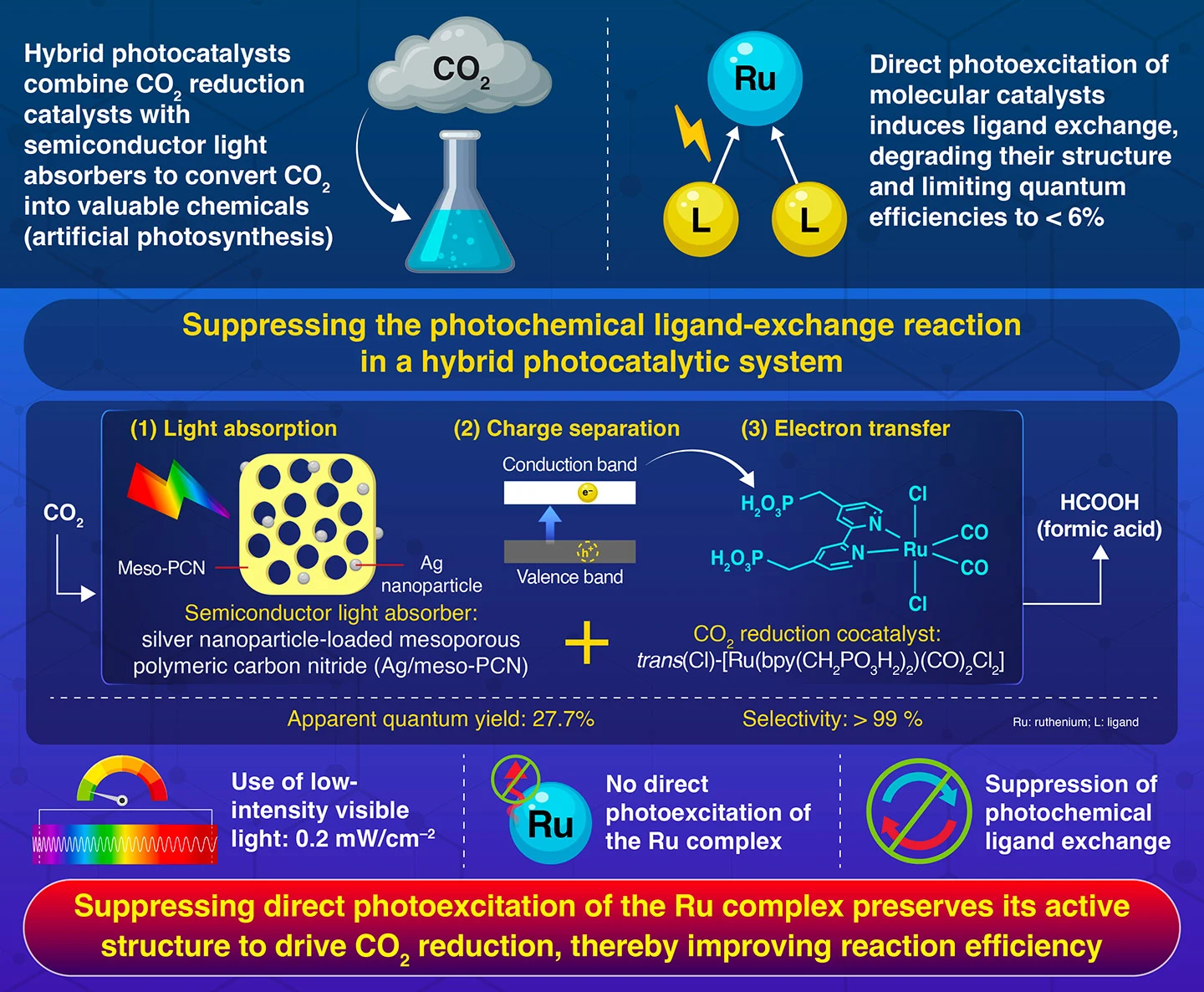
Just as plants use sunlight to transform CO2 into chemical energy in photosynthesis, scientists are developing technologies that can make useful chemicals in the same way. Termed artificial photosynthesis, the approach uses hybrid photocatalysts that pair highly selective molecular catalysts designed to target specific reactions with light-absorbing semiconductor materials.
Hybrid photocatalyst designs based on ruthenium (Ru) complexes attached to visible-light-absorbing semiconductors have been widely studied. However, the apparent quantum yield, a measure of how efficiently photons are converted into chemical products, has often remained below about 6%. A key reason is that the molecular catalyst can lose its original structure when it absorbs light, due to side reactions within the Ru complex.
Against this backdrop, researchers from Institute of Science Tokyo (Science Tokyo), Japan, have now achieved the conversion of CO2 to formate (HCOOH)-a valuable chemical that can serve as a hydrogen storage medium-with a quantum yield of about 28% by suppressing an undesirable photochemical reaction in the Ru complex. The study was led by Professor Kazuhiko Maeda and graduate student Ryuichi Nakada of the Department of Chemistry, Science Tokyo, and published online on February 5, 2026, in the Journal of the American Chemical Society.
"These results reveal an unrecognized limitation in molecule/semiconductor hybrid photocatalysts, specifically photochemical ligand exchange of the molecular cocatalyst, and demonstrate that controlling such side reactions offers an important strategy to design high-efficiency CO2reduction systems," says Maeda.
When the Ru catalyst absorbs light directly, it can undergo photoinduced ligand exchange, a process in which ligands attached to the metal center detach and are replaced by others. These alterations disrupt the catalyst's structure and significantly weaken its ability to convert CO2 to valuable products.
To address this, the team designed a system where an Ru complex is fixed onto a silver nanoparticle-loaded carbon nitride semiconductor. By carefully controlling the surface density of the Ru complex and using a low light intensity of 0.2 mW cm-2, they ensured that the semiconductor absorbed most of the photons. The photogenerated electrons were then transferred to the Ru center, where CO2 reduction took place. The addition of the silver nanoparticles suppresses the trapping of electrons within the semiconductor, allowing them to move more readily to the surface-bound Ru catalyst.
The researchers compared two Ru complexes, trans(Cl)-[Ru(bpyX2)(CO)2Cl2] , where bpyX2 is a 2,2'-bipyridine with substituents in the 4-position: RuP (X = PO3H2) and RuCP (X = CH2PO3H2).
In both systems, formic acid was the main product, while small amounts of hydrogen and traces of carbon monoxide were sometimes observed. However, RuCP outperformed RuP. Under optimized conditions, RuCP achieved an apparent quantum yield of 27.7% for formic acid formation at a wavelength of 400 nanometers, with formate selectivity greater than 99%, compared with 7.5% for RuP. Infrared spectroscopy helped explain the difference, revealing that RuCP retained its original catalytic structure much longer under light exposure, and therefore, remained active for CO2 reduction.
The findings suggest that building better hybrid photocatalysts requires ensuring that light does not unintentionally damage the molecular catalyst. "Rational selection of semiconductor materials with strong absorption in a wide visible light wavelength range and careful control of device architecture can prevent unwanted photochemical degradation of molecular catalysts and unlock their full potential in solar-to-chemical energy conversion," says Maeda.
Since Ru complexes are widely used in many photocatalytic and photoelectrochemical platforms, this insight could lead to much more efficient catalysts that could help us reach a carbon-neutral future.
Reference
- Authors:
- Ryuichi Nakada1, Rikuya Nagao2, Jo Onodera1, Xian Zhang1, Masahito Oura2, Megumi Okazaki1, Toshiya Tanaka1, Riku Koda1, Minato Tanaka1, Ken Onda2, and Kazuhiko Maeda1,3*
*Corresponding author
- Title:
- Elucidating the Origin of Hidden Limitations in Ru-Complex/Ag/Polymeric Carbon Nitride Hybrid Photocatalysts for Visible-Light CO2 Reduction
- Journal:
- Journal of the American Chemical Society, 2026, 148, 10, 10924-10933
- DOI:
- 10.1021/jacs.5c21374
- Affiliations:
- 1Department of Chemistry, Institute of Science Tokyo, Japan
2Department of Chemistry, Kyushu University, Japan
3Research Center for Autonomous Systems Materialogy (ASMat), Institute of Science Tokyo, Japan


