
Researchers at UC Davis School of Medicine have uncovered how an imbalanced gut microbiome escalates the production of metabolic byproducts by certain gut bacteria. This imbalance drives a feedback loop that worsens chronic kidney disease (CKD) in mice. The scientists identified an investigational drug that might break the destructive cycle. The findings were published in Science.
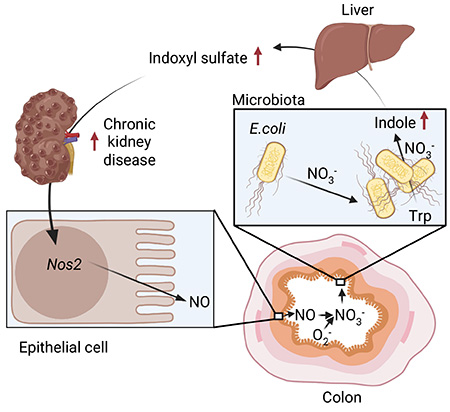
The team showed that kidney impairment increased nitrate levels in the colon. The nitrates turbocharged Escherichia coli's (E. coli) production of indole, an organic compound that turns into a harmful waste product — indoxyl sulfate — that further damages the kidneys.
Blocking the production of a single enzyme in the gut — inducible nitric oxide synthase (iNOS) — was capable of stopping this destructive cycle.

"Previous research has shown that chronic kidney disease is linked to an elevated fecal abundance of Enterobacteriaceae," said Jee-Yon Lee, first author of the study and a project scientist in the Department of Medical Microbiology and Immunology.
Enterobacteriaceae is a large family of bacteria that includes both harmless and pathogenic species.
"This study identifies nitrate from the host as a switch that turns common gut bacteria like E. coli into indole producers capable of accelerating chronic kidney disease," Lee said.
CKD affects about 1 in 7 adults in U.S.
Chronic kidney disease, which is a gradual loss of kidney function, affects about 1 in 7 adults in the U.S., or an estimated 35.5 million Americans. About 1 in 3 people with diabetes and 1 in 5 people with high blood pressure have kidney disease. Globally, about 788 million people were estimated to have CKD in 2023.
For people with kidney failure, hemodialysis is a life-saving procedure that removes waste and extra fluids from the blood. But indoxyl sulfate cannot be removed by dialysis because it binds to serum albumin, a common protein in the blood. Higher serum indoxyl sulfate levels are associated with more severe chronic kidney disease.
"By identifying the driver responsible for an increase of Enterobacteriaceae during chronic kidney disease, and by demonstrating the importance of these bacteria for indole production and disease progression, our research points to iNOS as a potential target for intervention strategies," said Andreas Bäumler, distinguished professor in the Department of Medical Microbiology and Immunology, and senior author of the paper.
Methods and possible therapy
The researchers tested specific strains of E. coli in mice. They also tested fecal samples from people with and without CKD.
In mice, they found:
- Kidney dysfunction caused an increased transcription of Nos2 (the gene responsible for creating iNOS) in the colon's mucous layer.
- Increased iNOS led to an increase in nitric oxide, which reacted with oxygen radicals to form nitrate.
- Increased nitrate levels fueled E. coli growth, leading to a higher production of indoxyl sulfate, a kidney toxin, creating the damaging feedback loop.
In addition to the mouse findings, the researchers found fecal samples from people with CKD showed the same effect seen in the mice. Although fecal samples from people with kidney disease showed higher levels of E. coli, indole production increased only when nitrate was added, compared with healthy controls.
To determine whether reducing iNOS levels could improve outcomes in the mice, researchers tested aminoguanidine, an investigational drug known to inhibit iNOS. Mice given the aminoguanidine showed reduced mucous nitrate, lowered indoxyl sulfate and improved kidney outcomes.
Limitations and next steps
Although the results are promising for finding a mechanism to reduce indole sulfate — and potentially improve the progression of kidney disease — the researchers note several limitations.
Although the human gut bacteria mirrored the nitrate‑dependent surge of indole in mice, more studies will be needed to confirm the results in people. Clinical trials are also needed to test whether iNOS inhibitors, or other agonists or inhibitors, could safely lower indoxyl sulfate and improve outcomes in people with CKD.
And finally, they note the gut ecosystem is complex. E. coli is not the only gut bacterium that produces indole, and long‑term suppression of nitrate pathways may carry unknown trade‑offs.
"This study shows that altering the gut environment — not just the microbes themselves — can have profound effects on disease progression," Bäumler said. "Targeting host pathways that shape microbial metabolism may represent a new way to intervene in chronic kidney disease."
A complete list of authors and funders appears in the paper.


