
"Development and Evaluation of an Injectable Acellular Dermal Matrix for Breast Reconstruction" ACS Applied Bio Materials
Removing part or all of the breast during breast cancer treatment is a potential outcome for some people. Reconstructive surgical procedures often involve prosthetic implants or transplanted tissue from elsewhere in the body. So, researchers reporting in ACS Applied Bio Materials developed a prototype injectable paste derived from human skin cells that could help restore breast volume after tumor removal, with less scarring and shorter healing time than current options.
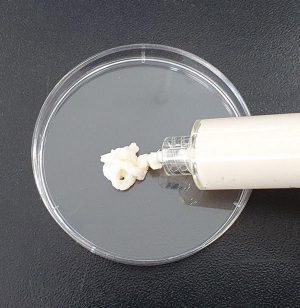
Adapted from ACS Applied Bio Materials 2025, DOI: 10.1021/acsabm.5c01538
"By promoting blood vessel growth and tissue remodeling while keeping inflammation low and reducing capsular contracture, the injectable acellular matrix could make breast reconstruction safer, less invasive and more accessible, thereby improving long-term comfort and cosmetic outcomes for patients," says Pham Ngoc Chien, one of the study's lead researchers.
During breast cancer treatment, cancerous cells and damaged tissue are often taken out, sometimes resulting in complete removal of the breast. For those who want to keep their breast volume, physicians turn to breast-conserving surgical techniques, where the remaining tissue is rearranged to account for space left by the tumor removal. Sometimes, skin and fat are even donated from other parts of the body to fill in the gaps left behind, like a skin graft. Though this technique preserves the shape of the breast for the patient, it leaves a scar where the tissue was donated from.
An alternative strategy involves acellular dermal matrix (ADM) - skin that has been processed to remove the outermost layer. This leaves a material with important cellular components for healing, including collagen, elastin and growth factors. Currently, ADM is available primarily in sheet form for tendon repair or plastic surgery, but Chien, Chan-Yeong Heo and colleagues wanted to create an injectable form of ADM that would be suitable for space-filling reconstructive breast surgery.
The researchers took a sample of skin donated by a living female participant and processed it through a series of steps including decellularizing, freezing and pulverizing to form small ADM particles. Then they added water to the particles to form a thick paste. The team injected small amounts of this paste into rats to test its biocompatibility and compared it to two commercially available ADM products. After a six-month period, the rats presented no adverse health effects. In fact, the animals treated with the new ADM paste had thinner layers of tissue form around the injected material than the rats treated with the commercially available product. Thinner tissue layers are preferable in breast implant procedures because they're less likely to cause complications such as infections or hematomas.
Longer-term safety trials and more complex tests are necessary before this material could be considered for clinical use. But the researchers say that this work highlights the potential of their ADM implant to improve breast reconstruction surgery.
The authors acknowledge funding from the Korean Ministry of Trade, Industry, and Energy. The use of human skin samples was approved by the Institutional Review Board of Seoul Asan Hospital.


