When Joshua Weiner begins to talk about his research at transplantation conferences, he sometimes starts by showing the remembrance cards he carries in his wallet that honor patients who have passed away.
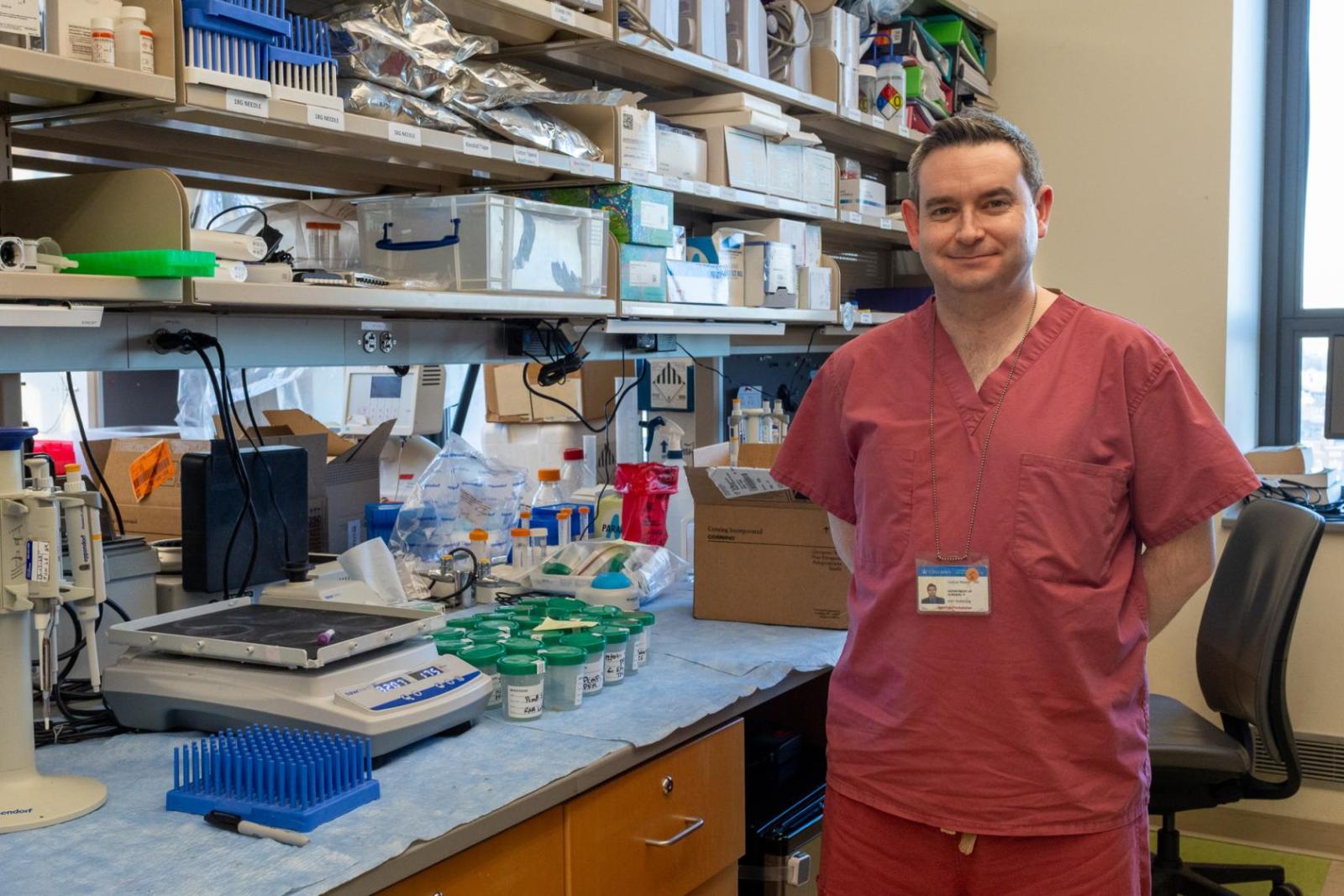
Joshua Weiner
Patient deaths are unfortunately a common occurrence for surgeons like Weiner who specialize in intestinal transplantation. Whereas nearly 80% of heart and kidney transplant recipients survive beyond five years, just under half of intestinal transplant recipients live that long after surgery, the lowest survival rate in solid-organ transplantation.
With such poor outcomes, only about a hundred intestinal transplants are performed each year, and many surgeons are discouraged from going into the field, says Weiner, the Florence Irving Assistant Professor of Surgery at Columbia University Vagelos College of Physicians and Surgeons and researcher at the Columbia Center for Translational Immunology.
Weiner is one of the few surgeon-scientists in the country trying to upend the status quo. The remembrance cards serve as a reminder of the stakes that are involved: "The people on these cards I carry with me are the reason I do this work," Weiner says."If nothing changes, intestinal transplant is probably a dying field. Fewer people are getting trained, and you can see how, after 20 years, there could be no one left who knows how to do it."
"If nothing changes, intestinal transplant is probably a dying field," he adds. "Fewer people are getting trained, and you can see how, after 20 years, there could be no one left who knows how to do it."
Today, when he's not performing surgery or attending to patients, Weiner is in the lab trying to coax the recipient's immune system into accepting the transplant, a major obstacle in the success of this procedure.
We recently spoke to him about his research and how it could potentially transform intestinal transplantation.
Why is intestinal transplantation so much harder than kidney or liver transplantation?
The bowel contains half of our immune system, so a lot of immune complications can arise with an intestinal transplant. Rejection is common, and the graft can also attack the patient.
Because of that, patients need a tremendous amount of immunosuppressive drugs which cause their own complications. Infections, high rates of cancer, neurotoxicity, kidney toxicity, wounds falling apart-immunosuppression is really toxic.
So we really need to find a better way.
Today fewer than 100 people each year get an intestinal transplant. If outcomes were better, how many people could benefit?
There's a huge need.
Most patients who need an intestinal transplant have short bowel syndrome, usually because they've lost a portion of their intestines from a traumatic injury or from surgery to treat Crohn's disease or cancer. Some children, especially premature babies, are born with a small amount of intestine or have conditions that require surgical removal. Some people actually have enough length of intestine, but it does not work properly.
Because their intestines cannot absorb enough nutrients, these patients rely on intravenous nutrition. But you can only live like that for so long before you start getting serious infections from the IV lines, which stay in for years. Or you run out of places to put IV lines because of blood clots. Or you develop liver failure from the IV nutrition. Long-term survival after intestinal transplants is not great compared to other organ transplants, but at some point, it becomes a better option than not getting a transplant.
About 20,000 people in the US rely on IV nutrition. If survival was more like kidney or liver transplant, I think we could go from doing 100 intestinal transplants a year to 1,000.
How close do you think you are to improving intestinal transplant outcomes?
Despite improvements in techniques and medications, we have not made much progress over the last 15 years. To make a transformative breakthrough, I think we need to modulate how we interface with the immune system.
The immune system makes intestinal transplantation difficult but also gives us opportunities to generate a state of tolerance, when the immune system recognizes but does not attack the transplant.
We've been working for years on different transplant protocols in pig models, and we're now able to get the pigs off immunosuppression completely.
We've identified a couple of ways to achieve that tolerance. One involves matching the donor's and recipient's immune systems. We just recently learned that the more the donor and recipient share a particular part of their genome-something called MHC Class II-the less rejection occurs. This type of immune matching is not currently taken into account in clinical transplantation.
We think that the more MHC Class II genes are shared, the more a special kind of suppressive T cell is active. These regulatory T cells, or Tregs, recognize the donated organ, but instead of telling the immune system to attack, they say don't attack. They stop rejection. It's exciting because it was the first demonstration that a recipient's immune system can be manipulated to tolerate an intestinal transplant without the use of immunosuppressive drugs.
We just submitted a grant to test the same concept in patients. The donor-recipient pairs will be parent-to-child or child-to-parent, so that half the MHC Class II genes will be shared.
If this matching makes a big difference compared to what we've seen in our historical patients who were not genetically matched in this way, then that's an approach we'll want to favor going forward. We think we'll also be able to find good matches with organs from unrelated, deceased donors.
Why are you drawn to intestinal transplantation when others are staying away from the field?
I feel like transplant in general, but especially intestinal transplant, is one of the few surgical fields you can go into and have a reasonable expectation of making a real difference and changing the field. There's still so much that's unknown and new discoveries to be made. There are lots of ways to fundamentally change-even reinvent-intestinal transplant surgery in a way that is not really possible in other, more established types of surgery. And that's really exciting.
It's also one of the few surgical sub-specialties that gives you a chance to be more like a complete doctor. In most surgical specialties, you fix the surgical problem and then a medical counterpart takes it from there. With intestinal transplant, you do advanced surgeries while also being very heavily involved in medical management. You get to be a complete physician, and your patients stay with you for life.