

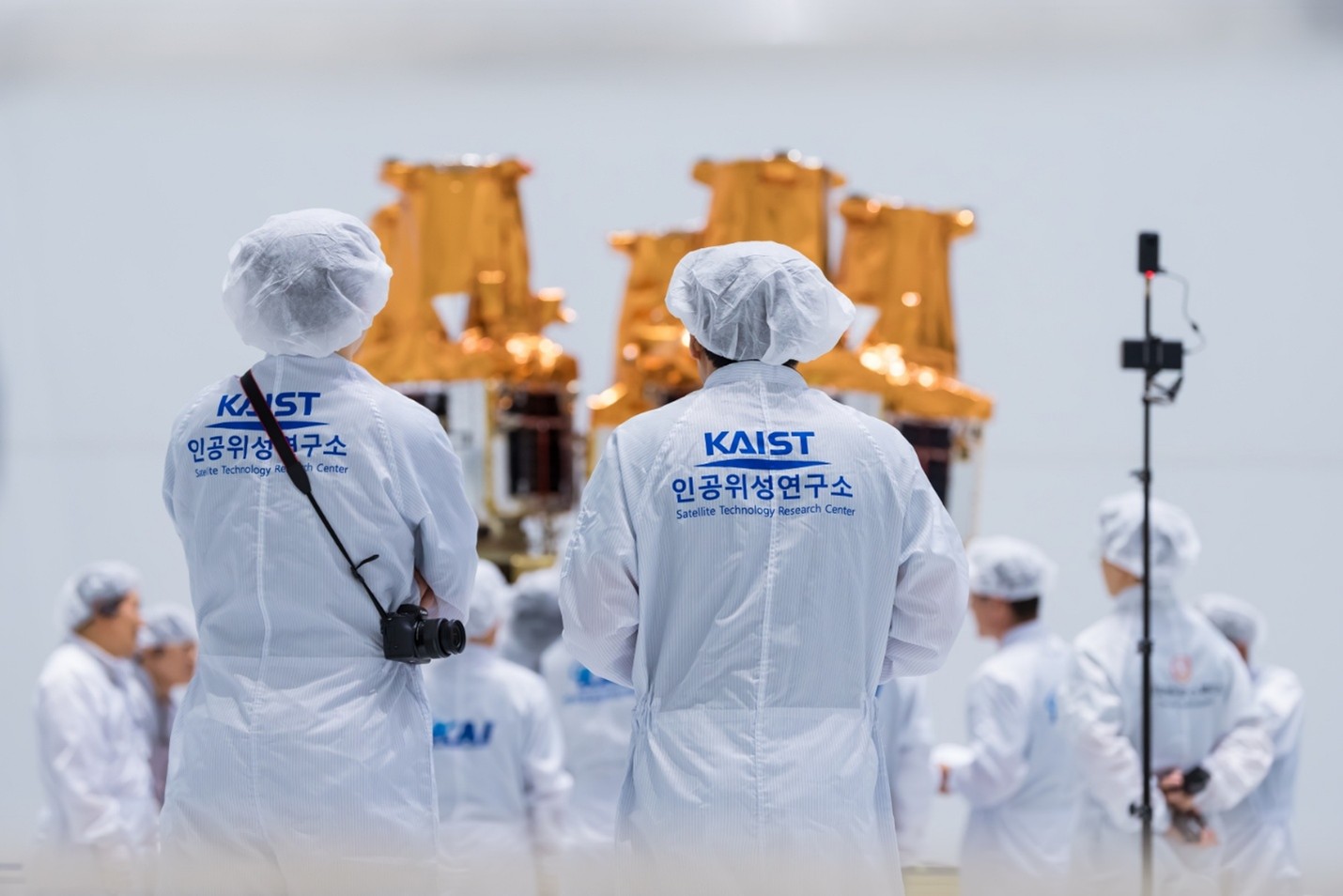
< Shipment ceremony for NEONSAT Nos. 2 through 6, attended by researchers from KAIST, the Korea Aerospace Research Institute, and Satrec Initiative, along with officials from the Korea AeroSpace Administration and other participants in the project >
To monitor areas affected by wildfires or floods using satellites, it is necessary to be able to image those locations again when needed. With a single satellite, it takes time to revisit the same area, but operating multiple satellites together can increase observation opportunities. Five NEONSAT microsatellites, part of a constellation development project led by KAIST, are heading into space aboard the Nuri launch vehicle.
KAIST (President Choongsik Bae) announced on October 6 that NEONSAT satellites Nos. 2 through 6, whose development project is led by the Satellite Technology Research Center of the KAIST Space Institute, will be launched as the primary payload of the fifth Nuri launch scheduled for October 7 from the Naro Space Center in Goheung, South Jeolla Province. The launch is scheduled to take place between 12:23 p.m. and 1:23 p.m., with the exact time to be determined on the day of launch.

< Figure 1. Mission concept of the NEONSAT constellation >
President Choongsik Bae said, "This launch marks an important milestone in expanding KAIST's long-accumulated capabilities in small satellite development into a satellite constellation system in which multiple satellites are manufactured and operated together," adding, "We hope our research and technologies will be reliably demonstrated in space and lead to tangible value that contributes to people's lives in areas such as disaster response and public safety."
NEONSAT is an Earth observation satellite weighing less than 100 kg per unit. It is designed to capture high-resolution imagery at approximately 1-meter resolution in panchromatic mode and 4-meter resolution in color. If the planned constellation of 10 mass-produced satellites is completed by 2027, the system will be able to image the Korean Peninsula more than three times a day and revisit the same location within 24 hours in the event of emergencies such as disasters.
This project is Korea's first development program for a practical, mass-produced satellite constellation. The KAIST Satellite Technology Research Center oversees the entire project, including satellite system development, and has established analytical methods and management procedures required to jointly develop, verify, and operate multiple satellites. The Korea Aerospace Research Institute is responsible for developing the ground system for constellation operations as well as satellite image calibration, validation, and utilization systems, while Satrec Initiative Co., Ltd. participated in the development of the satellite bus and high-resolution optical camera. The project is being carried out jointly by Korean industry, academia, and research institutions with support from the Korea AeroSpace Administration.

< Figure 2. NEONSAT Nos. 2 through 6, the first batch of mass-produced satellites, after completion of assembly and testing >
KAIST has assigned the common acronym "BTS" to each launch stage to reflect the progression of the satellite constellation development. The prototype satellite was designated "Beginning of The Swarm," the validation satellite "Bridging of The Swarm," the first batch of mass-produced satellites being launched this time "Beholding of The Swarm," and the second batch of mass-produced satellites scheduled for launch in 2027 "Beyond The Swarm." These names represent the progression from the prototype and validation stages to full-scale constellation launches and operations.
Jae-Hung Han, Director of the KAIST Space Institute, said, "The key to this project is not simply building a single satellite, but establishing a system in which multiple satellites are manufactured and verified to the same standards and operated together in orbit," adding, "After launch, we will carefully verify the condition of the satellites and the quality of their imagery to ensure that constellation observations proceed as planned."
In addition to the five NEONSAT satellites, the upcoming Nuri launch will carry 10 CubeSats as secondary payloads. Among them, another KAIST satellite, GBSAT, will investigate the low-Earth-orbit space environment.
< Figure 3. Researchers conducting final inspections of the five NEONSAT satellites mounted on the Nuri launch vehicle for its fifth launch (Courtesy of the Korea Aerospace Research Institute) >

< Figure 4. The five NEONSAT satellites (Nos. 2 through 6) fully mounted on the third stage of the Nuri launch vehicle for its fifth launch (Courtesy of the Korea Aerospace Research Institute) >


