
Researchers have identified a previously unknown mechanism by which the kidney precisely controls calcium excretion.
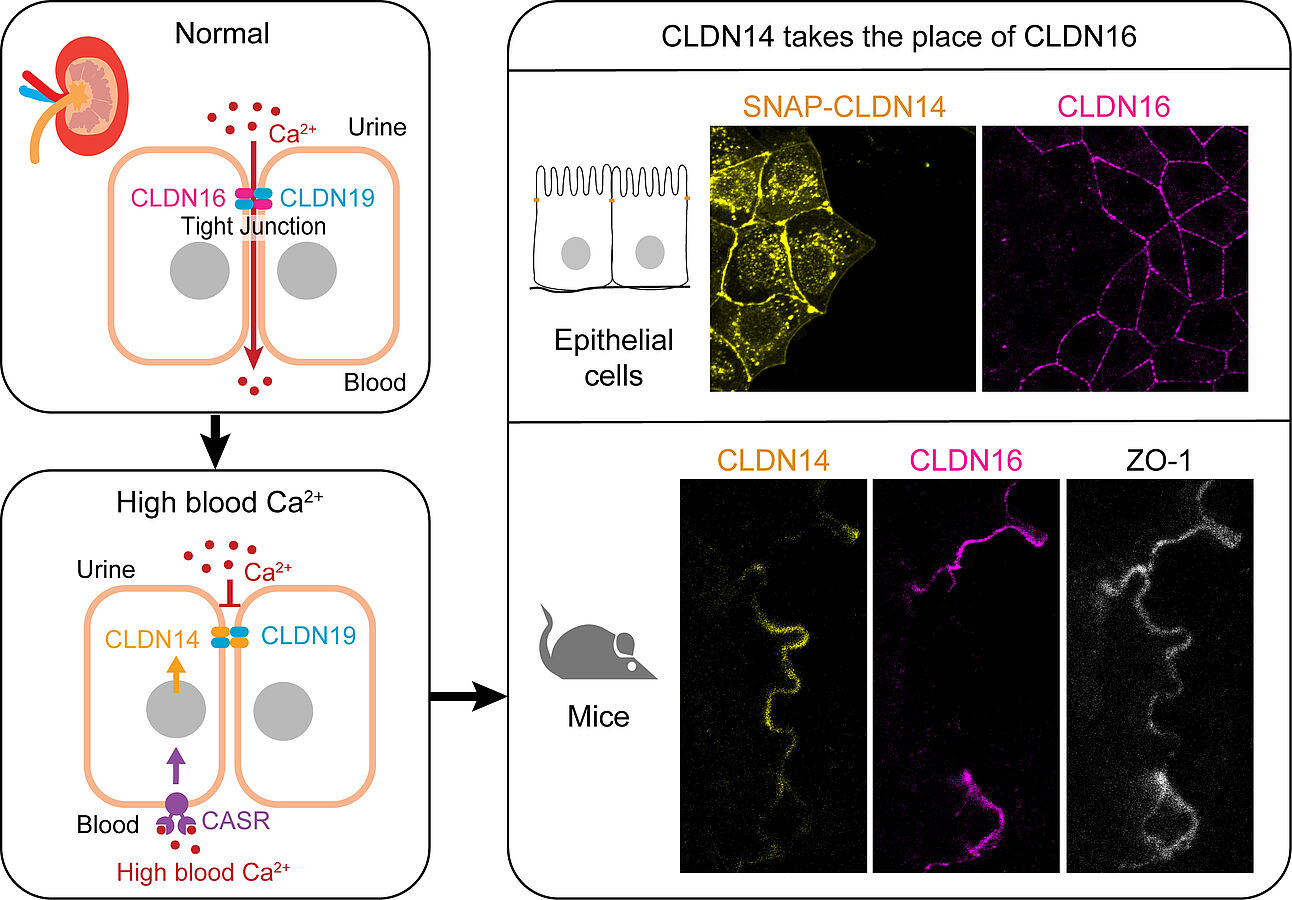
CLDN14 displaces CLDN16 in kidney tubule tight junctions and thereby reduces paracellular Ca²⁺ reabsorption when blood calcium levels are elevated. | Rozemarijn van der Veen
The claudin-14 protein plays a key role in this process: it displaces the paracellular transport protein claudin-16 in the tight junctions of the kidney, thereby altering the flow of calcium. The findings have been published in the renowned journal PNAS.
The human body depends on stable calcium homeostasis, which is for a large part regulated by the kidneys. Epithelial cells form tight junctions (TJs) that control the paracellular transport of substances-i.e., transport between cells. In a special segment of the kidney, the thick ascending limb, copolymers of the claudin proteins claudin-16 and claudin-19 enable the reabsorption of calcium from the urine back into the blood.
Elevated calcium levels in the blood activate the calcium sensing receptor, which in turn increases the expression of claudin-14. Claudin-14 disrupts the calcium conductivity of the claudin-16/19 copolymer, causing more calcium to be excreted in the urine. This mechanism protects against excessive calcium levels in the body. At the same time, it is known that genetic variants of claudin-14 can increase the risk of kidney stone disease.
Researchers led by Rozemarijn van der Veen, Marie Bieck, Nacéra Mezouar, Volker Haucke, and Martin Lehmann from Leibniz-FMP, as well as Henrik Dimke from the University of Southern Denmark in Odense, used state-of-the-art microscopy techniques, including high-resolution STED microscopy, as well as cell and mouse models to visualize and investigate the dynamic remodeling of tight junctions. They show for the first time that claudin-14 preferentially forms polymer structures with claudin-19, thus taking the place of claudin-16 over a period of several days.
The researchers were thus able to demonstrate a new mechanism by which the composition of claudin proteins in tight junctions adapts flexibly, regulating renal calcium excretion.
These findings provide valuable molecular insights into the regulation of calcium homeostasis in the kidney and open up new therapeutic perspectives for the treatment of kidney stones and calcium metabolism disorders.
Rozemarijn van der Veen, Marie Bieck, Nacéra Mezouar, Volker Haucke, Henrik Dimke, Martin Lehmann, Control of renal calcium permeability via a tight junctional claudin switch, PNAS, 122 (49), 2025.


