
Water. One of our planet's most vital and vulnerable resources is at risk. The increased presence of toxic substances in water, particularly micropollutants, jeopardizes human and environmental health.
To protect water quality for future generations, Dr. Maricor Arlos and her team at the University of Waterloo's Arlos Research Lab in the Faculty of Engineering, are studying the journey of micropollutants in urban water cycles and developing solutions to mitigate their harmful impact.
Working with partners like the City of Calgary, the research team uses advanced analytical instrumentation to detect contaminants in water, sediment and even aquatic organisms, and track their movements through the water cycle.
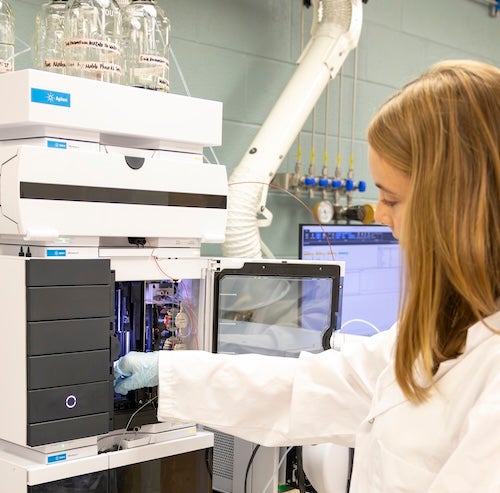 Sarah Delanty (PhD student) measures micropollutants in water using an instrument funded by NSERC RTI with support from engineering colleagues.
The information is then synthesized to generate insights that inform more effective environmental policies and practices while supporting the development of sustainable treatment technologies. Arlos is also renewing connections locally with the Region of Waterloo to contribute her expertise to long-term wastewater treatment planning.
"Given the ubiquity of harmful chemicals in modern life, it is no longer surprising to find them accumulating in bugs and fish," Arlos says. "The real question is whether they pose meaningful risk. Answering that has been a central focus of my research, helping water utilities to make more informed and strategic decisions."
Arlos, a Waterloo alum (BASc '11, MASc '13 and PhD '18), originally wanted to become a medical doctor. Her path shifted when she learned about the profound health and environmental implications of micropollutants - substances found in water that originate from various sources such as cosmetics, synthetic textiles, industrial chemicals and pharmaceuticals. Impressed by Waterloo's strong reputation in water research, Arlos pursued an interdisciplinary academic path that merged technical skills with ecotoxicological expertise. She completed her bachelor's and master's degrees in civil and environmental engineering and later earned a PhD in biology. Arlos's career has taken her from Canada to Switzerland, where she worked with the world-renowned Swiss Federal Institute of Aquatic Science and Technology, and back again - including a stop at the University of Alberta - before returning to Waterloo in 2024 as a professor in the Department of Civil and Environmental Engineering.
In 2025, Arlos received funding from the Canada Foundation for Innovation (CFI) through the John R. Evans Leaders Fund (JELF) to support her research work in advancing water quality management through micropollutant analysis. To help shape policy related to micropollutants, she has also helped translate research evidence into outreach communications for public discourse. As a researcher and educator who has always been drawn to helping people, Arlos believes in the importance of empathy in engineering. Her courses and supervision encourage students to consider the human dimensions of their work and research - the social, cultural and ethical implications of water access, quality and treatment.
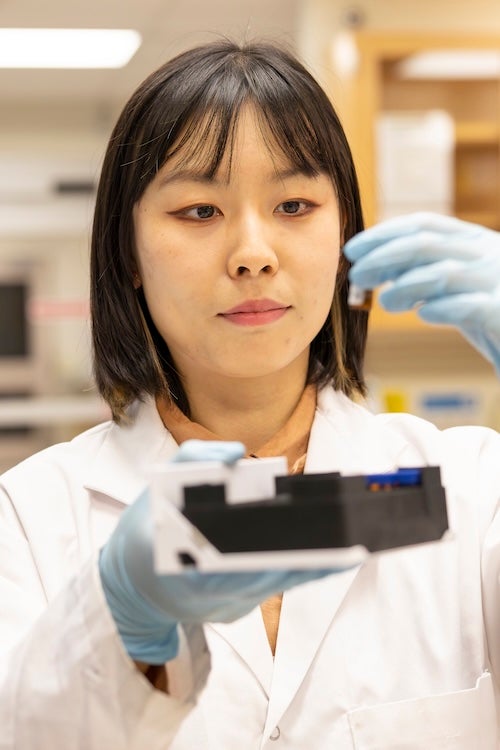 Jingya Pang, PhD student, Arlos Research Lab.
"We're trained as engineers to optimize our experimental performance and results," Jingya Pang, a PhD student, says.
"However, Dr. Arlos always asks us to think about the people behind the problems and reminds us that the real-world water problems are also about safety, equity and feasibility. In our lab, we look beyond the pollutants and consider what it means for water quality, potential side effects and whether a community could actually use the solution."
One of the lab's most meaningful projects to date involved collaboration with Indigenous communities in Alberta. Grounded in ceremony and mutual respect, this partnership focused on water quality from a community-defined perspective - where "safe" water means more than meeting technical thresholds. It's about honouring water as a living relative and a source of identity. This commitment continues in Ontario - in fall 2025 Arlos took her first- and second-year Environmental Engineering students (more than 100 students) out on the Grand River for rafting and paddling and incorporated a Water Ceremony led by Indigenous Knowledge Keeper Dr. Sarah Connors.
Arlos sees valuable career opportunities for future water professionals. As urban populations grow and environmental pressures intensify, the gap between wastewater discharge and drinking water intake narrows. Technological innovation that bridges societal needs with environmental realities is critical.
Her return to Waterloo marks not just a professional milestone, but a personal mission to help shift the narrative around water - to protect it, revalue it and teach others to do the same.
Interested in graduate study or industry partnerships with the Arlos Research Lab? Visit arloslab.com


