
Hydrogen, a clean energy source, requires a highly reliable and safe storage system, which is currently lacking. Layered hydrogen silicane (L-HSi) is a promising, safe, lightweight, and energy-efficient solid-state hydrogen carrier with potential for practical utility. This material releases hydrogen when irradiated with low-intensity visible-light sources like sunlight or LEDs. L-HSi represents a new direction for hydrogen carrier system research.
Novel, Safe, and Energy-Efficient Solid-State Hydrogen Carrier
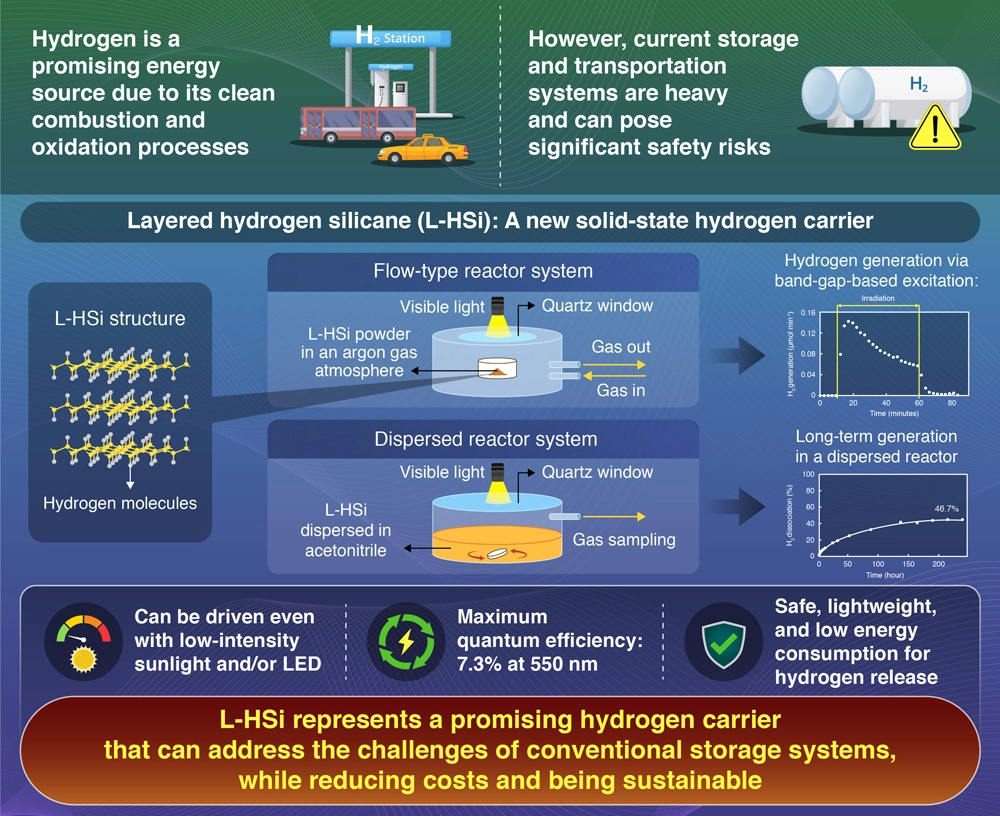
Hydrogen is a promising fuel that can replace conventional fossil fuels as it emits no carbon dioxide during combustion or oxidation and can be produced from a wide range of sources. However, a hydrogen-based economy requires not only clean production but also safe and efficient hydrogen storage and transportation. Current systems pose several drawbacks: compressed hydrogen tanks have low hydrogen densities and pose explosion risks, while liquid hydrogen tanks require extremely low temperatures and considerable energy.
Ammonia is a well-known liquid hydrogen carrier with a high hydrogen density, but its dehydrogenation requires extensive energy and comes with issues such as corrosiveness and toxicity. To solve these issues, researchers have turned towards solid-state hydrogen carrier materials. Unfortunately, most solid-state alloys consist of heavy metals and have limited gravimetric hydrogen capacities.
In a breakthrough, a research team consisting of Mr. Hirona Ito and Professor Masahiro Miyauchi from Institute of Science Tokyo (Science Tokyo), Ms. Mio Nakai and Professor Hideyuki Nakano from Kindai University, and Professor Takahiro Kondo from the University of Tsukuba, Japan, discovered a new solid-state hydrogen carrier called layered hydrogen silicane (L-HSi). Hydrogen can be released from L-HSi by visible light irradiation under ambient temperature and pressure. Their findings were published online in the journal Advanced Optical Materials on December 29, 2025.
L-HSi consists of silicon and hydrogen in a 1:1 ratio and exhibits a high gravimetric hydrogen capacity of 3.44 wt.%. Unlike conventional hydrogen storage systems, it is a stable, solid-state hydrogen carrier that can release hydrogen simply by exposure to low-intensity light sources like sunlight or LEDs.
The researchers synthesized L-HSi via decalcification of CaSi2 in a reaction with HCl and tested its hydrogen release properties. They placed L-HSi powder under an argon atmosphere in a gas-flow-type reactor and irradiated it with a xenon lamp at ambient temperature and pressure. The optical bandgap of L-HSi is 2.13 eV, corresponding to a wavelength of 600 nm, which absorbs visible light. The light was turned on 10 minutes after the experiment began and turned off at the 60-minute mark. During irradiation, the researchers clearly observed gaseous hydrogen formation.
Further heating tests under a dark environment and detailed spectroscopic analysis confirmed that hydrogen release was not due to a photothermal process, but instead, driven by bandgap excitation of L-HSi. Specifically, hydrogen was released when irradiated with wavelengths below 600 nm. The material showed a maximum quantum efficiency of 7.3% at 550 nm.
The researchers also conducted long-term irradiation tests, where L-HSi was dispersed in an organic medium inside the dispersed reactor. Under extended visible-light exposure, about 46.7% of the bonded hydrogen atoms were released. The team also confirmed that hydrogen could be effectively produced using low-intensity, economical light sources, including sunlight and LEDs.
L-HSi is a promising solid-state hydrogen carrier that can open new possibilities for safe, lightweight, and energy-efficient hydrogen storage. Looking forward, their research will focus on improving its reversibility and scalability for practical applications.
Reference
- Authors:
- Hirona Ito1, Mio Nakai2, Akira Yamaguchi1, Shin-ichi Ito3, Osamu Oki3,4, Takahiro Kondo3,4,5, Masahiro Miyauchi1, and Hideyuki Nakano2
- Title:
- Visible-Light-Driven Hydrogen Release from Layered Hydrogen Silicane
- Journal:
- Advanced Optical Materials
- Affiliations:
- 1Department of Materials Science and Engineering, School of Materials and Chemical Technology, Institute of Science Tokyo, Japan
2Department of Applied Chemistry, Faculty of Science and Engineering, Kindai University, Japan
3Department of Materials Science, Institute of Pure and Applied Sciences, University of Tsukuba, Japan
4Hydrogen Boride Research Center, Tsukuba Institute for Advanced Research, University of Tsukuba, Japan
5The Advanced Institute for Materials Research, Tohoku University, Japan


