
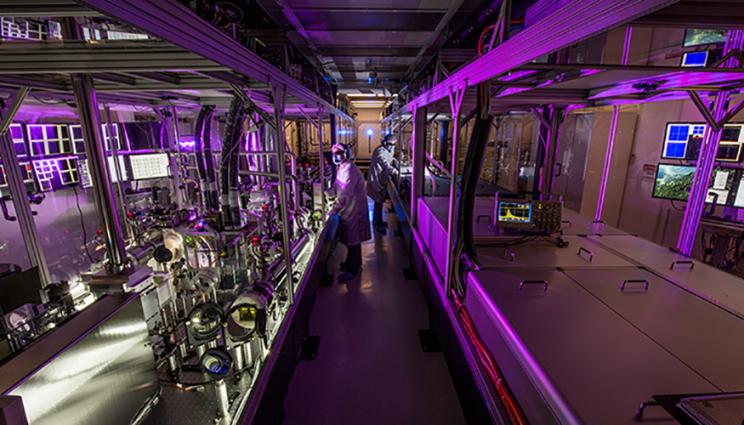
The High-Repetition-Rate Advanced Petawatt Laser System (HAPLS) - the world's most advanced and highest average power diode-pumped petawatt laser system-was designed, developed, and constructed in only three years by the NIF & Photon Science Directorate's Advanced Photon Technologies Program.
Lawrence Livermore National Laboratory (LLNL) and ELI-Beamlines in the Czech Republic have reached a major agreement that will build on the relationship between the two organizations and ramp up performance of the L3-High-Repetition-Rate Advanced Petawatt Laser System (L3-HAPLS) to its full design capabilities.
The Strategic Partnership Project (SPP) agreement, which was reached on Dec. 1, 2021, aims to enable the L3-HAPLS laser to operate at the petawatt (PW) level with a 10 Hz repetition rate for experiments. This will put ELI-Beamlines in a leading position among the world's laser facilities.
The L3-HAPLS laser was designed and built by LLNL, a world leader in the development of high-repetition-rate high peak-power laser technology.
"We are truly happy to start this new phase of collaboration with LLNL," said Bedřich Rus, leader of the ELI-Beamlines laser program. "The L3-HAPLS laser is already in high demand for experiments at one-half petawatt peak power and bringing its performance to one petawatt with 10 Hz repetition rate will make possible accessing entirely new regimes of high-average power laser-plasma interactions. We are very much looking forward to working again with our colleagues and friends from LLNL."
"This agreement continues a great relationship between ELI-Beamlines and LLNL on one of the world's most advanced rep-rated ultrafast laser systems," said LLNL's Vincent Tang, program director for the High Energy Density and Photon Systems organization in the National Ignition Facility & Photon Science Directorate. "Our partnership will help both teams move robustly into high-rep-rate, high-throughput laser-driven high energy density science to answer fundamental and mission science questions significantly faster."
The main objectives of the agreement are to:
- Ramp performance of the L3-HAPLS laser system to PW peak power and the designed 10 Hz repetition rate.


