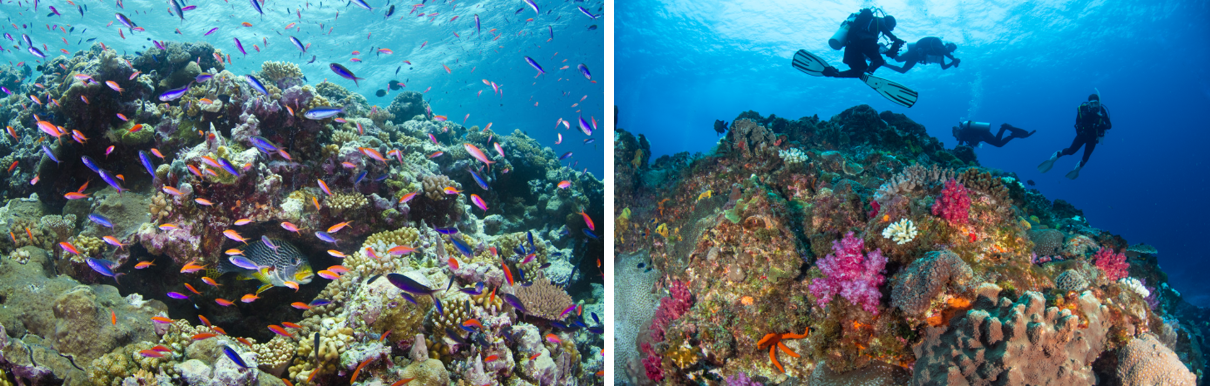
WWF calls for more marine sanctuaries to protect threatened species
Stills, broll and interviews here: https://dams.wwf.org.au/resourcespace?c=6604&k=77927aa27a
The longline fishery operating on Australia's east coast has accidentally killed 101 marine turtles since 2018, according to Commonwealth Fishery logbooks.
Alarmingly, the most commonly caught turtles are leatherbacks from the critically endangered Western Pacific subpopulation, which has declined by more than 80% since the 1980s.
With a review of national marine parks starting soon, the World Wide Fund for Nature Australia is calling for the creation of more marine sanctuaries in the Coral Sea Marine Region and the Temperate East Marine Region, which includes Lord Howe and Norfolk Islands.
For millennia, saltwater people have had a cultural and spiritual connection to Sea Country. New or improved sanctuary protections must be co-designed in partnership with First Nations communities and guided by Traditional Owner leadership and knowledge systems.
These sanctuaries, co-managed with First Nations communities, should be free from all extractive activities to provide safe havens for ocean travellers like whales and turtles.
"This is a once-in-a-generation opportunity to create a world class system of marine protection. Our threatened species need areas free from mining and fishing. Areas they can migrate through, give birth and feed," said Richard Leck, Head of Oceans, WWF-Australia.
"We're calling for 30% of Australia's oceans to be declared sanctuaries. Incredible marine wildlife, First Nations Saltwater people, and the lifestyles and livelihoods of coastal communities all depend on a healthy ocean," he said.
Like longline operations globally, Australia's Eastern Tuna and Billfish Fishery accidentally hooks, entangles or collides with turtles. These different types of physical contact are called "interactions".
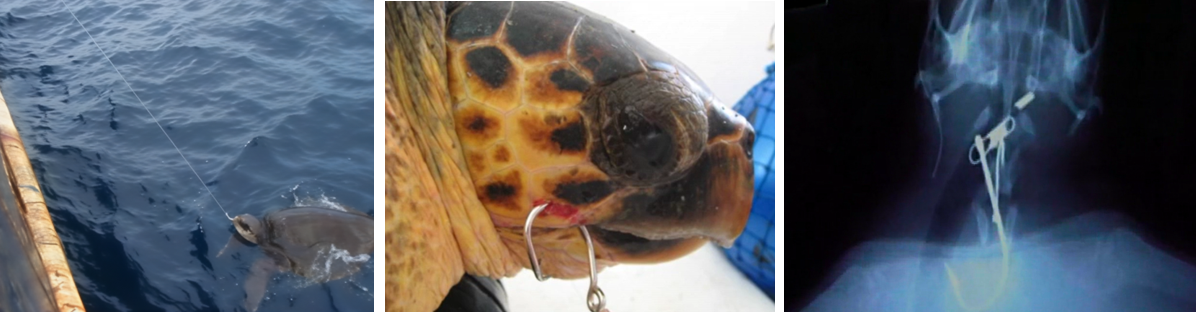
Commonwealth logbooks for this fishery record 817 interactions with turtles since 2018. That figure could be higher.
An independent review of the fishery found "a small number of boats are persistently under reporting bycatch".
Officially, 101 turtles were killed with 714 released alive (1 of those injured). But it's not known how many survived post release.
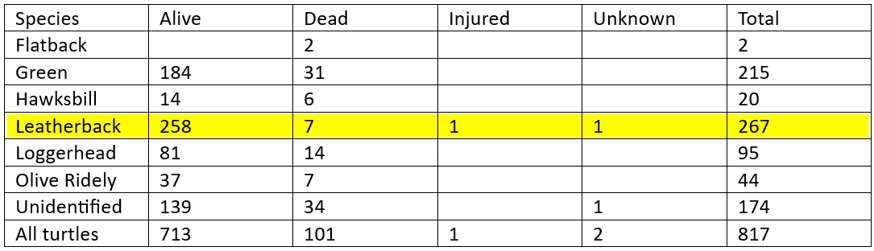
There were interactions with 267 Western Pacific leatherbacks with 258 released alive. But seven were killed, one was injured, and it was unknown whether one was alive or dead. Leatherbacks caught in this Australian fishery likely originate from nesting grounds in Indonesia, Papua New Guinea, and the Solomon Islands.
Dr Sean Williamson, from Monash University, and Dr Anna Ortega, from the University of Western Australia, recently completed modelling the population viability of Western Pacific leatherbacks which have been declining by about 6% a year.
"Our modelling indicated that the loss of even a small number of additional adult turtles each year can markedly accelerate the decline of critically endangered Western Pacific Leatherbacks," Dr Williamson said.
"This is particularly concerning given that leatherbacks were the turtle species most frequently interacted with in the Eastern Tuna and Billfish Fishery over the 2018–2025 period. While seven confirmed mortalities may appear numerically small, for a critically endangered population already experiencing long-term decline, the loss of even a few mature individuals can have disproportionate impacts on population viability.
"There is also uncertainty around post-release survivorship. While many turtles are recorded as released alive, some individuals may later succumb to injuries, stress, exhaustion, or complications associated with hooking and entanglement," Dr Williamson said.
A 2024 review estimated about 22% of leatherbacks released from the New Zealand surface longline fishery do not survive.
Combined, the Coral Sea and Temperate East Marine Regions support more than 400 threatened species and more than 50 different habitats.
Associate Professor Carissa Klein from Queensland University said about 75% of the Coral Sea Marine Park is open to fishing.
"When you stop fishing by establishing a marine sanctuary, you get more fish, those fish get bigger and have more babies. Inside the sanctuary, this is great for biodiversity. Fish don't know boundaries and some swim outside the sanctuary. This is great for fisheries as there are more fish. Ecosystems within marine sanctuaries are healthier and more likely to be resilient to some of the impacts from climate change," said Dr Klein.
"We are really good at protecting places no one wants. Most of the important ecosystems and areas for biodiversity are not well protected in the Coral Sea and Temperate East Marine Regions. The government needs to put marine sanctuaries in the places that matter so that all the habitats and species have at least 30% of their range protected. It's an insurance against all the threats coming towards them," Dr Klein said.
WWF-Australia has launched a petition calling on the Australian government to create and strengthen marine sanctuaries to protect at least 30% of Australia's oceans by 2030.
Specific asks are to:
- Expand existing marine parks and create new ones to better protect marine life across our oceans.
- Ensure Sea Country decisions are guided by First Nations leadership, Indigenous knowledge, science and local community voices.
- Strengthen protection where it's needed most, providing safe havens for ocean travellers like whales and turtles.
- Ensure marine sanctuaries are co-managed with First Nations communities and well connected to safeguard marine wildlife as they undertake their epic migrations along ancient routes.
- Ban unsustainable industrial activities in all marine parks, such as mining and destructive fishing practices.
- Increase marine sanctuary protection in the Coral Sea and around Lord Howe and Norfolk Islands first, while progressing stronger protections nationwide.
Go to https://wwf.org.au/get-involved/marine-sanctuaries/