Published on
A study by UNIGE and EMBL shows how differences in tissue mechanical properties shape the diversity of forms across species.

Why do animals display such a wide range of shapes, even within the same group? By studying corals, jellyfish, and sea anemones, scientists from the University of Geneva (UNIGE) and the European Molecular Biology Laboratory (EMBL) show that this diversity is partly explained by the physical properties of tissues, such as their ability to contract, stretch, or resist deformation. These characteristics also make it possible to predict the morphology of these marine organisms. Published in the journal Cell, these findings pave the way for a better understanding of how biological forms evolve.
The diversity of life forms is striking. To explain it, research has largely focused on genetics. While genes play a central role in development, they are not sufficient to explain how tissues bend, stretch, and reorganize to form a specific organism. This process, known as morphogenesis, is studied by the group of Aissam Ikmi, Group Leader at EMBL Heidelberg and co-author of the study.
"Comparing genomes helps identify genetic differences linked to shape diversity, but it does not allow us to predict the final form of an organism. We need to understand how cells act collectively to generate mechanical forces," explains the researcher.
By shedding light on the links between genes, mechanical forces, and morphology, it opens new perspectives for the study of evolution.
The collaboration with the group of Guillaume Salbreux, Full Professor in the Department of Genetics and Evolution within the Section of Biology at the Faculty of Science of UNIGE, a specialist in theoretical physics and co-author of the study, made it possible to address the question from the perspective of mechanobiology – how physical forces influence biological processes. The scientists thus investigated how shape diversity emerges at the tissue level, where cells interact and generate mechanical constraints.
Forces acting on tissues shape morphology
To test this idea, the team studied cnidarians – a group including corals, jellyfish, and sea anemones – known for their wide variety of shapes despite relatively simple body plans. By combining experimental observations and theoretical modeling, the researchers identified three key physical parameters of tissues that explain two major features of morphology: elongation (how stretched a body is) and polarity (the asymmetry between different parts of the body).
By adjusting these parameters in their model, the scientists were able to account for different cnidarian forms observed in nature. Each combination of parameters defines what the researchers call a "mechanotype", that is, a set of physical characteristics specific to each species. "It is at this level that molecular changes become predictive of form," says Aissam Ikmi. "We believe evolution acts on these mechanotypes to generate new morphologies."
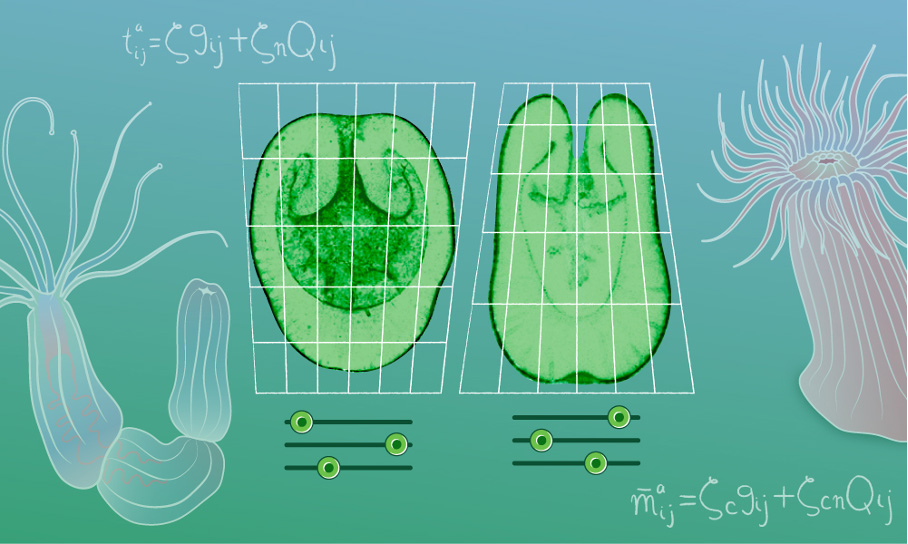
Inspired by the theories of D'Arcy Thompson, scientists combined theoretical and experimental approaches to establish 'mechanotypes' as the physical links between genes and body shapes. Pictured are cross sections of larvae from Nemaotstella (left) and Aiptasia (right), with the sliders underneath representing the mechanical modules which combine to give rise to an organism's mechanotype. © Daniela Velasco/EMBL
The team then tested this hypothesis experimentally on the sea anemone Nematostella. By modifying certain mechanical parameters through genetic interventions, they were able to alter the shape of the larvae. Individuals that were initially elongated adopted a more spherical morphology. "These experiments allow to understand how the mechanical properties of a given species determine its shape," explains Nicolas Cuny, postdoctoral researcher in Guillaume Salbreux's group and co-first author of the study.
"Beyond its immediate findings, this study highlights the relevance of an interdisciplinary approach combining biology, physics, and mathematics. By shedding light on the links between genes, mechanical forces, and morphology, it opens new perspectives for the study of evolution," concludes Guillaume Salbreux.