
Historian Harriet Washington '76 discovered her power for reading between the lines in the URochester library archives.
"What is past is prologue," wrote William Shakespeare in The Tempest, one of his final plays. As an undergraduate student at the University of Rochester, Harriet Washington '76 found herself poring over the confessional physician narratives at Rush Rhees Library and the version of events they captured. That formative experience would lead to a career reopening the medical history record for closer examination. Who compiled it, and to what ends? Who has trained the lens, and to whose exclusion? And critically, why do events of the last several centuries loom so large today?
As a leading historian of medicine and bioethicist, Washington is known for work that insists on accuracy over nostalgia, complexity over comfort. With her seventh book to be published in 2027, she examines how medical practices are shaped by culture, power, and race, and how those legacies persist for patients and caregivers today. Along the way, she has rescued overlooked figures from obscurity-and helped unseat others, literally, from their pedestals. (Specifically, the James Marion Sims statue in New York City's Central Park-more on this later.)
Where 'competing passions' converge
Originally from Fort Dix, New Jersey, Washington arrived at URochester in 1972 with what she mistook for competing passions. "I had a deep love for history and kinship with the past, but didn't see what practical use I could put to it," she recalls. "I also had a desire to become a physician."
At URochester, Washington studied with three influential professors who clarified her career path and passion: "to somehow meld literature, history, and medicine."
The first was Margaret Perry, who introduced Washington to the writers of the Harlem Renaissance. Perry, hired in 1970 to lead the University's Education Library, served as an assistant professor of English as well as the acting director of University Libraries. Among other works, Perry authored The Harlem Renaissance: An Annotated Biography and Commentary (Garland Publishing, 1982) and The Short Fiction of Rudolph Fisher (Greenwood Press, 1987). Fisher, an early radiologist, musician, and writer, would become one of three subjects of Washington's forthcoming biography, Renaissance Men.
"I was seeing that the history of medicine had been carefully curated to exclude the experience of African Americans, people of color, and poor people. That lit my fire."
Washington also credits Russell Peck, the prominent medieval scholar who spent more than five decades at URochester. "He really encouraged my interest in not only medieval history, but also the value of history in fully understanding the present," she says. And finally, R. Carey Macintosh, author of The Evolution of English Prose, 1700-1800: Style, Politeness, and Print Culture (Cambridge University Press, 1998), was "very supportive of me at a critical juncture," drawing out both content and confidence.
The physician confessional literature at Rush Rhees Library "was full of doctors who bragged about their exploits in foreign lands, bringing the 'blessings' of Western medicine," she recalls. While these stories were moving, she says, something in their tone bothered her: disdain for women, people of color, and other cultures written off as simple-minded. "When I would raise this issue, people would become angry with me…. 'You have no degree in history. Be gone.' That was frustrating for me, but I knew I was onto something."
A detective at work in the archives
At the University's Strong Memorial Hospital, Washington continued reading between the lines-this time, of files for patients awaiting kidney transplants. Were they thick or thin? Did they say, "loving family, stable job," or just include a curt advisory to prepare this patient for "imminent demise"?
"I felt like a detective. I was finding information. I was exposing something. I was proposing solutions. I was seeing patterns that people had not seen before. I was seeing that the history of medicine had been carefully curated to exclude the experience of African Americans, people of color, and poor people. That lit my fire. I knew that someone had to find out why it happened, and how to reverse it."
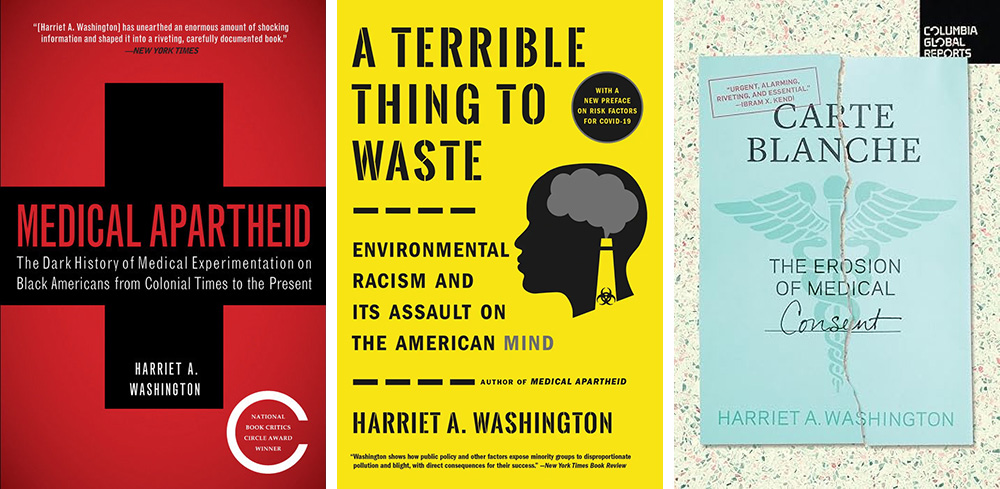
Washington tapped into that spirit of inquiry to become a noted journalist, author, and medical ethicist. Her book Medical Apartheid: The Dark History of Medical Experimentation on Black Americans from Colonial Times to the Present (Doubleday) won the 2007 National Book Critics Circle Award for nonfiction. In 2019, she published A Terrible Thing to Waste: Environmental Racism and Its Assault on the American Mind. And in 2021, her Carte Blanche: The Erosion of Medical Consent (Columbia Global Reports) drew praise from author Ibram X. Kendi as "urgent, alarming, riveting, and essential."
Washington has been a fellow in ethics at Harvard Medical School, a fellow at the Harvard School of Public Health, and a senior research scholar at the National Center for Bioethics at Tuskegee University. She now teaches bioethics at Columbia University.
Tripling down on history
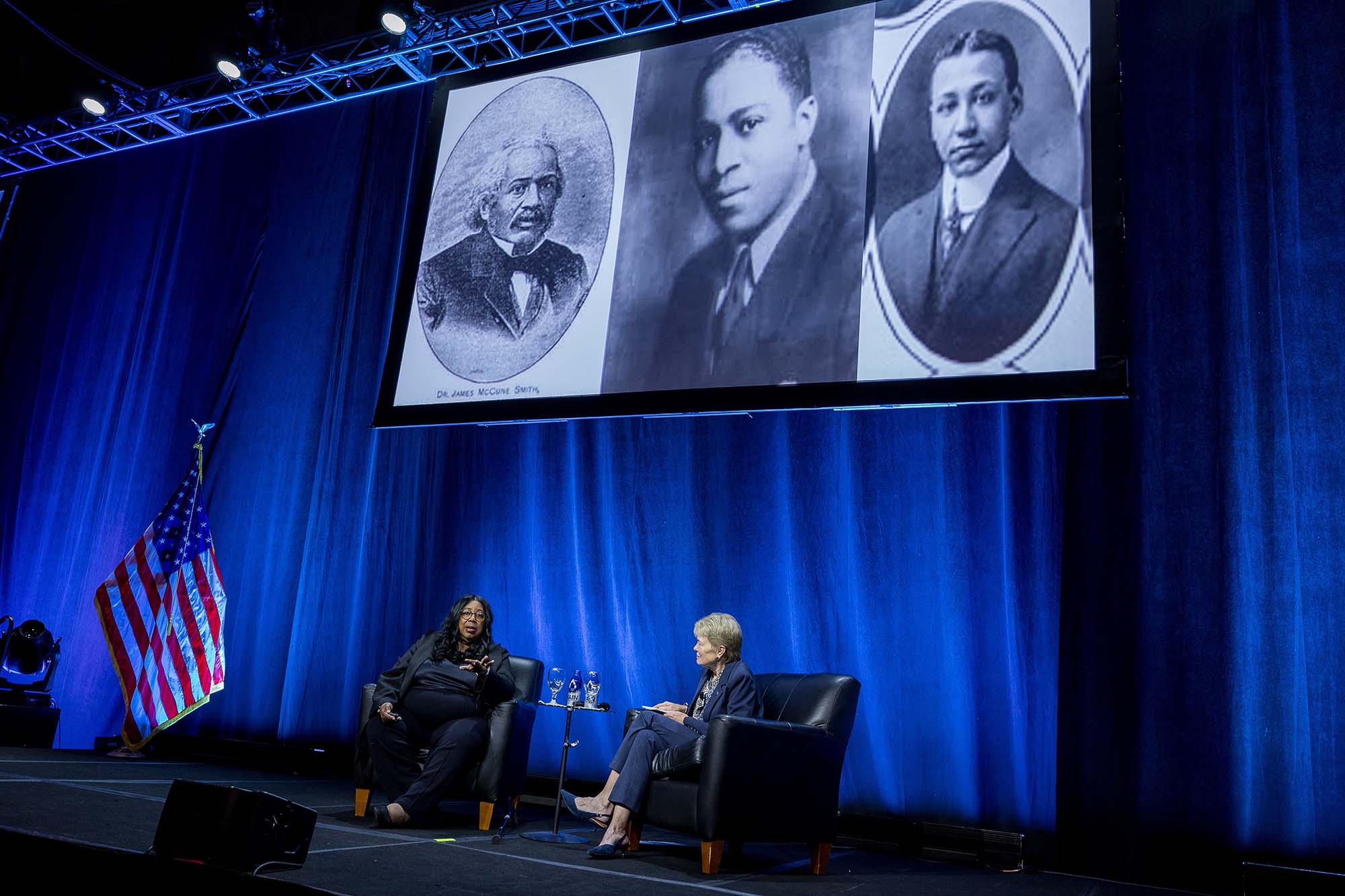
Renaissance Men, Washington's first biography-and a triple one at that-tells the story of three Black physicians who transformed American medicine while contending with daunting barriers: Fisher, James McCune Smith, and Louis T. Wright. Smith, denied entry to US medical schools, earned his medical degree from the University of Glasgow in 1837 and became a leading abolitionist intellectual. Fisher bridged science and art as both a radiologist and Harlem Renaissance cultural figure. Wright, director of surgery at Harlem Hospital, was a pioneering researcher and civil rights activist.
During a campus visit in fall 2025, Washington received the University's Frederick Douglass Medal, bestowed on individuals whose scholarship and civic engagement honor the legacy of the famed 19th-century African American abolitionist. University President Sarah Mangelsdorf noted that Washington's work "has profoundly influenced how we understand the intersection of race, medicine, and ethics. She is one of the most important voices in contemporary bioethics."
Knocking down to build up
Washington continues to argue for reforms that rebuild trust in healthcare systems, from changing research laws to establishing clear, data-driven policies to ensure equitable patient care, particularly in pain treatment and access to medication.
"There's a difference between nostalgia and history," she insists. Smallpox vaccination, defibrillator technology, and even the surgery for the congenital heart disorder known as Tetralogy of Fallot (or "blue baby syndrome") owe a debt to Black ingenuity. Washington, who curates a medical-humanities film series, often screens the 2004 movie Something the Lord Made, a biopic of the cardiac inventor Vivien Thomas.
"We've given many people 400 years' worth of reasons not to trust our healthcare system."
Her research contributed to the successful effort to remove the statue of Dr. J. Marion Sims-the revered obstetric surgeon and "father of gynecology"-from Central Park in 2018, after renewed scrutiny of his non-consensual experiments on enslaved women. She supported the campaign, largely driven by medical students, while remaining behind the scenes, determined to preserve her credibility as a historian. Still: "Every time I spoke, I would see a row of older men glowering at me, waiting for the Q&A to jump down my throat."
Even now, she sees the past playing out, with illnesses like COVID-19 laying bare the disparities of both disease burdens and treatment outcomes. "How to restore or inculcate patient trust is the most frequently asked question I get," she says. "I always say, that's the wrong question. We've given many people 400 years' worth of reasons not to trust our healthcare system. The question then becomes: 'How do we build a more trustworthy healthcare system?' Having a more complete, inclusive, accurate history of medicine could help significantly."


