
The spread of a particular genre of music reflects the borders between medieval empires in Europe. This is shown by a study conducted by a musicologist at the University of Würzburg.
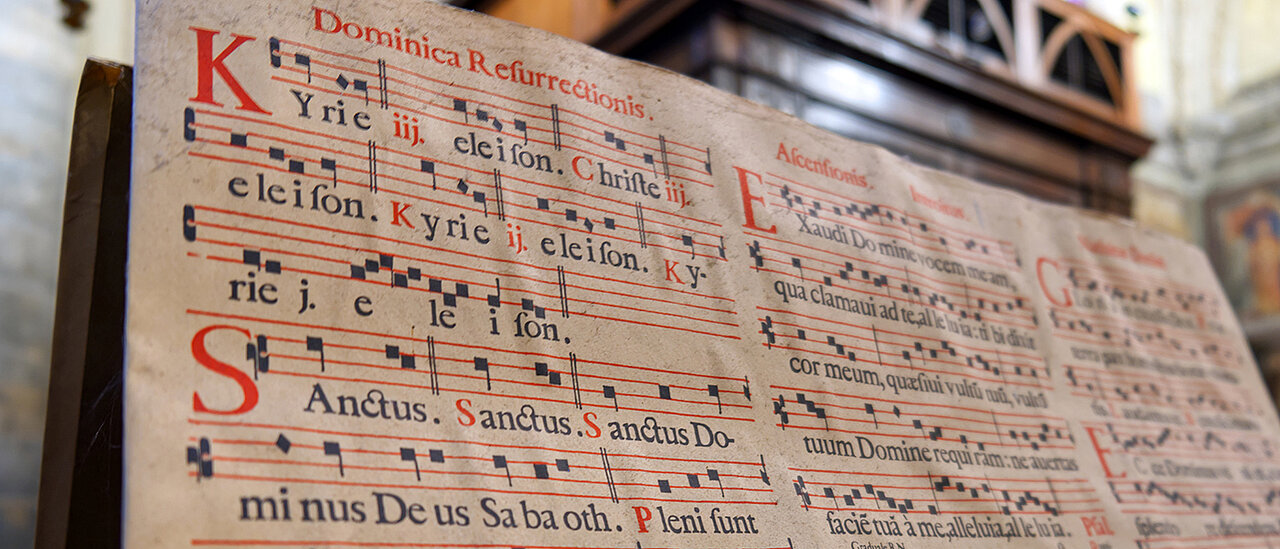
Music is known to be a matter of taste, and there is a genre to suit every taste: from popular music genres such as pop and rock to niche music such as deathstep, which combines the electronic sound of dubstep with a metal aesthetic. One genre that was popular in the Middle Ages is tropes. These are inserted texts and melodies that appeared in Gregorian chants.
A trope can serve, for example, as an introduction to a biblical story or as a commentary on the sung chant. These insertions arose because preachers wanted to make their liturgies more creative. This was because it was strictly forbidden to change the chants themselves. These were considered the "word of God" that the Pope had received and was to pass on to the preachers.
Tim Eipert has now analyzed a total of over 4,000 trope elements from 163 manuscripts using a new digital model. Eipert is currently pursuing his doctorate under Fabian Moss, junior professor of Digital Music Philology and Music Theory at Julius-Maximilians-Universität Würzburg (JMU).
The model divided the tropes into several levels and four main clusters. It used the individual insertions within the chorales to form clusters, which can then be displayed on a map. The songs were composed between the 9th and 14th centuries AD. The manuscripts originate from areas that mainly comprise the present-day countries of France, Germany, Switzerland, Austria, Italy, and southern Great Britain.
Result: Political borders influence musical exchange
The result: "It became apparent that the spread of the clusters was severely restricted by the political borders of the time following the Treaty of Verdun in 843 AD. Cultural exchange regarding the chorales apparently took place little beyond the borders of the empires at that time," explains Eipert. The musical tradition thus reflects the political fragmentation of Europe.
For context: The Treaty of Verdun divided the Frankish Empire of the Carolingians into three territories. The sons of Emperor Louis the Pious - Lothar, Charles the Bald, and Louis the German - became rulers of the new empires. Their territories stretched across large parts of Central Europe, from Rome to the North Sea.
From medieval chorales to Taylor Swift
"The study demonstrates how powerful data-driven methods can be for historical musicology," says the JMU scientist. His model can also be applied to other music genres and beyond the boundaries of musicology.
Eipert had already integrated it into a course: JMU student Jason Ackermann, for example, used it to analyse the comment sections under Taylor Swift and Radiohead videos on YouTube and identify superfans.
Next, the musicologist will focus on integrating additional models into the existing application. Among other things, these will also include text and melody elements in the clusters to obtain an even better picture of the distribution of tropes.
The model is available as open source data .
Originalpublication
Eipert, T. and Moss, F.C. (2026) 'Inferring Communities of Medieval Music Manuscripts Using Stochastic Block Models', Transactions of the International Society for Music Information Retrieval, 9(1), 26 February 2026, https://doi.org/10.5334/tismir.298


