On Earth, extreme solar activity often appears to us as beautiful, benign auroras. But venturing beyond the safety of our magnetic field, one faces the full brunt of a temperamental star that can suddenly erupt with flares and coronal mass ejections.
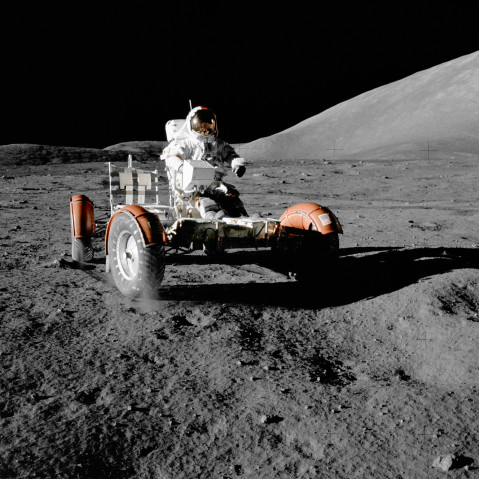
These outbursts occasionally trigger so-called solar proton events (SPEs), in which high-energy particles are flung towards Earth at up to 90% of the speed of light. In 1972, a string of SPEs occurred between the Apollo 16 and 17 moon missions - had these coincided with either expedition, the astronauts would have been helplessly exposed to deadly particle radiation. As we return to the Moon, understanding these sporadic events is becoming more urgent.
Now, researchers from the Okinawa Institute of Science and Technology (OIST) have shown a new approach for detecting historical SPEs, where they use medieval records to guide ultra-precise carbon-14 measurements of buried asurano trees in Northern Japan. Using this combined approach, the physicists have identified and dated an SPE to a period between winter 1200 to spring 1201 CE in the medieval period, when solar activity was extremely high. Their findings were published today in the Proceedings of the Japan Academy, Series B.
Professor Hiroko Miyahara from the Solar-Terrestrial Environment and Climate Unit explains: "Previous studies on historical SPEs have focused on rare, extremely powerful events. Our paper provides a basis for detecting sub-extreme SPEs - events that occur more frequently and are around 10-30% of the size of the most extreme cases, but still hazardous. Sub-extreme SPEs are more challenging to detect, but our method now allows us to efficiently identify them and better understand the conditions under which they are more likely to occur."
Red lights in the northern sky
Most high-energy protons from SPEs are deflected by the Earth's magnetic field. However, near the poles, where the geomagnetic field lines are open to space, or during particularly strong events, some particles can get through and collide with atmospheric gases. This forms carbon-14 compounds that circulate globally through the atmosphere and are incorporated into organic materials. By measuring the carbon-14 content in preserved organic material, such as buried trees, researchers can identify fluctuations in solar activity over the last 10,000 years. With ultra-precise measurements - which the researchers previously developed over a decade-long process - smaller fluctuations that are impossible to detect with conventional methods can now be seen, allowing detection of sub-extreme SPEs.
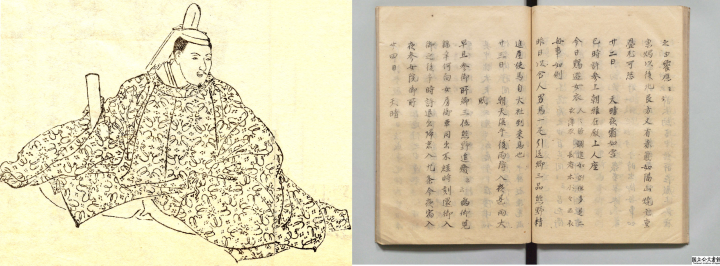
However, because the ultra-precise method is time-consuming, the team needed to first know when and where to look for evidence of past solar weather events. In the present study, the first clue came from Meigetsuki, the diary of the influential Japanese courtier and poet, Fujiwara no Teika (1162-1241), who witnessed "red lights in the northern sky over Kyoto" in February 1204 CE.
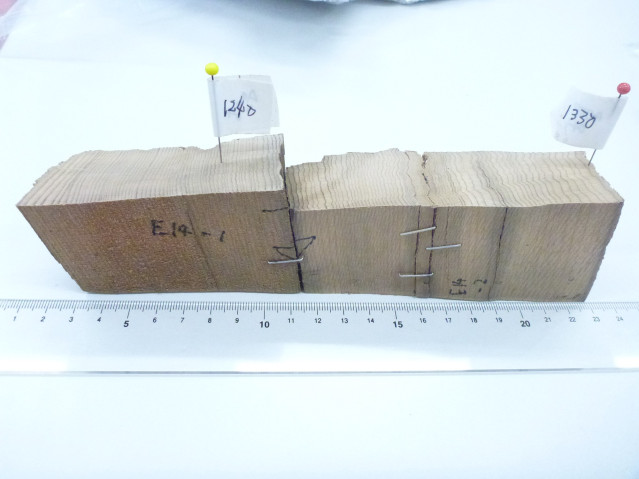
While SPEs do not themselves cause aurora, they often accompany space weather that does, providing a target period for the researchers to investigate. They then measured the carbon-14 content of asunaro wood unearthed in the northern Aomori Prefecture and found carbon-14 spikes indicative of a sub-extreme SPE. Together with dendroclimatic studies - that is, a dating method based on comparing patterns of tree-ring growth associated with regional climate - the researchers placed this specific event sometime between winter 1200 CE and spring 1201 CE, a period during which a red, low-latitude aurora had been seen in China.
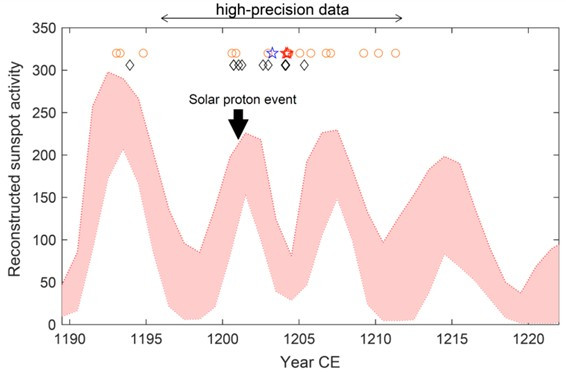
"The high-precision data not only allowed us to accurately date sub-extreme solar proton events, but it also lets us clearly reconstruct the solar cycles of the period," adds Miyahara. "Today, the Sun's activity fluctuates over eleven-year-long cycles, but we've found that the cycle was just seven to eight years long back then, indicating a very active Sun. The SPE we have dated occurred at the peak of one of these cycles."
This study helps close gaps in the historical record of solar activity, thereby improving our understanding of unpredictable and hazardous events like SPEs. But as Miyahara emphasizes, precise carbon-14 measurements must be combined with other approaches.
"Historical literature provides a candidate time window, and dendroclimatology enables direct intercomparison between detected SPE and reports of sunspots and auroras recorded in literature. Integrated approaches like these are necessary to accurately reconstruct past solar activity, helping us better understand the characteristics of extreme space weather," concludes Miyahara. "For example, while the SPE we found occurred near the peak of the solar cycle, some of the prolonged low-latitude aurora recorded in the literature seems to fall near the minimum of our reconstructed solar cycle. This is unexpected, and we're excited to look further into what solar conditions could cause this."