
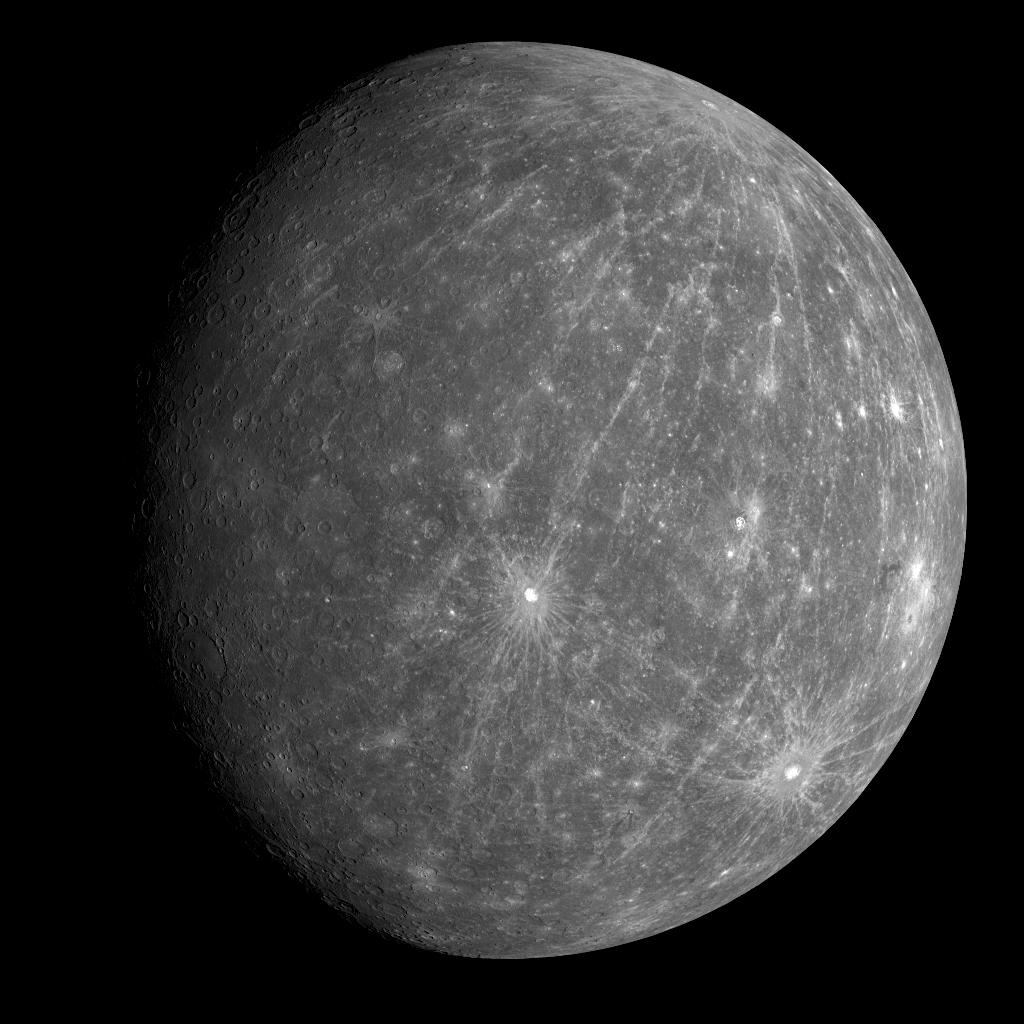
Mercury as seen by NASA's MESSENGER spacecraft in 2008. Credit: NASA/Johns Hopkins University Applied Physics Laboratory/Carnegie Institution of Washington via NASA Image and Video Library.
Mercury's surface is riddled with wrinkles, evidence of a once-larger planet that has shrunk over time. A new study finds that Mercury may have contracted 10% to 30% more than previously thought - a loss of up to 14.5 miles (23 kilometers) of total diameter since the planet formed - due to debris from impact craters obscuring the signs of the planet's shrinking.
The study appears in in Geophysical Research Letters, AGU's journal for high-impact, innovative, and timely articles on major advances spanning across all major geoscience disciplines.
You're Hot Then You're Cold
Like the other rocky planets in our solar system, Mercury formed through a flurry of violent collisions between rocks and asteroids orbiting the Sun around 4.5 billion years ago. The energy from these impacts generated huge amounts of heat, which Mercury has been losing ever since.
Like a balloon left out in the cold, Mercury's interior shrank as it cooled, and the outermost rocky layers compensated for the planet's changing size by crumpling and cracking to form tectonic features such as scarps and ridges. The degree of shrinking is important for helping researchers infer key features of Mercury's interior and evolution.
"More shrinking means Mercury could have a larger metal core, less light elements like silicon mixed into the metal core, or a higher starting temperature," explained Gaku Nishiyama, a planetary scientist at the German Aerospace Center (DLR) Institute of Space Research and lead author on the study.
Maps and Missions
Cooling should shrink a planet roughly uniformly, making "wrinkle" features, known as shortening structures, similarly common everywhere. But the formation of new impact craters creates depressions and covers the landscape in debris, making the surface rougher and rendering the signs of shrinkage harder to spot among billions of years of geologic features.
Nishiyama worked with his team to combine previous maps of geologic evidence for contraction with new maps of surface roughness - a measure of how lumpy a landscape is - for the entire planet's surface. For the first time, they showed that the roughest areas on Mercury have fewer visible wrinkles.
"It made us think that there's a process obscuring shortening structures," said Nishiyama. He thinks impact debris in rough areas could be covering up the shrinkage wrinkles, like freshly added gravel hiding the ruts in a road.
Nishiyama and his team used the contraction required to form shrinkage ridges and scarps in less disrupted areas to estimate how much contraction likely occurred planet wide, including under rough patches. They found that missing features in rough areas could amount to 10% to 30% more shrinkage over Mercury's lifetime - a total change of up to 14.5 miles (23 kilometers) in the planet's diameter rather than the currently estimated 2.5 to 10 miles (4 to 16 kilometers).
"30% is a little bit surprising, but the corrected amount of contraction actually makes sense to me," explained Nishiyama. With his updated shrinkage estimate, observations of how much Mercury has cooled and shrunk are now more in step with predictions based on physics, suggesting we are closer to understanding what is going on inside the solar system's smallest rocky planet.
According to Nishiyama, the updated figures could still be an underestimate. Existing Mercury data from NASA's MESSENGER mission, which ended in 2015, can only be reliably used to measure features larger than about 3 miles (5 kilometers) across. In November 2026, BepiColombo - only the third-ever mission to Mercury- will begin collecting higher-resolution scans of Mercury's surface. Researchers like Nishiyama, who is part of the mission science team, hope this new data will reveal scarps, ridges and impact craters in more detail than ever before.
Notes for journalists:
This study is published in Geophysical Research Letters, an open-access AGU journal, and is available to view and download at this link: https://agupubs.onlinelibrary.wiley.com/doi/10.1029/2026GL124067
Paper title:
"Underestimation of Planetary Contraction due to Obscuration by Surface Roughness: The Case of Mercury"
Authors:
- Gaku Nishiyama, Institute of Space Research, German Aerospace Center (DLR); Department of Cosmosciences, Hokkaido University, Japan; Department of Earth and Planetary Science, The University of Tokyo, Japan.
- Adrien Broquet, Institute of Space Research, German Aerospace Center (DLR).
- Nicola Tosi, Institute of Space Research, German Aerospace Center (DLR).
- Frank Preusker, Institute of Space Research, German Aerospace Center (DLR).
- Alexander Stark, Institute of Space Research, German Aerospace Center (DLR).
- Hauke Hußmann, Institute of Space Research, German Aerospace Center (DLR).
- Ernst Hauber, Institute of Space Research, German Aerospace Center (DLR).
AGU (www.agu.org) is a global community supporting more than half a million professionals and advocates in Earth and space sciences. Through broad and inclusive partnerships, AGU aims to advance discovery and solution science that accelerate knowledge and create solutions that are ethical, unbiased and respectful of communities and their values. Our programs include serving as a scholarly publisher, convening virtual and in-person events and providing career support. We live our values in everything we do, such as our net zero energy renovated building in Washington, D.C. and our Ethics and Equity Center, which fosters a diverse and inclusive geoscience community to ensure responsible conduct.
Subscribe or change your emailing preferences for the AGU Newsroom


