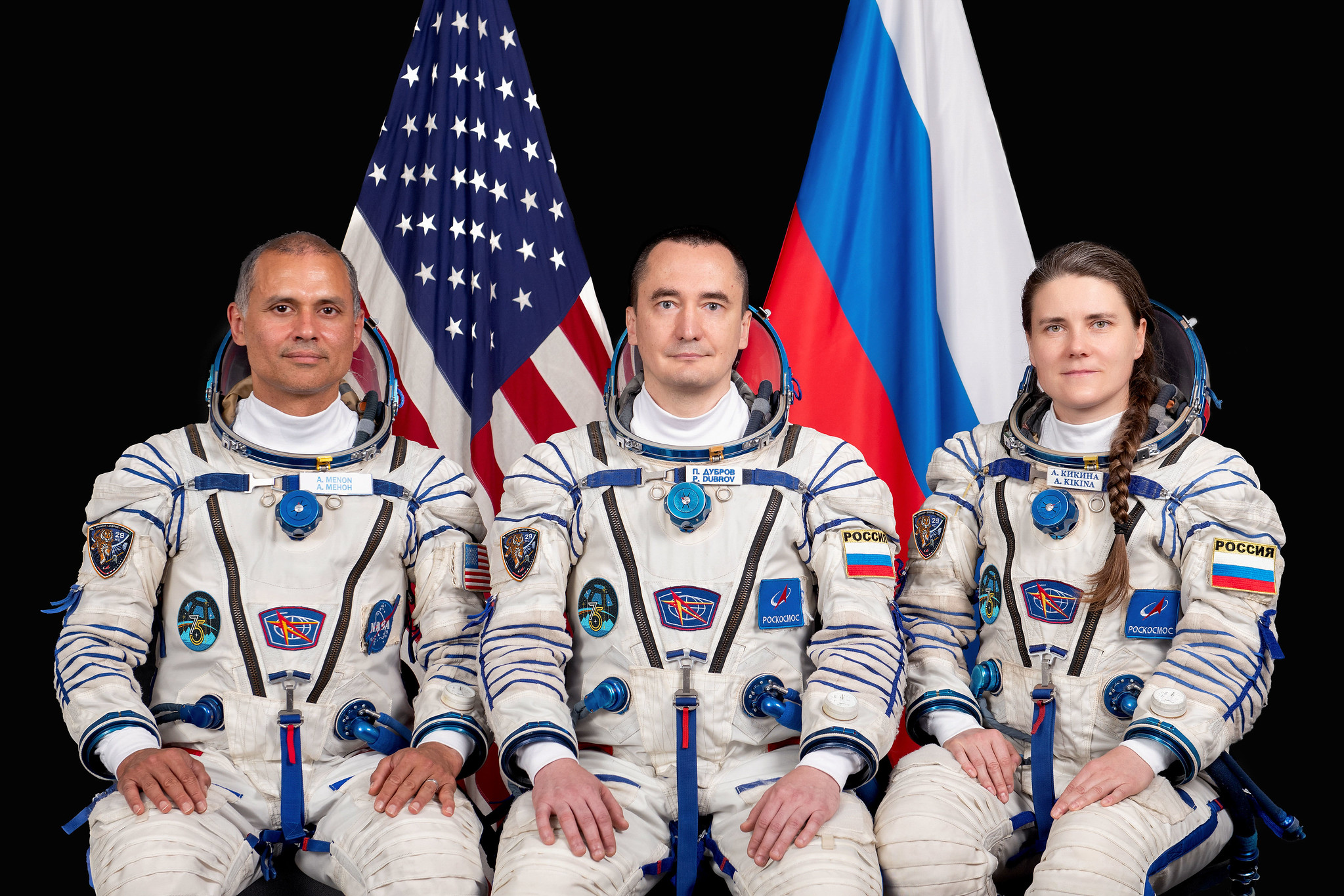
NASA astronaut Anil Menon will launch aboard the Roscosmos Soyuz MS-29 spacecraft to the International Space Station on Tuesday, July 14, accompanied by cosmonauts Pyotr Dubrov and Anna Kikina, where they will join the Expedition 74 crew advancing scientific research.
Menon, Dubrov, and Kikina will lift off at 10:47 a.m. EDT (7:47 p.m. Baikonur time) from the Baikonur Cosmodrome in Kazakhstan. Live launch and docking coverage is available on NASA+, Amazon Prime, and the agency's YouTube channel. Learn how to watch NASA content through a variety of online platforms, including social media.
After a two-orbit, three-hour trip to the station, the spacecraft will automatically dock at 1:56 p.m. to the Prichal module. Shortly afterward, hatches will open between the Soyuz and the orbiting laboratory.
Once aboard, the trio will join NASA astronauts Jessica Meir, Jack Hathaway, and Chris Williams, ESA (European Space Agency) astronaut Sophie Adenot, and Roscosmos cosmonauts Sergey Kud-Sverchkov, Sergei Mikaev, and Andrey Fedyaev.
NASA's coverage schedule is as follows (all times Eastern and subject to change based on real-time operations):
Tuesday, July 14
9:45 a.m. - Launch coverage begins on NASA+, Amazon Prime, and YouTube.
10:47 a.m. - Launch
1:10 p.m. - Rendezvous and docking coverage begins on NASA+, Amazon Prime, and YouTube.
1:56 p.m. - Docking
3:30 p.m. - Hatch opening and welcome coverage begins on NASA+, Amazon Prime, and YouTube.
3:55 p.m. - Hatch opening
Menon, Dubrov, and Kikina will spend about eight months aboard the orbital complex as International Space Station Expedition 74/75 crew members before returning to Earth in April 2027. This will be Menon's first spaceflight and the second for both Dubrov and Kikina.
During his stay on the station, Menon will conduct scientific research and technology demonstrations aimed at advancing human space exploration and benefiting life on Earth. He will continue research to refine in-space production of semiconductor crystals to enable the large-scale manufacturing of components needed for high-performance computers, artificial intelligence, and improved medical devices. Menon also will perform ultrasound using augmented reality and artificial intelligence methods that could eliminate the need for medical support from Earth on future space missions. He will be a test subject helping researchers understand how blood flow is affected in space to protect future astronauts. He also will test bioprinting vascular constructs in microgravity to improve understanding of the aging process to advance therapeutic developments.
For more than 25 years, people have lived and worked continuously aboard the International Space Station, advancing scientific knowledge and making research breakthroughs not possible on Earth. The space station helps NASA understand and overcome the challenges of human spaceflight, expand commercial opportunities in low Earth orbit, and build on the foundation for long-duration missions to the Moon, as part of the Artemis program, and to Mars.