
A tiny parasitoid wasp from Asia has established itself in the Netherlands without deliberate release. Field research by Wageningen University & Research (WUR) shows that the species Leptopilina japonica parasitises young larvae of the spotted-wing drosophila. This gives the biological control of this persistent fruit pest an unexpected support.
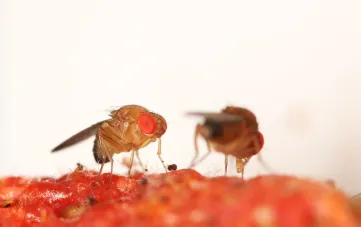
The spotted-wing drosophila (Drosophila suzukii) has caused major damage since it arrived in Europe, affecting cherries, raspberries, currants and other soft fruits. Unlike native fruit flies, the female lays her eggs in ripening fruit while it is still on the plant. The larvae then develop inside the fruit, causing it to spoil and become unmarketable. The spotted-wing drosophila is difficult to control not only because it reproduces on dozens of plant species, but also because it has no effective natural enemies in Europe. In its native range in Asia, the spotted-wing drosophila is a less important pest, because its populations are controlled by a community of specialized parasitoid wasps.
Found at 24 of 35 locations
Last summer, WUR examined fruits from 35 locations across seven provinces in the Netherlands and found populations of Leptopilina japonica at 24 locations, sometimes in high numbers. The finding of the species in Drenthe marks, so far, the northernmost limit of the species' European range. The wasp is about 1.5 millimetres long and highly specialised. It lays its eggs almost exclusively in young larvae of the spotted-wing drosophila. A parasitioid wasp larva develops in a single host insect and ultimately kills it, thereby helping to control the pest.
Why existing European parasitoids fall short
Parasitoid wasps that occur in Europe are ineffective against the spotted-wing drosophila. They mainly search for larvae in rotting fruit on the ground or in plant litter. The spotted-wing drosophila, by contrast, develops in ripening fruit on shrubs and trees.
In addition, European parasitoid wasps are not adapted to larvae of the spotted-wing drosophila and are not 'compatible' with this host. The fruit fly can encapsulate their eggs arresting their development. Leptopilina japonica actively searches in fruit that is still on the plant and can bypass the defence mechanism of the spotted-wing drosophila.
Researchers consider finding a beneficial development
The species was first observed outside Asia in Canada in 2016, and it is now found in eleven US states. In Europe, it was subsequently confirmed in Italy (2019), Switzerland and Germany (2021), France (2022), Belgium (2022) and the United Kingdom (2024). The spotted-wing drosophila and this parasitoid wasp appear to be spreading together from Southeast Asia.
In countries where the wasp has been present for longer, no unwanted side effects on other species have been reported. It targets the spotted-wing drosophila almost exclusively. To a very limited extent, it also parasitises a few common fruit fly species, such as the common fruit fly (Drosophilamelanogaster). The researchers do not expect the presence of Leptopilina japonica in the Netherlands to cause problems, and they see the finding as a positive development.
Further research in fruit crops
Whether the parasitoid wasp can maintain itself long-term in commercial fruit orchards, and to what extent it can suppress spotted-wing drosophila populations on its own, is being studied further. The researchers expect the species will likely follow the fruit fly each year from natural habitats into cultivated fruit areas.
Alongside this spontaneous establishment, WUR recently started introducing another specialised Asian parasitoid wasp, Ganaspis kimorum, at five locations in the Netherlands in 2025. Research is under way to see whether this species also establishes itself and contributes to the biological control of the spotted-wing drosophila.


