
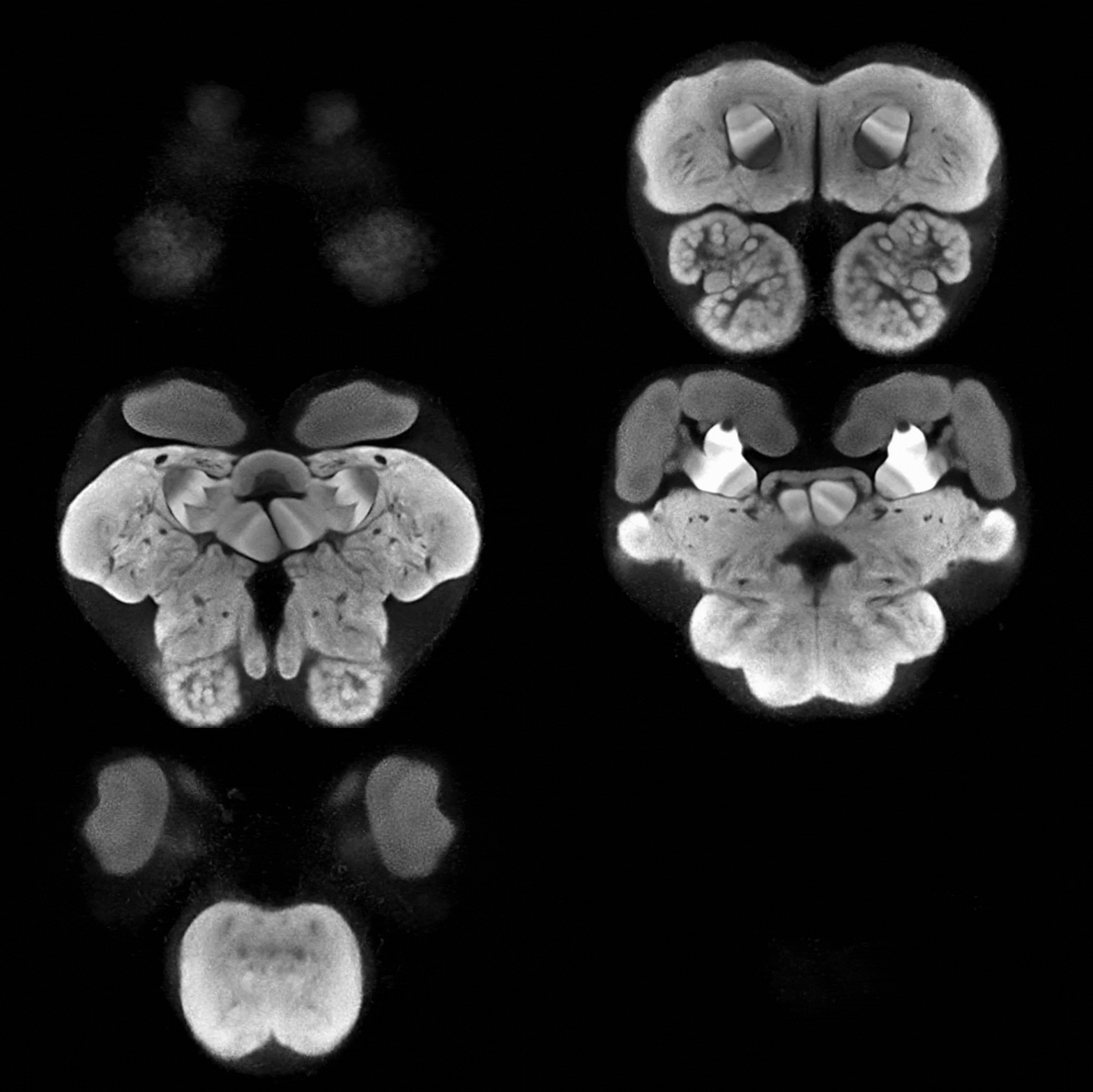
Researchers created this first-of-its kind map by merging 40 ant brains into one. (Credit: Kronauer lab)
Every clonal raider ant lives a nearly identical life. Each new generation of these blind, queenless ants is born at the same time, eats the same things, lives in the same environment, and-as an asexually reproducing species-has the exact same genes. It's hard to find a more textbook example of a society where the individual matters less than the collective.
And yet researchers from Rockefeller's Laboratory of Social Evolution and Behavior, headed by Daniel Kronauer, have discovered a surprising individuality of brain characteristics among clonal raider ants that may yield new insights into the neuroscience of individuality within animal societies, which range in variety and complexity from ants to us. Among other things, the scientists found a massive variation in brain size as well as a distinct "tilt" in a specific region of the brain associated with higher order processing. The orientation of this tilt was evenly divided among the ants; half tilted left while the other half tilted right.
This finding was made possible by their creation of the first reference brain of the clonal raider ant, a specialty of Kronauer's lab and an emerging model species for both ant researchers and the field of neuroscience. Inspired by techniques used to create reference brains for model organisms such as the ever-popular Drosophila melanogaster (the fruit fly), this version was meticulously assembled from data from 40 ant brains. The team's research was recently published in Current Biology.
"We started the project with the goal of creating a reference brain that could serve as a technical tool for the ant neuroscience research community, but we very quickly started making unexpected biological discoveries," says co-first author Lindsey Lopes, a postdoctoral fellow in the lab. "Much of what we observed has never been reported before."
"The clonal raider ant presents a very powerful model for all sorts of neuroscience questions because you can completely control for genotype," says co-first author Dominic Frank, a research associate in the lab. "We've built something that not only gives us a better understanding of brain anatomy, but also provides the framework for investigating the neuronal and genetic underpinnings of the sorts of social behaviors that ants are well known for."
Model systems
Such references are valuable tools for studying the central nervous system, as both Frank and Lopes knew from their research on the fruit fly and nematode, respectively, before they joined Kronauer's ant-focused lab in 2019.
Reference brains exist for just two other ant species-Cataglyphis nodus, aka the desert ant, and Cardiocondyla obscurior, a kind of tramp ant. Each of those is drawn from a single ant.
More technically challenging is creating a reference brain drawn from multiple individuals. Such reference brains have been created for the fruit fly, mouse, and zebrafish, among other common model organisms. "Those are comprised of many brains averaged together using computational tools, so they're more representative of the population," Lopes says. "That hadn't been done yet for any ant species, so we decided to see if we could do it."
The researchers selected 40 clonal raider ants from a specific lineage called clonal line B, the most studied one in Kronauer's lab. They focused on 11 regions that are easy to identify and have been researched extensively in other insects. They then used a monoclonal antibody that recognizes a protein found at synapses to tag connections between nerve cells. By creating these labels at each synapse, they were able to visualize the anatomy of each ant's brain-and then map them onto each other to create the reference brain.
"Building this required a lot of technical chops," Frank says. "We had to stain and image each brain on the confocal microscope, which gave us very high-resolution data sets, and then we had to do the computational side to create the reference brain."
Surprising variations
They also poured over the 40 exquisitely detailed individual brain maps. Most immediately they observed that half of them had mushroom bodies-parts of the ant brain important for learning, memory, and other higher-order processing-that tilted to the left. But the other half had mushroom bodies that tilted to the right.
"As far as we know, this has never been described before in any insect," Lopes says.
They also found an unexpected variety of brain size. "When we were doing the imaging, we saw that sometimes we could fit the whole brain in a single camera image, and sometimes we needed four images," Lopes says.
This too has never been described before. Previous research on ant brain size variation has found a correlation between body size and brain size-that is, the bigger the body, the bigger the brain. But clonal raider ants are virtually all the same size. So what could account for the individual variation?
The scientists suggest that the findings may reflect behavioral individuality and division of labor in the clonal raider ant-an unexpected discovery, considering the collectivist nature of ant societies.
"One of the implications of our paper is that the clonal raider ant can actually be a very powerful model for studying things like individuality within eusocial insects like ants," Frank says. "We already know that some individuals prefer to take care of the young of the colony while others prefer to forage or raid, and some of this variation in behavior might be linked to the variation we observe at the level of the brain."
A new model species
The scientists hope ant-focused researchers-of which there are many-will use the clonal raider ant reference brain for their own neuroscience projects. To that end, the reference brain was designed to be a virtual common space a la Virtual Fly Brain, an interactive tool for neurobiologists studying Drosophila melanogaster. As with the fly project, ant researchers can map their own data onto this reference brain, enabling the comparison of data collected across experiments and laboratories.
Using the clonal raider ant as the model organism for studying how the ant brain generates social behavior could also help align findings across species, leading to broader conclusions about the neuroscience of sociality, Frank says.
"Since I started my lab at Rockefeller, developing tools and resources for the clonal raider ant has gone hand in hand with making biological discoveries," Kronauer says. "One of the first things we did was to sequence the species' genome, which in turn allowed us to conduct experiments in behavioral genetics. Going forward, we want to understand social behavior at the level of the brain and neural circuits, and this requires new tools. The clonal raider ant reference brain is an important step in that direction."


