A newly developed architecture for full-duplex wireless transceivers solves the long-standing problem of self-interference, as reported by researchers from Science Tokyo. They implemented an innovative switching strategy that isolates self-interference in the time domain by alternating transmission and reception faster than the wireless signal period, enabling effective simultaneous transmission and reception. Experiments using 400-MHz-wide millimeter-wave signals (5G-compatible) highlight the technology's potential for future Beyond 5G/6G infrastructure, including extended reality systems, and smart factories.
Doubling Spectrum Efficiency for Next-Generation Wireless Communications
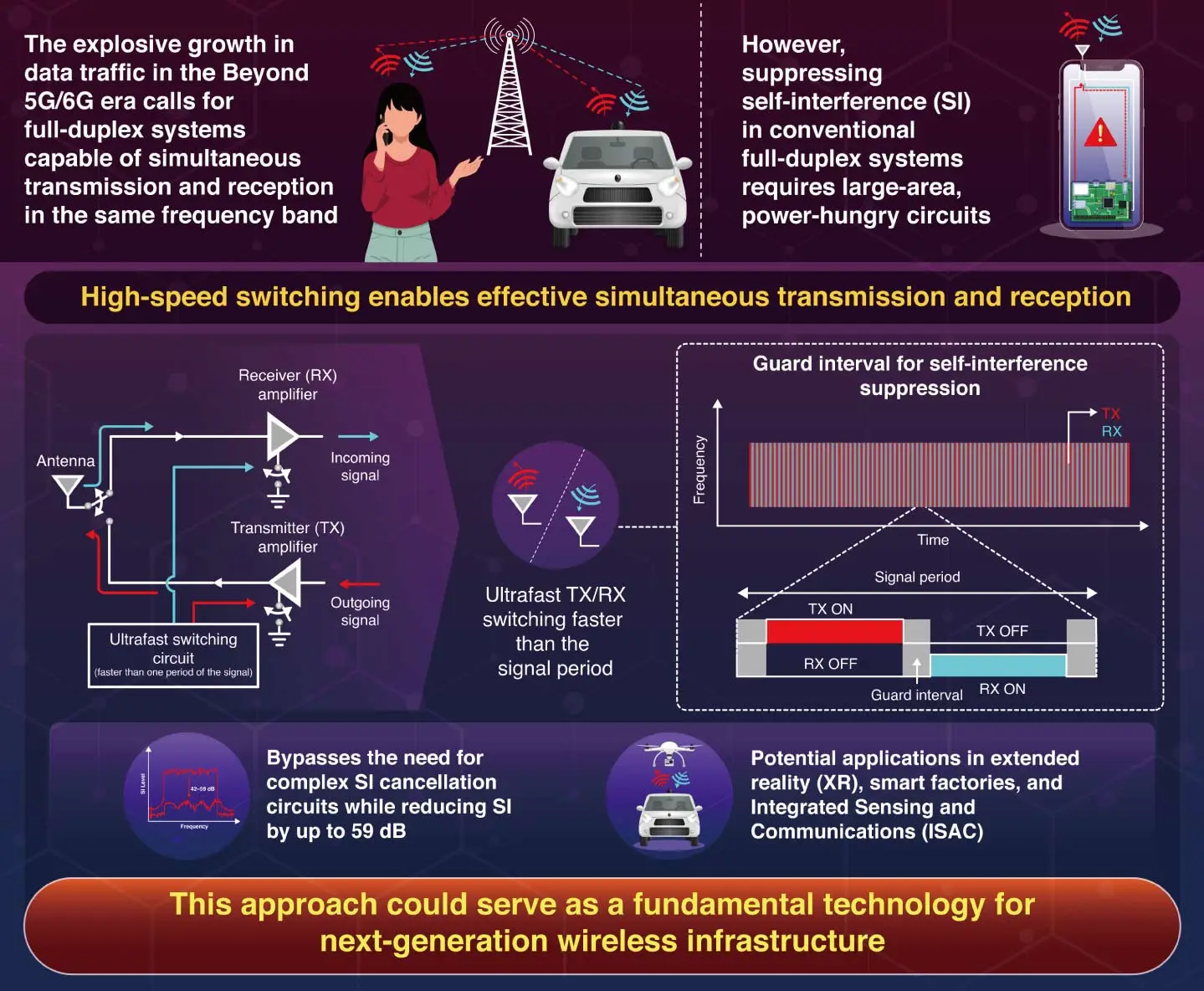
As we dive deeper into the 5G era and approach the transition to 6G, wireless traffic worldwide continues to grow without signs of slowing down. Emerging technologies such as artificial intelligence, extended reality (XR), autonomous systems, and smart factories require ultrafast and low-latency wireless links, capable of handling enormous amounts of data. One promising solution to tackle this demand is in-band full-duplex (FD) communication, in which devices transmit and receive signals simultaneously using the same frequency channel. In theory, this approach could double spectrum utilization efficiency compared with conventional half-duplex wireless systems.
However, despite its potential, FD communication remains difficult to implement in practice because of a problem known as self-interference (SI). In FD systems, the transmitter's own signal tends to leak into the receiver, which can overwhelm weak incoming signals. Conventional approaches to address SI typically rely on cancellation circuits, but these take up considerable chip area and drastically increase the system's overall complexity and power consumption, leading to reduced efficiency.
To overcome this challenge, a research team led by Professor Kenichi Okada from the Department of Electrical and Electronic Engineering, Institute of Science Tokyo (Science Tokyo), Japan, has developed a reconfigurable 24-28 GHz time-division FD transceiver that bypasses the need for dedicated SI cancellation circuits altogether. Their findings will be presented at the 2026 IEEE/JSAP Symposium on VLSI Technology & Circuits, to be held in Honolulu from June 14 to 18, 2026.
The transceiver alternates between transmission and reception at a rate faster than the wireless signal period, effectively enabling simultaneous transmission and reception. A guard interval inserted between transmission and reception isolates SI in the time domain, allowing the proposed architecture to suppress SI without requiring dedicated cancellation circuitry.
In this way, the proposed architecture eliminates the need for additional SI cancellation paths and components, greatly simplifying the transceiver's hardware while enabling broadband operation. The researchers demonstrated this design experimentally using 400-MHz-wide millimeter-wave signals compliant with 5G New Radio standards. Over-the-air measurements showed that the system reduced SI by 42-59 dB. "Compared with prior SI cancellation-based FD architectures, whose performance degrades beyond 100 to 160 MHz, our approach demonstrates superior wideband scalability," explains Okada.
Notably, the experimental chip was fabricated using a standard 65-nanometer CMOS process, meaning the design is fully compatible with existing manufacturing methods. "Overall, the results show that our strategy can significantly improve the utilization efficiency of limited frequency resources," remarks Okada. "We expect it to serve as a fundamental technology for next-generation wireless infrastructure requiring ultrahigh-speed and low-latency communication, such as real-time control in smart factories and bidirectional communication for high-definition XR applications."
Beyond these use cases, the proposed approach could also support emerging 6G technologies such as Integrated Sensing and Communications (ISAC), which integrates wireless communication and sensing within a single system. Such implementations could ultimately benefit a broad range of sectors, from transportation and urban planning to manufacturing and public safety.
This work is partially supported by National Institute of Information and Communications Technology (NICT) in Japan (JPJ012368C00801).
Reference
- Authors:
- Dongfan Xu1*, Haiyun Gu1, Minzhe Tang1, Yuxuan Liu1, Ziyuan Ren1, Yilun Chen1, Minghao Fan1, Duo Li1, Zheng Li1, Yi Zhang1, Daxu Zhang1, Zezheng Liu1, Chun Wang1, Sena Kato1, Yudai Yamazaki1, Hiroyuki Sakai1, Yuncheng Zhang1, Kazuaki Kunihiro1, and Kenichi Okada1*
- Title:
- A Reconfigurable 24-28GHz Time-Division Full-Duplex Transceiver with 59dB Self-Interference Rejection over 400MHz
- Journal:
- Proceedings of 2026 IEEE/JSAP Symposium on VLSI Technology & Circuits
- Affiliations:
- 1Department of Electrical and Electronic Engineering, Institute of Science Tokyo, Japan